



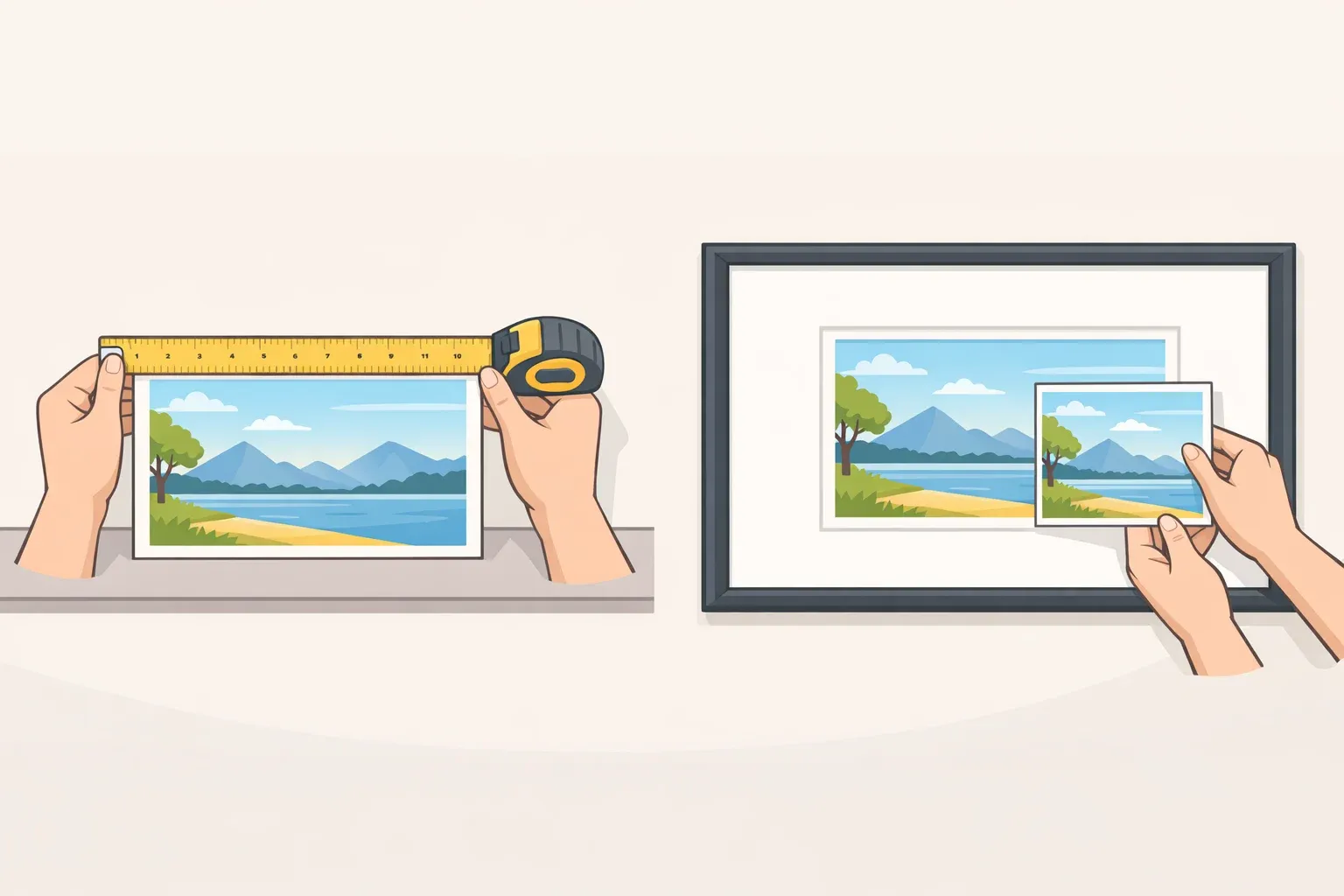
How to make cheap art look expensive: the custom mat method
Most odd-size art never gets framed. A print from an online shop, a page pulled from a vintage book, a photograph you love that happens to be 5×8 standard frames come in fixed sizes, and the result is usually a choice between cropping the image or leaving it propped against a wall indefinitely. A custom-cut mat solves both problems: it bridges your image's actual dimensions to whatever standard frame you're using, fills the gap with a clean wide border, and produces the look of custom framing at a fraction of the cost. As A Home Is Announced noted last summer, even with a 70% discount coupon, full custom framing can run $400 for a single piece. A custom mat ordered online runs $15–28. This method skips the shop entirely.
This guide walks through the complete process of how to make cheap art look expensive using a single custom-cut mat, from measuring your image to hanging the finished piece. One worked example runs continuously through every step. You'll also find the specification choices worth paying attention to, the four mistakes that break the effect, and a quick checklist for ordering.
Prerequisites: Your artwork, a ruler, and internet access. No tools or craft experience required. The method works for prints, photographs, and paper-based art. It is not the right approach for canvases, oversized posters with large blank margins, or artwork that already fits snugly inside a standard frame those cases are covered at the end.
Why presentation does most of the perceptual work
People don't evaluate art in isolation. When study participants handled identical paintings in frames secretly weighted with lead, they rated the heavier-framed versions as more valuable and expressed willingness to pay more the artwork itself was unchanged, Dan Ariely reports. Viewers judge the presentation along with the image, factoring in weight, lighting, and the overall context of the object.
Artworks presented in more elaborate frames are consistently perceived as more valuable than those in simpler frames, even when the underlying artwork is identical, according to WahooArt's analysis of framing psychology. A wide, clean mat sends that same signal: someone took this piece seriously. That's why a $20 mat inside a $10 thrift-store frame can make a $5 print read as considered and intentional and why the same print tacked to a wall reads as an afterthought.
Phase 1: Choose your frame before you measure anything else
Getting the sequence right matters. The frame comes first because custom mats are cut to fit a specific frame's interior, not a theoretical standard size.
Step 1: Measure the image area of your artwork.
Measure the width and height of the image itself, not the full paper it's printed on. If there's a blank white margin around the design common with digital prints ignore it. Record these two numbers. This is your image size.
Worked example: A botanical print. The image area measures 5 inches wide × 8 inches tall. The paper it's printed on is 6×9, but that margin is irrelevant.
⚠️ Gotcha: Measuring the full paper instead of the image area is the most common sizing error. The mat opening gets cut to your image dimensions use the paper size instead, and your mat will reveal blank white margin rather than image, which looks unfinished.
Step 2: Calculate your target frame size and find a standard match.
Add 4 inches to each image dimension; this gives you a 2-inch border on all four sides. Then match against common standard frame sizes: 5×7, 8×10, 8×12, 11×14, 12×16, 16×20. Find the nearest size that's at least as large as your calculation. Slightly more than 2 inches of border is fine the mat fills the remaining space, and wider borders read as more considered.
Worked example: 5×8 image + 4 inches each = 9×12 minimum. Nearest standard size: 11×14, which gives roughly 3 inches of border on all sides. Good.
Step 3: Source the frame.
Before buying new, check thrift stores, estate sales, and resale platforms. The last two weeks of the month tend to yield the best prices, as people starting new leases price items to clear quickly, Apartment Therapy notes. Look for frames that include glass. The finish condition matters less than structural solidity a wood or metal frame can be repainted; a thin plastic frame rarely looks substantial and can't be made so.
Favor wood or metal over flimsy plastic. Physical heft is one of the contextual cues viewers use to assign value, and a solid secondhand frame, repainted if needed, usually reads better than a cheap new plastic one.
Worked example: An 11×14 wood frame found at a thrift store. Likely cost: $5–15 with glass included.
Phase 2: Measure the actual frame and order the mat
Standard frame sizes are nominal. A frame sold as 11×14 frequently has an interior opening that measures 10¾ × 13¾ or something similarly inexact. The mat must fit the actual frame, not the label.
Step 4: Measure the frame's actual interior opening.
Open or remove the backing. Measure the window the space the glass sits in from inside edge to inside edge on all sides. This is your mat outer size. Write it down.
Worked example: Interior opening of the 11×14 thrift frame measures 10¾ × 13¾.
⚠️ Gotcha: Many frames have a lip or rabbet that reduces the visible opening by ¼ inch or more. Skip this measurement and order to the frame's labeled size, and the mat won't fit.
Step 5: Order the custom mat.
Online mat services ask for three numbers:
- Mat outer size your measured frame interior (e.g., 10¾ × 13¾)
- Image opening size your image size minus ⅛ inch on each side
- Material specifications see Step 6
The ⅛-inch reduction on the opening creates a slight overlap that holds the print in place and gives you alignment flexibility during assembly. Ordering the opening to the exact image size makes framing unnecessarily fussy, as A Home Is Announced explains the small overlap is the difference between a mat that centers itself and one that requires four hands.
Worked example: Mat outer = 10¾ × 13¾. Image opening = 4⅞ × 7⅞ (5×8 minus ⅛ inch each side). Border on all sides: approximately 3 inches.
Step 6: Choose your mat specifications.
Three choices that affect the final result:
- Thickness 4-ply vs. 8-ply. Standard mats are 4-ply. Upgrading to 8-ply doubles the depth of the beveled cut at the image opening edge that angled shadow line is much of what makes custom framing look substantial up close. Upgrade for any piece you want to display long-term, any original work, or any print you genuinely care about. Four-ply is adequate for rotating seasonal décor or art you expect to replace within a year.
- Quality grade. Economy is fine for decorative prints. For originals, sentimental pieces, or anything meant to last decades, select Conservation (acid-free). Standard mat board contains trace acids that gradually yellow and degrade whatever they're in contact with, including the artwork.
- Color. White or warm white is the safe default. Match the mat's tone to the image's color cast: a bright-white mat against warm-toned art vintage prints, watercolors, film photographs makes the image look dingy by contrast. Black-and-white photography and line drawings can handle either tone, but cool white tends to read as crisper. When in doubt, order warm white.
An optional upgrade worth considering: an accent mat a second mat in a contrasting color placed behind the first creates a thin colored reveal (typically ¼ inch) around the image opening. A reveal in black, navy, or a color pulled from the artwork reads as intentional without being ornate. Small cost increase, noticeable result.
Worked example: 8-ply, warm white, Conservation grade. Accent mat in black for a ¼-inch reveal. Estimated mat cost: $18–28 depending on service and grade.
Phase 3: Assemble and hang the finished frame
Step 7: Assemble the frame.
Clean the glass on both sides before closing fingerprints are invisible until light hits the frame at the wrong angle and they become the only thing you see. Center the mat over the artwork, verify the image sits evenly in the opening, then close the backing. Secure the backing with points or tabs at least every six inches; anything less and the backing shifts, which shifts the mat, which shifts the image, per Apartment Therapy's guidance.
Worked example total cost: Thrift frame ($5–15) + custom mat ($18–28) = approximately $23–43 for a result that reads far closer to custom framing than the price suggests.
Step 8: Hang it at the right height with enough wall space.
Presentation doesn't end at assembly. A properly framed piece on a crowded wall loses most of its effect galleries maintain uncluttered presentation spaces so viewers can engage closely, and the same logic applies at home, Gallery Fuel notes. Research by philosopher Jesse Prinz found that viewers assign higher perceived value to works hung slightly above standard eye level, just enough to require a subtle upward tilt of the head, according to Gallery Fuel.
Hang with two D-ring hangers screwed in at equal distances from the top, connected by picture wire for level adjustment. One well-framed piece on a clear wall reads as more intentional than four competing on a busy one.
The four mistakes that break the effect
Follow every step above and still get a mediocre result? One of these is usually responsible.
- Mat border too narrow. Below about 2 inches, the border reads as a gap, not a deliberate choice. The perceptual shift requires actual breathing room. If your frame is only marginally larger than your image, find a bigger frame rather than accepting a ½-inch mat.
- Flimsy frame. A thin plastic frame undercuts even a well-ordered mat. The visual effect depends partly on physical substance go for wood or metal, even secondhand and slightly battered. A dated wood frame repainted beats a cheap new plastic one.
- Wrong mat temperature. Bright-white mat against warm-toned imagery is the most common color mismatch. The contrast ages the image. Match mat warmth to the image's palette.
- Crowded context. Even a perfect frame is diminished by visual competition. Give the piece wall space.
When this approach won't work
This method suits prints, photographs, illustrations, and paper-based art in odd sizes. It's the wrong approach in three specific situations.
Posters with large printed margins. If the design includes intentional white space as part of the layout, measuring just the interior design area becomes ambiguous. The mat will hide content that may have been meant to show.
Art that already fits a standard frame closely. If a 5×7 print fits neatly in a 5×7 frame, adding a mat creates a tiny sliver of border that looks worse than no mat at all. For close-fit art, either hang it without a mat or move up two standard frame sizes to create genuine breathing room.
Originals with significant monetary or sentimental value. The method works for display, but framing anything irreplaceable in a secondhand frame with a basic mat carries risk. Use Conservation grade mat, archival backing board, and UV-protective glass. When in doubt on originals, the professional framer's $400 bill is insurance, not luxury.
The one-glance checklist
The worked example, end to end: a 5×8 botanical print, measured carefully at the image edge. Target frame size calculated at 11×14. A $5–15 thrift frame sourced with glass included. Actual interior measured at 10¾ × 13¾. Custom mat ordered online: outer 10¾ × 13¾, opening 4⅞ × 7⅞, 8-ply, Conservation grade, warm white with a ¼-inch black accent reveal. Total cost: $23–43, for a result that reads far closer to custom framing than the price suggests.
Before ordering, confirm you have all six numbers:
- Image size (width × height of the image itself, not the paper)
- Target frame size (image + 4 inches each dimension, matched to nearest standard)
- Actual frame interior opening (measured, not assumed from the label)
- Mat opening (image size minus ⅛ inch each side)
- Mat thickness (8-ply if the piece matters; 4-ply if it's temporary décor)
- Mat grade (Conservation for originals and long-term display; Economy for everything else)
The art doesn't need to change. The margins do.



Comments
Be the first, drop a comment!