



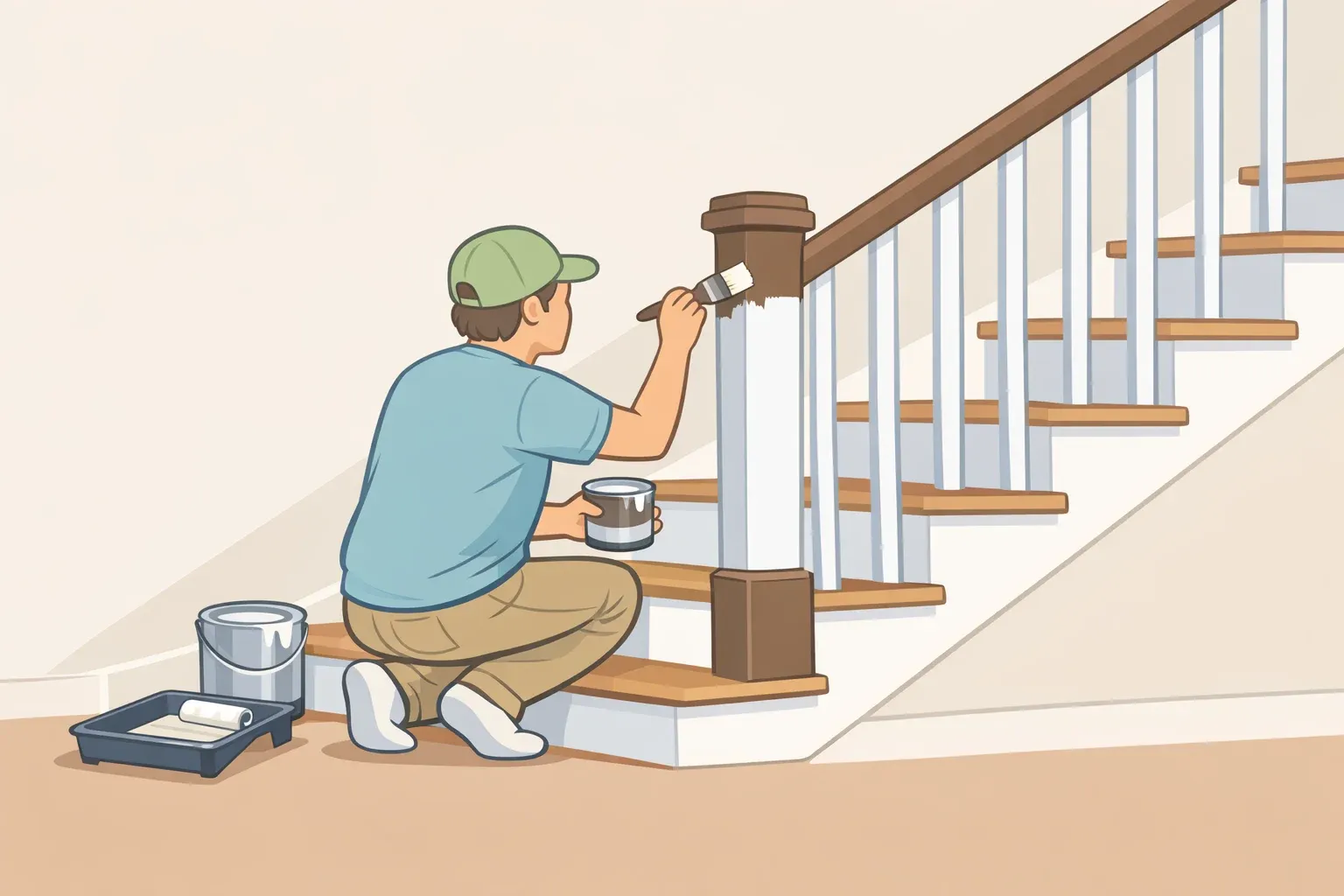
DIY Staircase Makeover: Painting Risers and Railings on a Weekend
This guide walks through modernizing a dated interior staircase by painting the risers and refreshing the existing railings. Total materials: roughly $75–$150. By the end, you'll know whether your stairs qualify for a cosmetic-only refresh, how to paint risers so they hold up to daily foot traffic, and how to bring the railings in line within the same weekend.
Scope matters here. This is a DIY staircase makeover focused on risers and railings, not treads. Risers are the vertical faces between steps, the elements that read "dated" most aggressively when finished in dark-stained wood. They're the highest-impact target for paint. Tread refinishing is a separate project with different prep requirements; it's addressed briefly at the end and left out of the core guide.
Before buying anything, run the 20-minute safety screen below. It will tell you whether to proceed.
Budget staircase remodel: what paint can and can't fix
This is a cosmetic project. If your staircase has a structural problem, such as inconsistent riser heights, a handrail that wobbles under load, or open gaps that exceed code limits, paint is not your starting point.
Four Generations One Roof documented in early 2024 that painting stair risers white required nothing beyond primer, paint, and patience, and that the result immediately unified the staircase with freshly painted trim and doors elsewhere in the home. For a more complete railing refresh, Lauren Koster Creative put the upper ceiling at around $300 back in 2021. Treat that as a reasonable ceiling for a paint-and-railing project today, not a floor.
The structural screen below takes 20 minutes. Run it before you touch a paintbrush.
Step 1: Run a quick safety screen (20 minutes, one tape measure)
This screen isn't meant to turn you into a building inspector. It's meant to surface the specific problems that paint cannot fix.
A note on the source: the dimensions below come from a PermitDeck summary of 2021 IRC residential stair requirements, published this month. They're a useful screening tool, but interior stair requirements can vary by jurisdiction and renovation context. If you find anything borderline, your local building department is the authoritative source.
Check riser consistency. Measure the height of several risers across the full flight, including the top and bottom. If any two risers in the same flight differ by more than 3/8 of an inch, the geometry is off. Per the 2021 IRC as summarized by PermitDeck, the fix typically requires carpentry corrections to restore uniform riser heights, not shimming and painting over the discrepancy. The top and bottom risers are the most common failure points.
Check tread depth and stair width. While the tape measure is out: each tread should be at least 10 inches deep measured nosing to nosing, and the staircase should be at least 36 inches wide, per IRC standards. Both are pass/fail indicators of whether the structure was built to standard. A staircase that fails these dimensions has geometry problems that no cosmetic work addresses.
Check the handrail. Any staircase with four or more risers needs a graspable handrail running the full length of the flight, mounted between 34 and 38 inches above the stair nosings, per IRC R311.7.8. "Graspable" has a specific meaning: a graspable profile meeting IRC handrail requirements. A flat 2x4 on edge does not qualify. Confirm the rail runs from the first riser to the last, because a handrail that stops six inches short at either end is a common defect. If yours is missing, non-graspable, or truncated, that's a physical fix before the paint project, not after.
Check open riser gaps and baluster spacing. If your stairs have open risers, confirm the gap between treads is too narrow for a 4-inch sphere to pass through. Check baluster spacing by the same logic: the gaps between spindles on the stair guard should be under 4-3/8 inches, per IRC.
Decision point: Everything passes? Move to Step 2. Any check fails? Address the structural or safety issue first. Paint does not fix a geometry problem or a missing handrail. It just makes the problem harder to notice until someone gets hurt.
Time estimate: 20 minutes to measure.
Step 2: Prep the risers (the step that determines how long this lasts)
Good prep is the difference between painted risers that still look sharp years later and ones that chip within a season. No shortcuts here that don't cost you later.
Materials needed:
Shellac-based primer (Zinsser BIN is the proven choice for stained wood)
Satin or semi-gloss interior paint in your chosen color
120-grit sandpaper
Tack cloth or damp rags
Painter's tape
2-inch angled brush
Small roller (4-inch works well on risers)
Estimated cost: $75–$150 depending on staircase size and paint selection
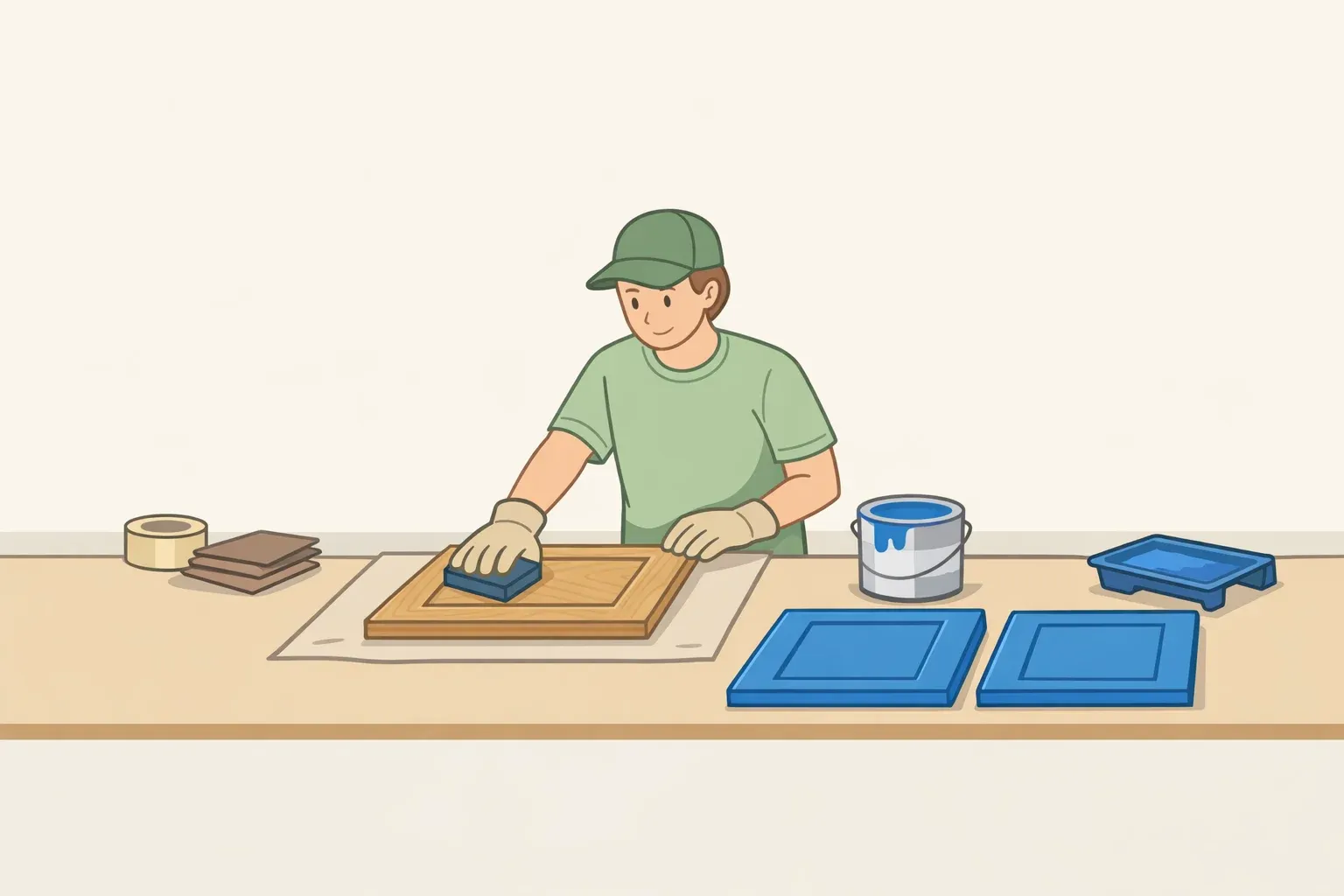
Step 2a: Sand. Scuff every riser face with 120-grit sandpaper. You're not removing material; you're breaking the gloss on the existing stain or finish so primer has something to grip. Wipe all dust off completely with a tack cloth or slightly damp rag, then let the surfaces dry fully. Skipping this step is the single most common reason paint fails on previously stained wood.
Step 2b: Apply two coats of shellac-based primer. On stained wood, a shellac-based primer such as Zinsser BIN is the safer choice if you want to avoid tannin bleed-through. Tannins in stained wood can leach through finish coats in yellowish or brownish shadows, and they'll keep doing it no matter how many layers of paint you add on top. Four Generations One Roof used Zinsser BIN on stained risers in early 2024 and called two full coats non-negotiable. Let each coat dry fully, typically 45 minutes to an hour, before applying the next.
One practical note: shellac-based primer has a strong odor. Open windows, run a fan, and keep people and pets out of the stairwell while it's wet and for at least an hour after each coat. The smell dissipates quickly once dry, but it's not something to ignore.
Step 2c: Apply two coats of finish paint. Use satin or semi-gloss. Flat finishes show scuffs immediately in high-traffic areas like stairs. Four Generations One Roof used Sherwin-Williams Emerald Interior in Westhighland White, a warm white that reads bright without appearing stark against wood floors. White is the lowest-risk choice because it coordinates with most interior trim; charcoal, black, and navy are legitimate modern alternatives if they match existing baseboards and casings.
On sheen and brush vs. roller: semi-gloss is the most wipe-able option and the most forgiving on a surface that gets kicked and scuffed daily. Satin sits one step below in durability but hides surface imperfections better. For application, roll the flat face of each riser first to get even coverage fast, then use the angled brush to cut in cleanly along the tread edge and into the corners. Brush marks from cutting in will blend into a rolled surface better than the reverse.
On cutting in against stained treads: this edge is the most visible line in the whole project. Apply painter's tape along the top edge of each riser where it meets the tread nosing, press it down firmly with a putty knife edge, and peel it off while the paint is still slightly wet, not after it has cured hard. Dry tape removal pulls edges.
⚠ Paint in alternating sections, not all at once. If the staircase is in active use during the project, paint every other riser in one session, let them cure for 24 hours, then complete the remaining risers. Footprints in uncured paint are difficult to repair cleanly and will require spot-sanding and another coat.
After this step, the risers will already look like a different staircase: brighter, cleaner, contemporary. The railings will look immediately more dated by comparison, which is exactly the motivation to move to Step 3 the same weekend.
Time estimate: Two hours of active work on Day 1 for primer coats. Two hours on Day 2 for finish coats. Full cure before foot traffic: 24 hours minimum, 48 hours ideal.
Step 3: Paint the existing railings and balusters
Replacing railings is a different project, one that involves permits in some jurisdictions, additional tools, and significantly higher cost. If the existing handrail is structurally sound and the profile is graspable, painting it is the practical call for a dated staircase makeover. This step completes the job.
Prep the same way as the risers. Sand to break the gloss, wipe clean, let dry completely. Shellac-based primer is still the right choice on stained wood. Two coats of primer, two coats of finish paint, same sequence, same patience.
Color strategy. Painting balusters and handrails the same white as the risers creates a unified look that makes the whole staircase read as intentional rather than assembled from parts. When replacement wasn't in the budget, Four Generations One Roof painted existing handrails white to match the risers and reported a clean, cohesive result that looked deliberate rather than improvised.
Mask carefully at the tread line. The joint where a baluster base meets the stair tread is the most demanding masking point in the project. A crisp line between painted baluster and natural or refinished tread is what separates a careful DIY from one that looks rushed. Take the extra five minutes per step; it shows.
⚠ Paint does not change a handrail's profile. If Step 1 flagged a non-graspable flat 2x4 top rail, that's a physical correction, not a paint problem. The fix is mounting a 1-1/2-inch round handrail on brackets to the inside of the existing top rail, or replacing the top rail profile entirely, then painting everything together. Don't paint over a safety problem.
Time estimate: Two hours of active work, split across the same weekend as the risers. Coordinate the railing work around the alternating-riser cure schedule if the staircase is in use.
After this step, risers, balusters, and handrail are unified: same prep, same primer, same finish. The staircase looks like a deliberate design choice rather than original construction that survived untouched.
If you want to go further: separate staircase renovation ideas
The three steps above complete this guide. Everything below is a different project, with different tools, a different timeline, and potentially different budget and permit requirements. These are not add-ons to a weekend; they're their own weekends.
Selective baluster replacement. If individual balusters are broken, missing, or visually incompatible even after painting, they can be swapped out one at a time without touching the rest of the system. This Old House documented the process in 2023: measure the existing baluster, cut the replacement to match, drill a Forstner-bit hole in the tread for a connecting dowel, set with wood glue, and secure the top with trim-head screws and a pin nailer. Tools required include a drill with Forstner bits, a circular or coping saw, and a pin nailer, which is a meaningful step up from a paint-only project.
Modern railing infill. For a more significant style shift, Pinto Carpentry outlined two contemporary directions last year: squared wood rails paired with stainless steel cable for a minimalist look, and light wood rails with satin-black geometric metal panels for a family-friendly modern aesthetic. Cable infill is worth scrutinizing before committing. Horizontal lines create climbing footholds and may not meet guard-spacing requirements in households with young children or pets.
Tread refinishing. If treads are carpet-covered or have a worn finish, removing and refinishing them completes the visual picture. That's a separate project, not a finishing step. It involves floor sanders, stain matching, and a full cure period before the stairs can carry foot traffic again. Budget and plan it independently.
A clear finish and what to leave alone
The core project, painted risers and refreshed railings, is a weekend's work and a paint store receipt. Two coats of shellac-based primer and two coats of satin or semi-gloss finish paint, applied in that sequence, produce a staircase that looks brighter, cleaner, and unified with the rest of the home's interior trim. Four Generations One Roof demonstrated in early 2024 that the sequence holds on previously stained wood when the primer step isn't skipped.
Stop before this project if risers vary more than 3/8 inch across the flight, the handrail is missing or non-graspable, or any structural element is unstable, per IRC standards. Those are carpentry problems. This is a painting guide.
Budget separately and plan independently for baluster replacement, railing system redesign, and tread refinishing. Each changes the scope, timeline, and potentially the permit requirements. Finishing the paint refresh first is useful: it tells you what still bothers you once the dated finish is gone. In many cases, the answer is nothing.





Comments
Be the first, drop a comment!