



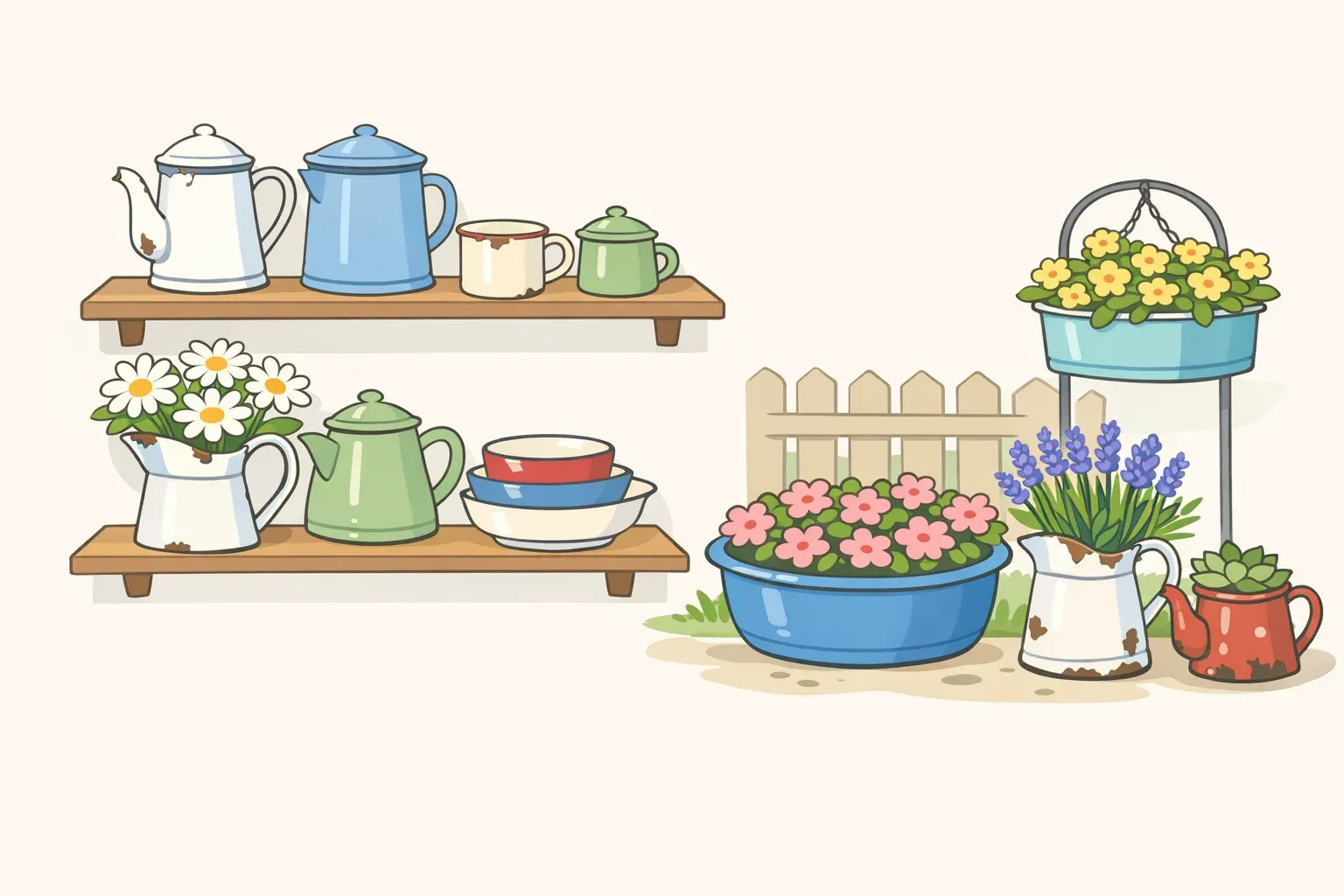
At a flea market, three questions settle every enamelware purchase: Is the glaze intact? Does the shape suit a planter or a shelf? And does the piece sit flat? Answer those before buying, and decorating with enamelware becomes straightforward. Pristine glaze stays indoors on a shelf or mantel, no modification needed. Chips and wear redirect a piece to the garden or the stenciling table. This guide walks through four practical applications of that logic: indoor display, outdoor planters, surface customization, and functional kitchen use.
Most enamelware turns up at garage sales and thrift shops. Genuine vintage pieces and reproductions show up alongside each other; both work for decorating.
Before you buy: three questions to ask at the sale
Condition assessment at the point of purchase drives every downstream decision. Run through this before anything goes in your bag.
1. What's the glaze doing? Visible chips, flaking, or crazing mean the piece is an outdoor planting or surface customization candidate. Pieces in excellent condition get no drainage holes drilled and go inside instead. Mixing those paths up produces worse results than following the condition where it leads.
2. What's the shape? Coffeepots and kettles are the most adaptable forms: wide enough for plant roots, tall enough to anchor a grouped arrangement. Small cups and mugs suit wall and ladder hangs. Flat-bottomed shallow pieces like spittoons work for compact plants that don't need depth.
3. Does it sit flat? Check that the base is stable. A wobbly seam won't wreck a stenciling project, but it matters for outdoor planting and indoor shelf display.
On reproductions: Some pieces in a collected display are reproductions. Don't pass on a well-priced piece because it isn't vintage.
What you'll need before starting. Any outdoor planting application requires drilling a drainage hole in the base. For indoor pieces used as planters, have a waterproof liner or catch tray ready before the soil goes in.
Vintage enamelware decor ideas for indoor display
The cleanest indoor use requires the least work. Pieces in excellent condition, placed on a shelf, mantel, or kitchen counter exactly as found, suit farmhouse kitchens and similar settings without any modification. The smooth glaze reads as intentional. Nothing needs to be done to it.
Shelf arrangements. Cluster three to five varied shapes at one end of an open shelf: a tall coffeepot, a medium pitcher, and two smaller cups. Vary the height, keep the color palette consistent. The goal is "collected over time," not "purchased as a set."
Wall and ladder hangs. Cups and mugs mount on a single nail without bracket hardware. On a leaning ladder, nails driven into the rungs hold small pots; a center drainage hole fits over the nail directly, keeping the piece from sliding. The same approach works on a wall or along a covered porch railing.
Catch this before it becomes a problem: indoor cup hangs planted with herbs or small succulents need a waterproof liner underneath. The drainage hole that works correctly outdoors will drip onto walls and shelving without a catch system in place.
Farmhouse enamelware decorating ideas for outdoor planters
Step 1: Drill a drainage hole in the base before any outdoor planting. Drill holes in all outdoor pieces as a first step. Skipping it is the most common mistake. Water trapped in a sealed metal base will pool around plant roots and accelerate rust in the base metal; drill first, plant second.
Use a step drill bit or titanium-coated metal bit. Standard twist bits tend to crack the glaze at the hole edge.
Step 2: Decide where the piece lives. Enamelware sits outside through long cold winters the same way galvanized planters do. That's a real advantage: ceramic and terracotta cost more at the source and create a winter storage problem that enamelware simply doesn't.
Step 3: Raise the arrangement off the ground. Three coffeepot planters raised to different heights on an oak barrel read as a deliberate garden feature. A single pot sitting on the ground reads as a found object. A barrel, a crate, a stack of bricks: anything that gets the pots off the ground converts individual pieces into a composed arrangement.
Unusual shapes. An enamelware spittoon planted with hen-and-chicks is a specific, workable example: compact succulents suit shallow vessels that won't support deeper-rooted plants. Match plant scale to container depth, and most otherwise-idle shapes find a purpose.
A single coffeepot planter placed among rusted farm implements adds plant softness and color that keeps the grouping from reading as clutter. Same drilled pot, different context, different effect.
Surface customization: turning worn pieces into usable decor
Chips, staining, and surface wear that rule a piece out of indoor display make it a candidate for stenciling or decor transfers. The decoration draws the eye to the design rather than the damage. Two coffeepots in poor condition, stenciled with boho-style patterns, became usable display pieces rather than thrift-store rejects.
Stenciling vs. transfers. Stenciling uses paint applied with a pouncing technique: dab straight down rather than brushing across the curved surface to prevent bleeding under the stencil edge. A decor transfer is an adhesive printed design applied by rubbing it, producing a cleaner line with less technique. One decorated coffeepot used a transfer specifically for a sharper finish.
Transfers hold up outdoors, at least in one documented case. A spittoon decorated with a farm-themed decor transfer survived sun, rain, and snow with the design intact. One case, not a universal guarantee, but worth knowing.
Seasonal pieces. A small kettle and coffeepot stenciled with Christmas graphics show how a dedicated seasonal group stenciled for holiday use and stored between seasons extends the decorating range without much investment. At $5 to $10 per piece, setting a few aside for a single season is a low-cost commitment.
Enamelware planter ideas for functional kitchen use
A reproduction tissue holder, stenciled and planted with kitchen herbs near a window, is the most direct example of a piece that decorates while serving a daily purpose. Any shallow enamelware piece near a kitchen window follows the same logic: put it where it gets used, not just seen.
For kitchen use, the choice between a reproduction and a vintage find comes down to what questions you're willing to leave open. Reproductions appear alongside genuine vintage pieces in collected displays. The decorating result looks the same; reproductions bring a known finish and no surface history to account for.
Food adjacency note: when a piece is decorated before planting edible herbs, plant roots and soil contact the interior, not the decorated exterior. That said, verify that any paint or transfer product is labeled safe for incidental food contact before using it near a kitchen. This guide doesn't make that determination.
Indoor drainage applies here as it does everywhere else. A drilled base that functions correctly outdoors needs a saucer or tray underneath it on a windowsill or counter. Skip it, and the surface below pays for it.
What to take out of this guide
The nail-mount approach is the most transferable technique here. One nail, one drilled hole, no additional hardware: it works indoors and outdoors, scales from a single cup to a full wall arrangement, and costs nothing beyond the piece itself.
The outdoor planter case holds up practically. Enamelware at $5–$10 per piece, left outside year-round without cracking, is genuinely cheaper over time than ceramic or terracotta with winter storage factored in.
Three areas this guide doesn't cover and are worth researching separately: how to distinguish genuine vintage pieces from reproductions at the point of purchase; whether sealing enamel edges after drilling slows rust progression; and long-term plant health in metal containers, particularly heat buildup in summer. One firsthand DIY account is the full source base here. Practical application examples, yes. Technical materials guidance, look elsewhere.



Comments
Be the first, drop a comment!