



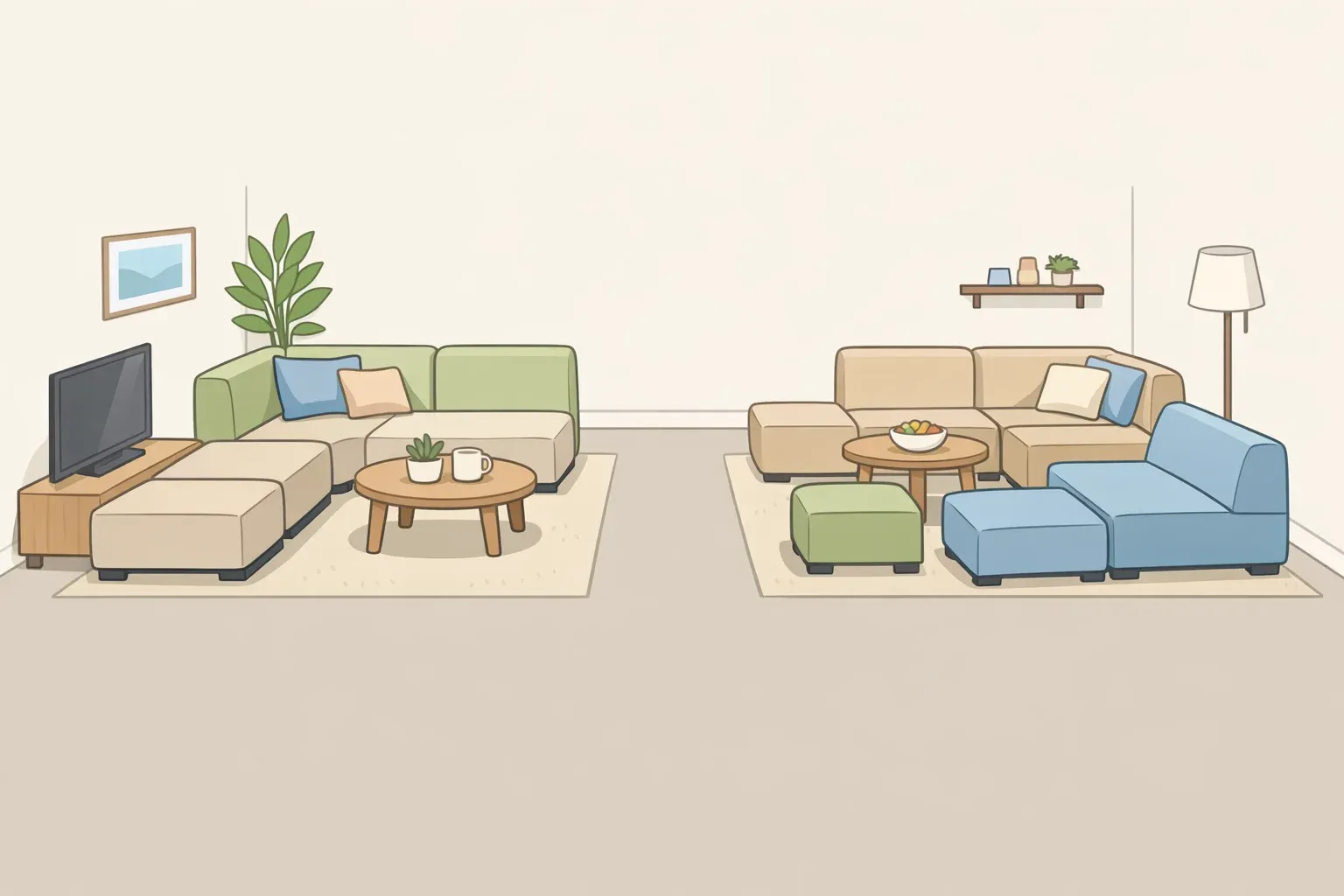
Chaise Sofa Alternatives for Compact and Flexible Living Rooms
The appeal of a sofa with a chaise is legitimate. You want somewhere to stretch out, a place to decompress at the end of the day with your feet up and the television on. Nobody is questioning the desire. The problem is that better chaise sofa alternatives rarely get a fair hearing at the point of sale, because the showroom floor flatters the format. What it cannot simulate is your actual apartment, your next apartment, or the dinner party where the chaise turns into an obstacle rather than an amenity.
This guide is written for a specific reader: someone furnishing a compact or frequently changing living space. Renters. People who move with regularity. Households where the living room pulls double duty as a gathering space and a personal retreat. If your last sofa worked perfectly until you moved, or if your current room feels like it was arranged around the furniture rather than the other way around, this is aimed at you. For those situations, the two living room seating alternatives covered here give you comparable lounging payoff without the layout lock-in.
One caveat worth stating upfront: home lounging furniture has been studied far less rigorously than office or classroom seating. A PMC systematic review covering a decade of furniture ergonomics research found that only a small number of researchers had evaluated home furniture ergonomics at all. Design media fills that gap with expert opinion and aesthetic judgment, not clinical data. The practical guidance here is grounded, but not definitive.
Sofa with chaise pros and cons: what a fixed configuration actually costs your room
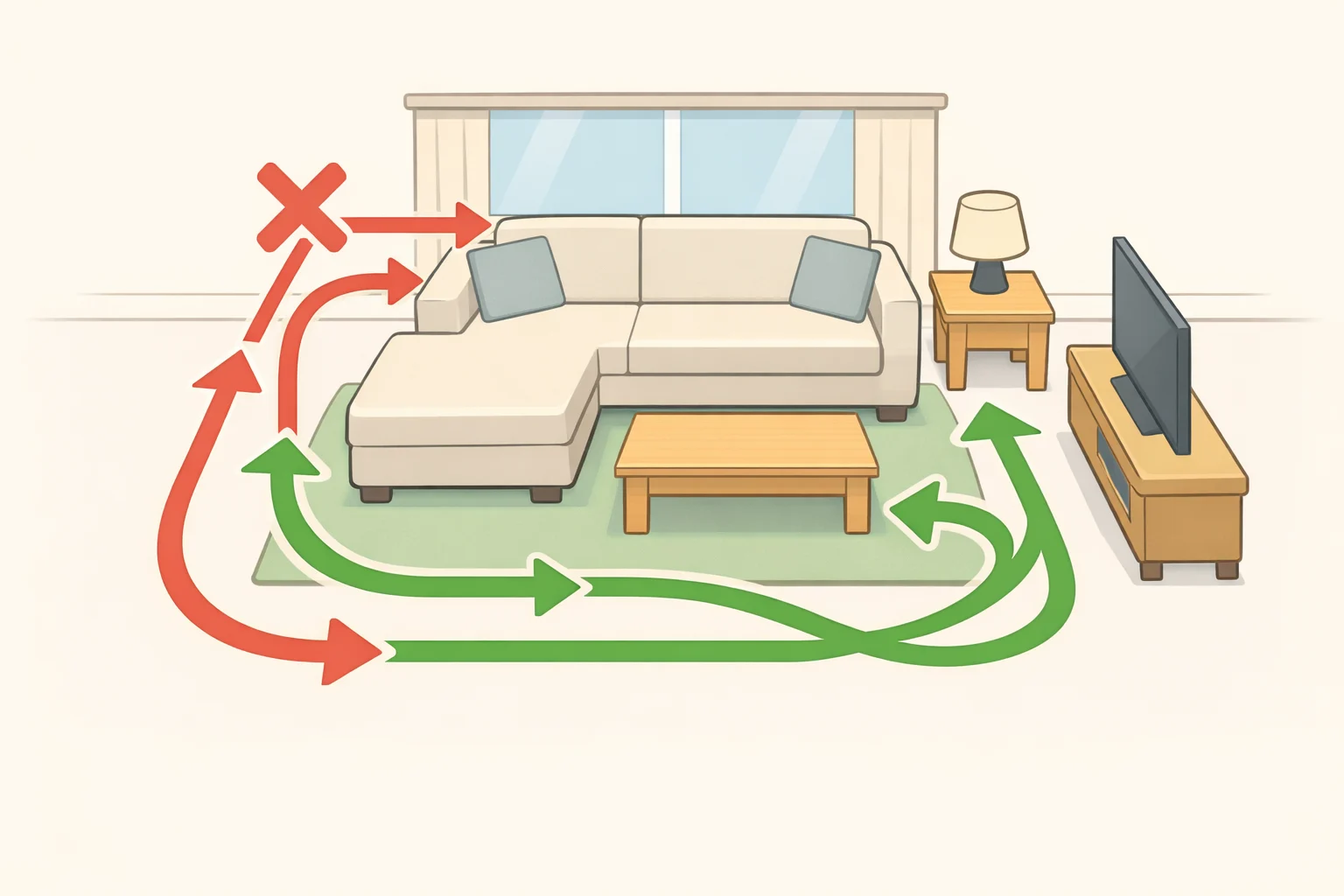
An interior designer quoted by Hunker earlier this year put it plainly: the central problem with an integrated chaise is a fundamental lack of flexibility. Because the piece is large and directionally fixed, it dictates how everything else in the room arranges around it.
The spatial math is concrete. A chaise extension projects roughly two feet or more from one end of the sofa, and that projection only reads correctly pointing in one direction. Relative to walls, windows, doorways, and traffic paths, you get one viable configuration per room. As one interior designer told Hunker, the large footprint makes proper room flow and clearances "tricky to work around." In practice, that means the walking path from your entry to your kitchen now routes around the end of a sofa, or the chaise sits in front of a window you wanted to keep open.
The flexibility problem compounds when you move. If the new apartment has a different wall orientation, tighter clearances, or a window where the chaise needs to go, the configuration often fails entirely. Hunker frames this without euphemism: you are simply out of luck, and it is time to buy a new sofa, one that is otherwise perfectly fine.
Then there is the social use problem, which is subtler but just as consistent.
Guests almost never recline fully on the chaise portion during gatherings. As the Hunker designer observes, guests reliably choose the upright seats beside it or perch on the ottoman end, because conversation calls for a forward, mobile posture: easy eye contact, easy exit. The chaise turns out to be furniture for one person, used alone, after everyone leaves.
When the room is full and someone needs to sit next to the person stretched out on the chaise, the exit problem surfaces. According to Hunker, the lounger cannot get up without climbing over the extended end or asking their neighbor to stand, a small but reliably awkward moment that compounds over years of use.
None of this makes the fixed chaise a bad product categorically. In a large, stable room, in a long-term living situation, for a solo or two-person household, it is a reasonable purchase. The tradeoffs are simply rarely surfaced at the point of sale. What follows is a guide for buyers who suspect those tradeoffs apply to their situation and who want a clear alternative rather than a list of options.
Two paths to the same payoff: how to choose between modular and a dedicated lounging piece
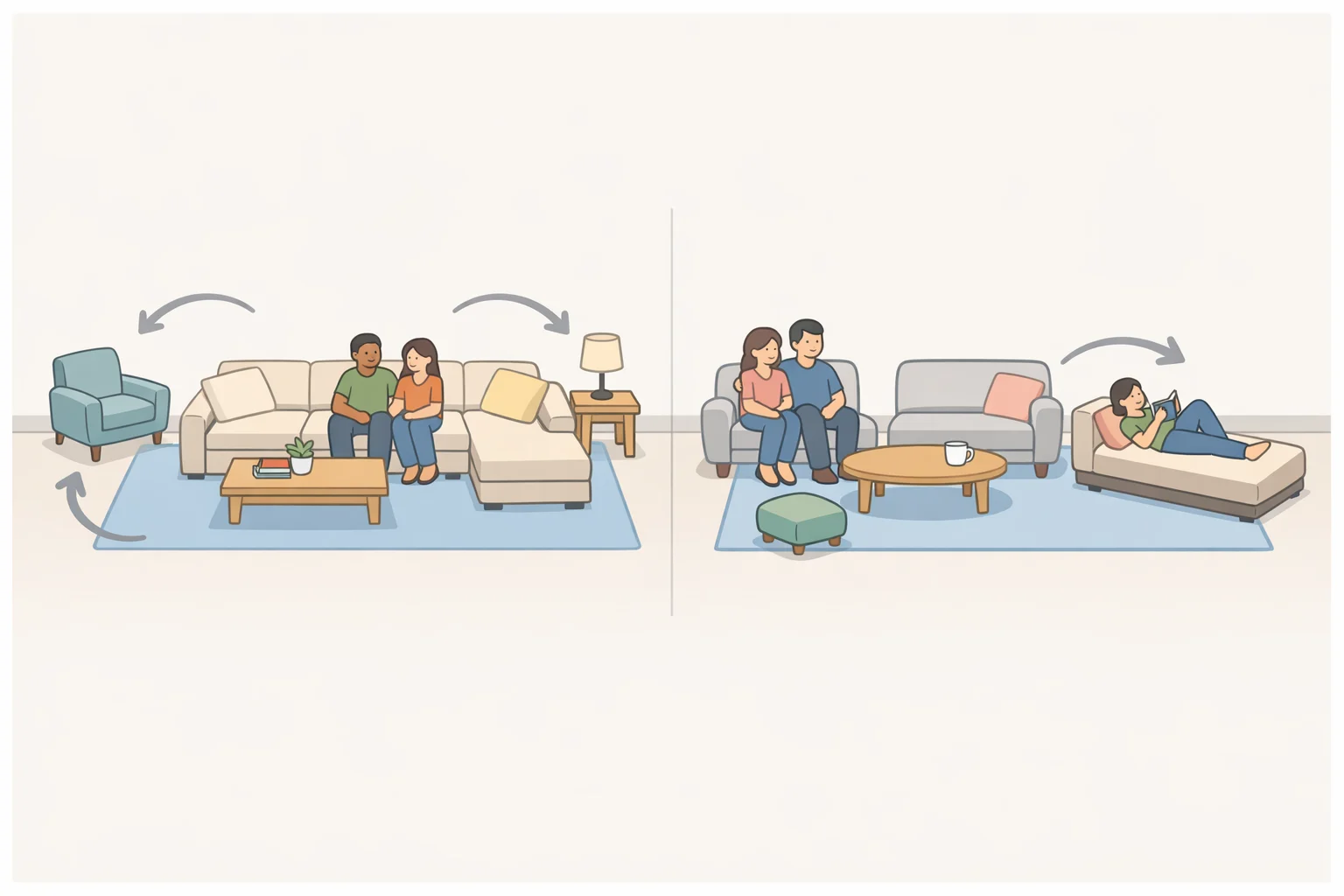
The two most practical chaise sofa alternatives are not interchangeable, and treating them as a single category will lead to the wrong purchase.
One preserves the full sofa format and simply makes the chaise portion movable: same footprint, same seating capacity, reconfigurable placement. The other shrinks the whole proposition, a smaller, dedicated piece that handles lounging without pretending to be a sofa. Which one belongs in your room depends on four things: available floor space, whether you need full sofa seating capacity, how often your layout is likely to change, and whether the piece will anchor the room or supplement it.
| Modular sofa + detachable ottoman | Fainting couch / daybed-style lounger | |
|---|---|---|
| Footprint | Comparable to a standard sectional | Noticeably smaller; closer to a loveseat or large chair |
| Flexibility | High; ottoman detaches, sofa functions independently | High; standalone piece, moves easily |
| Social seating | Full sofa capacity retained | Supplements existing seating; not a sofa replacement |
| Best suited for | Renters wanting sofa + chaise in one adaptable piece | Smaller rooms, reading nooks, bedrooms, secondary seating |
| Moving risk | Low; components reconfigure to suit new layouts | Very low; small, standalone |
Here is the short version for readers who want a quick steer before going deeper. If this will be your main sofa and you need to seat guests regularly, go modular. If you already have a sofa and want a dedicated lounging spot, or if you are furnishing a nook, a bedroom corner, or a smaller room where a sectional would take over, the fainting couch or daybed-style lounger is the right category. If you move often or expect your next place to have a different layout, avoid a fixed chaise entirely.
Before committing to either path, one research-backed caveat applies to both. A small experimental study of 12 participants, measuring pressure distribution across nine seat-and-backrest angle combinations, found that BMI and gender significantly affected which configurations felt most comfortable, according to research published in 2023. No form factor is right for all bodies, regardless of what the product description claims. Sit in any candidate piece before purchasing. Prioritize seat depth and back angle for your body, not just the silhouette.
Both alternatives solve the core problem: lounging without permanent layout commitment. The sections below provide enough detail to know what to look for when shopping.
The modular sofa instead of chaise: when a sectional with movable chaise makes sense
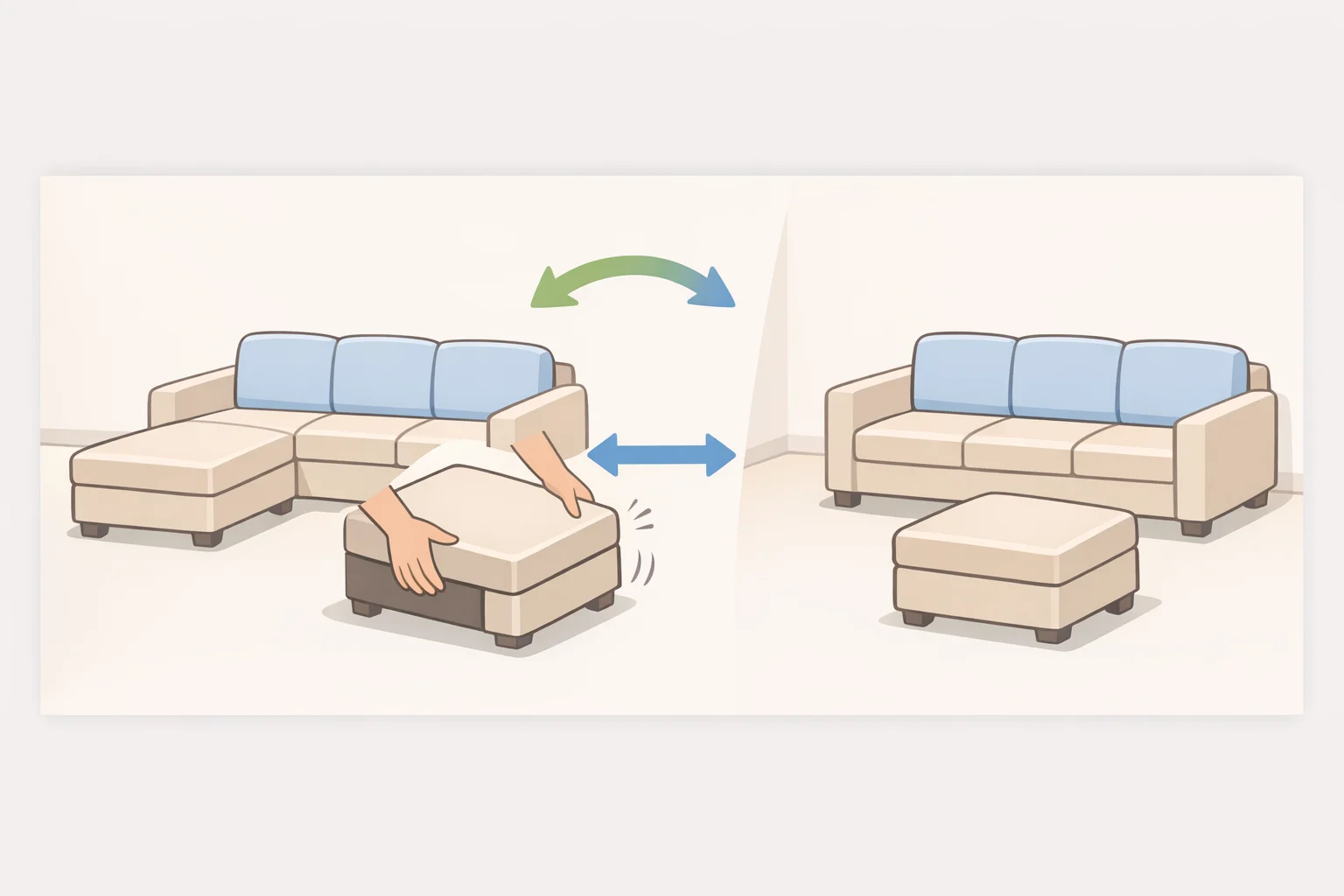
The interior designer quoted by Hunker recommends modular sectionals specifically configured so the arm piece and chaise piece are separate, freestanding components. That single feature, genuine freestanding separability, is what converts a sectional from a fixed-layout liability into an adaptable one. A left-facing configuration in one apartment becomes right-facing in the next, without replacing anything or buying additional components.
The most flexible version of this approach pairs a sofa with a matching modular ottoman. Pushed flush against the sofa end, the ottoman looks and functions nearly identically to an integrated chaise. Pull it away, and the sofa reverts to a standard configuration; the ottoman becomes a standalone piece, a coffee table, extra seat, or footrest depending on the evening. Some versions include reversible cushions, allowing the piece to convert between chaise-extension mode and a finished standalone ottoman with no visible seam or compromise in either configuration, as Hunker noted earlier this year.
When shopping, search specifically for "modular sectional with movable chaise" or "sofa with matching ottoman" rather than standard L-shaped sectionals, which are often fixed assemblies marketed with the word modular applied loosely. Confirm that the ottoman or chaise unit is genuinely freestanding and does not require attachment hardware to function in either mode. Also check that the ottoman height matches the sofa seat height exactly; a mismatch breaks the chaise illusion and makes the combined piece uncomfortable to use.
On the question of seat depth: ergonomics research, including the PMC systematic review covering 2012 to 2022, found that seat-depth fit matters to comfort and that sizing toward smaller users tends to serve the widest range of body types. If multiple people with different builds will use the sofa regularly, be cautious about very deep seats and confirm the depth works for the shortest adult in the household, not just the tallest.
This option is best suited to renters who want sofa-and-chaise in one piece, households that entertain regularly and need full sofa seating capacity, and anyone whose next move is likely to involve a room with a different orientation.
The dedicated lounging piece: what the fainting couch actually is and when it solves the problem
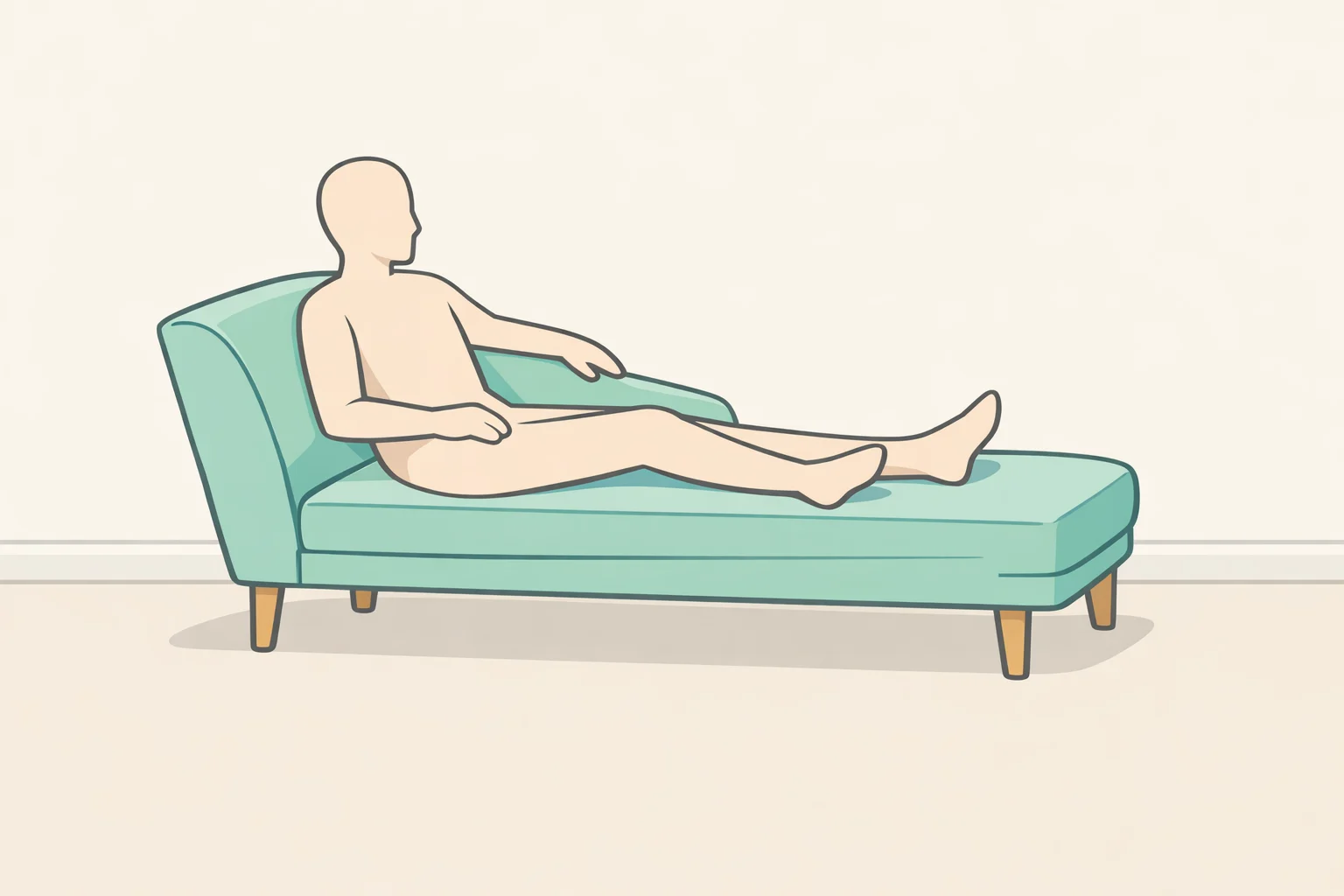
The fainting couch is a daybed variant, typically shorter than a standard sofa, with the backrest and any armrests running along only one side of the frame. House Beautiful notes that the term is often used interchangeably with settee, chaise, and daybed, which means search terms matter more than the label. The asymmetric silhouette is the key practical feature: it lets you stretch your legs out without requiring the full bilateral footprint of a chaise attachment.
The form became culturally prominent in the 1800s, tied to Victorian-era mythology and a complicated history of medicalized gender. Reclining furniture itself is considerably older; historians trace dedicated lounging pieces back to at least the 7th century BC, according to House Beautiful. The backstory gives the category personality. The form factor is what gives it utility.
Contemporary versions have shed the Victorian ornament. Most feature a single back, minimal or absent arms on the open side, and a geometry calibrated for mild recline, enough to stretch out and decompress without fully checking out of the room. House Beautiful describes this as being "upright enough to stay awake." That is the practical distinction from a full chaise: it allows partial recline without turning into a private cocoon.
Set expectations clearly before shopping: a fainting couch is not a sofa replacement for most households. Buyers who need it to absorb all their guest seating will find it undersized. Buyers who want a dedicated lounging spot as a secondary piece alongside an existing sofa, or as the primary seating in a bedroom corner or reading nook, will find it exactly right-sized.
Search terms that surface relevant silhouettes include "recamier," "méridienne," "daybed settee," and "chaise longue" (the French singular form, distinct from the sectional attachment). The 2023 experimental study found substantial variation in comfort based on individual body characteristics, so this is a piece worth sitting in before ordering online, since back angle and seat height vary considerably across manufacturers.
It works best in smaller living rooms where a sectional would dominate, households with an existing sofa that already covers seating needs, bedroom or nook placements, and for buyers who want a piece with a clear design identity rather than a backup seating fix.
Which one is actually right for you
The decision is cleaner than the furniture market's terminology makes it appear.
If this is your main sofa and you want chaise functionality, go modular. Find a sectional or sofa-plus-ottoman setup where the chaise component is genuinely freestanding and reconfigurable. Confirm that from the specifications, not the product description. As one interior designer told Hunker earlier this year, the sofa-plus-modular-ottoman is the most adaptable format: the ottoman produces near-identical chaise functionality when pulled up flush, and reverts to standard sofa seating the moment it moves away.
If you already have seating covered and want a dedicated place to stretch out, the fainting couch or daybed-settee handles that specific job with less floor commitment than a typical sectional. Shorter frame, one-sided back, a footprint that leaves the rest of the room intact. House Beautiful documents the category's continuous use across centuries precisely because the geometry works, not because the name is charming.
Holding onto a fixed chaise? Worth it if the room is large, the layout is stable, and a move is not coming. Otherwise, the layout math tends to work against you over time, and the moment it stops fitting, a sofa that is otherwise fine becomes a replacement purchase.
One note on comfort claims across all of this: the PMC systematic review covering a decade of seating research found that home furniture has been studied far less than office or classroom seating. Design media fills that gap with taste and opinion. Sit in the piece. Prioritize seat depth and back angle for your body. The category name matters considerably less than the geometry.




Comments
Be the first, drop a comment!