



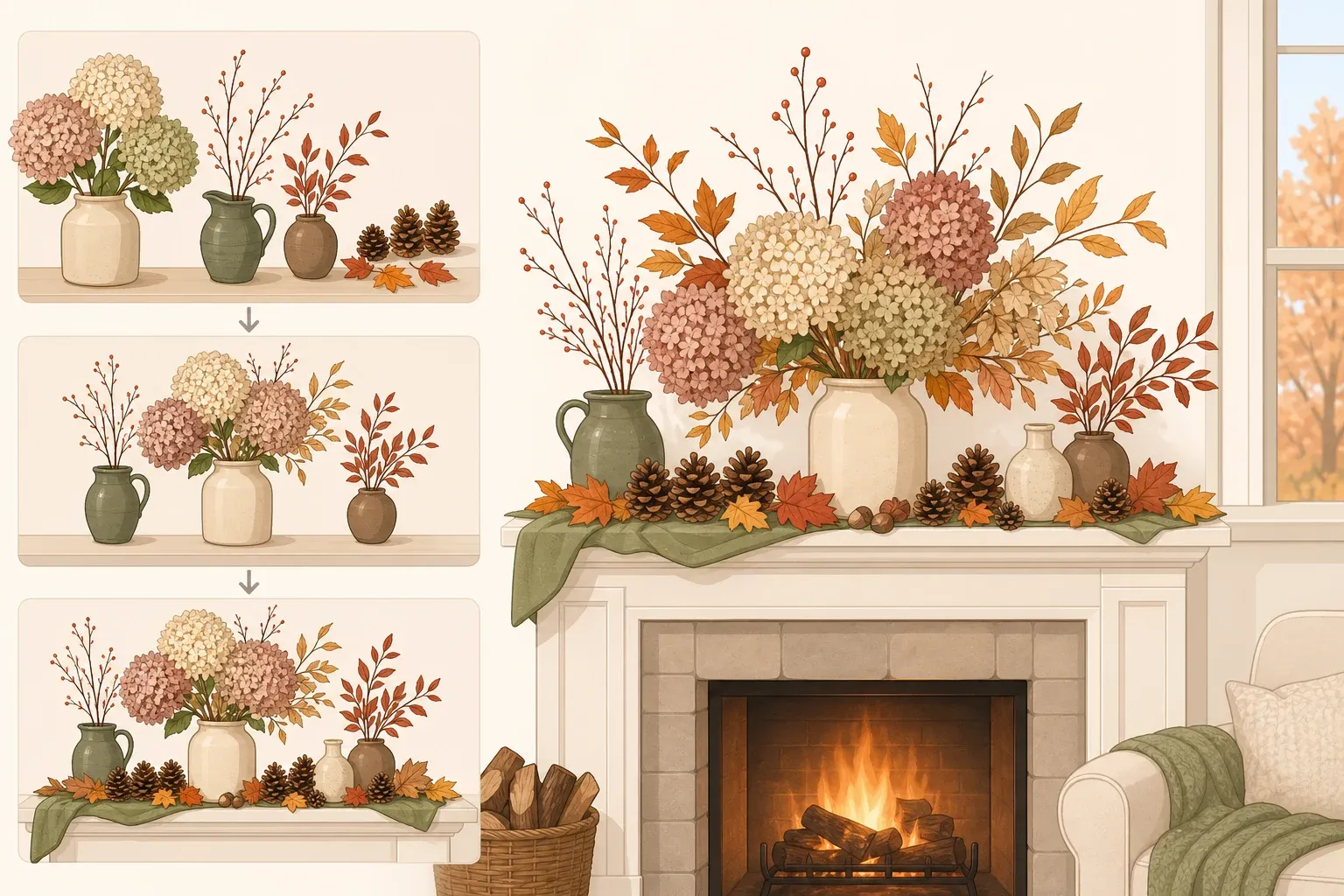
A full, layered fall mantel doesn't require a trip to the craft store. If your yard has hydrangeas drying on the stem, branches with turning leaves, seed pods, pinecones, or ornamental grasses, a few vases already sitting in a cupboard can turn them into a mantel display that costs nothing. These fall mantel decorating ideas work with whatever vessels are already on hand, as long as those vessels sit flat and stable and won't end up near any heat source, which makes this one of the easiest ways to pull together free fall decor from the yard before the season slips by.
Before gathering anything, settle one question: will this fireplace actually get lit while the display is up? The rule is simple. If the fireplace will be used, remove dried branches, grasses, flowers, and other combustible material from the mantel unless the manufacturer's instructions for that specific unit permit that exact placement and clearance. If the fireplace is staying cold for the entire display window, whether it's purely decorative or just not getting used for a few weeks, a full natural arrangement is fair game. Experts recommend keeping decorations at least three feet from the fireplace and vents as general guidance, a distance worth measuring on the actual mantel rather than assuming.
Decide before you gather: the three-foot rule and the cold-mantel test
Run through this short checklist before collecting a single branch:
What type of fireplace is this: wood-burning, gas insert, or a purely decorative unit that never gets lit?
How far is the mantel shelf from the firebox opening and any vents?
Will the fireplace be lit at any point while the display is up, even just once?
Does the manufacturer's manual list a clearance requirement for the mantel or nearby combustibles?
That three-foot figure is general fireplace-decor guidance, not a spec written for any particular wood-burning fireplace, gas insert, or decorative unit, so treat it as a starting point rather than a settled number. Check the specifications of the fireplace in question before relying on it.
A full, layered arrangement built from branches, dried hydrangeas, and loose grasses is the natural fall mantel decor version of this project, and it belongs on a mantel that's staying cold for the entire time the display is up. That means it comes down before the first fire of the season, not just on the days the fireplace happens to sit unused.
If the fireplace will be used: a fire-resistant mantel instead
Skip the natural materials entirely if there's any real chance of a fire while the mantel is dressed. Metal, glass, ceramic, and fire-resistant artificial trees or wreaths are decor categories less likely to catch fire, and those translate well to a mantel: metal lanterns, glass vessels, and ceramic pumpkins can stand in for branches and dried blooms.
A safety screen or glass fireplace door helps keep sparks and embers contained on an active wood-burning fireplace, but it's protection for the room, not a clearance substitute. It doesn't change what the manufacturer's manual allows on the mantel itself, so check that manual before deciding what stays on the shelf once the fire is going.
What you'll need (mostly free)
Most of this DIY fall mantel decor comes straight from the yard, if it's growing there. Round up what's already drying on the stem or still fresh enough to cut:
Hydrangea blooms, either already dried on the plant or freshly cut
Branches with turning leaves
Seed pods, pinecones, and acorns
Ornamental grasses
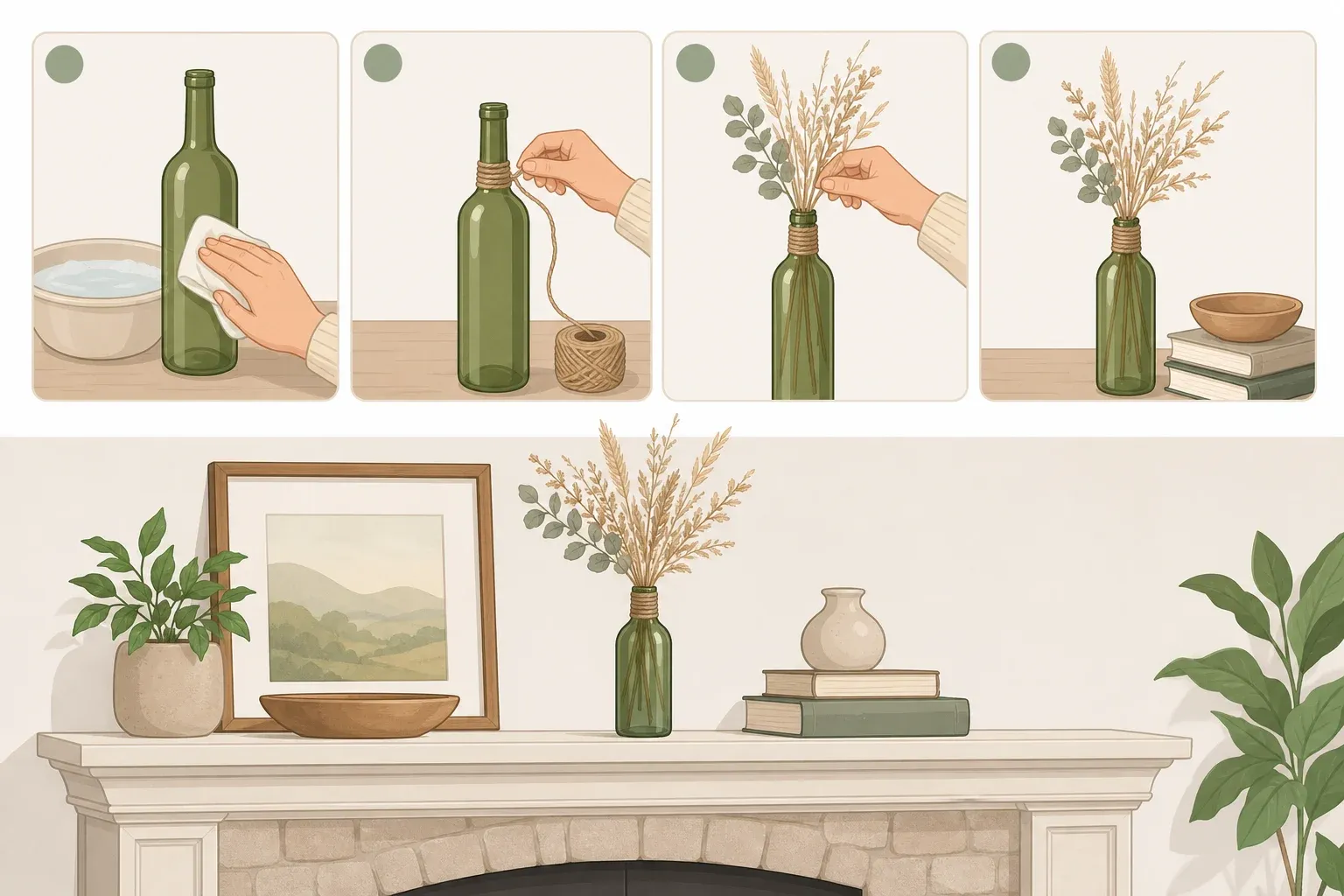
From inside the house, pull together a couple of vases, jars, or lanterns in different heights, along with floral wire or tape to anchor stems and ribbon or twine if the vessels need dressing up. Use vessels that sit flat and stable; a wobbly or top-heavy container isn't worth using even on a cold fireplace.
This project is ordinary DIY. Trimming stems and arranging branches doesn't call for any special skill. Deciding what's safe near a specific fireplace is a different kind of decision, and that one belongs to the manual or a qualified chimney professional, not a styling preference.
If candlelight is part of the plan, go with battery-powered flameless candles instead of real flame. Flameless candles are the safer option for decor placed near a fireplace.
Before you cut: choosing and trimming branches
Look for branches already close to the height needed for the chosen vessel; it's easier to trim down than to wish for more length later. Cut each stem at a slight angle with clean pruners so it can still draw up moisture, and strip off any leaves that would sit underwater in the vase.
Pick branches with some flex over ones that snap easily. Dried-out, brittle wood tends to shed bark and small pieces once it warms up indoors. Wear gloves around thorns, rough bark, or scratchy seed pods, and keep pruners pointed away from hands while cutting.
Before bringing anything in, skip berries that can't be identified, material with mold or soft rot, and anything that may have been sprayed with pesticide. Shake branches and seed heads outside first to knock loose dirt, debris, and the odd insect.
This gathering step is only for the cold-mantel version of the project. If the fireplace will be in use during the display window, go with the fire-resistant approach above instead.
Fall mantel decorating ideas with free yard finds
These steps show how to decorate a mantel for fall once the cold-mantel path above fits the room. If candles or string lights are part of the plan, keep them battery-powered and check the lighting notes in the variations section before plugging anything in.
Clear and measure the mantel. Wipe the shelf down and measure its full length so there's a clear sense of how much material to gather and where the anchor vessels will sit.
Set the anchor vessels first. Start with two or three vessels at different heights, placing the tallest roughly a third of the way in from one end and a shorter one near the opposite end. This split is more of a styling choice than a rule, but it keeps one side of the mantel from looking heavier than the other.
Pick one vessel as the focal point. Usually the tallest one. It holds the most dramatic branch or bloom cluster, and everything else fills in around it instead of competing for attention.
Build height with branches first. Tuck a few tall branches into the focal vessel before adding anything else, so the top line of the arrangement is set before it fills in below.
Layer in hydrangeas, grasses, and seed pods around the vessels. Keep every piece within the mantel's footprint. Nothing should hang below the bottom edge, since that's a hazard near an active firebox.
Anchor loose stems with floral wire or tape inside each vessel so nothing shifts if bumped. Test each vessel afterward with a gentle nudge; if anything wobbles or a stem slides loose, add more wire until it holds still. Securing mantel decor matters most in homes with pets or young kids who might bump into it.
Edit before calling it finished. Try repeating the same three or four materials at different heights rather than adding more individual objects. A crowded mantel now is also more pieces to account for once the fireplace gets lit again.
A finished display should read as one arrangement with a clear focal point, not a collection of separate objects. Weight should spread across the mantel's length, and every vessel should pass the nudge test from step six.
Troubleshooting common mantel problems
A vessel still wobbles after the nudge test. Add more floral wire around the base of the stems, or pack crumpled kraft paper or floral foam inside the vessel to hold everything upright. If a vessel won't sit flat on the mantel at all, swap it for one with a wider, flatter base instead of forcing it to work.
The arrangement reads as cluttered instead of full. Pull individual objects rather than whole material categories. Fullness comes from repeating a few materials at varied heights, not from adding new kinds of items, and stepping back a few feet to check the silhouette usually makes the extra pieces obvious.
Fresh-cut stems are drooping within a few days. Recut the stem ends at an angle and change the vase water; hydrangeas in particular rehydrate well with a fresh cut. If a stem keeps wilting after that, it's past its vase life and worth swapping for a dried piece.
Dried material is shedding more than expected. A little dropped petal or seed is normal. Heavy shedding usually means the material has gone past brittle into crumbling, so pull that piece and replace it rather than trying to prop it back into shape.
Variations for tight spaces, dried displays, and fall fireplace mantel ideas
Narrow or shallow mantel: Use one tall anchor vessel instead of two or three, then run a low, flat layer of grasses and seed pods along the rest of the shelf. This keeps the display from overhanging a shelf too shallow to hold multiple containers, for the same reason nothing should hang below the mantel's edge.
All-dried-material version: Build the arrangement entirely from materials already dried on the branch or vine, skipping fresh-cut stems. This skips the wait for stems to dry on their own and generally means less water-related upkeep, since there's nothing left to wilt. It still sheds dust and the occasional dropped petal over time, so check it the same way as a mixed fresh-and-dried display.
Lighting, if added: Before plugging in any string lights, inspect the cords and bulbs for fraying or damage, and unplug them whenever leaving the house or heading to bed. These apply whether the fireplace is lit or not.
Finish line: maintaining, storing, and the one rule that doesn't bend
A finished mantel should look intentionally layered, with one focal point and weight spread across its length, not crowded with miscellaneous pieces. Cutting back on the number of individual items is a clutter habit worth keeping even on a cold fireplace, since clearing the mantel solves the fire-hazard problem but not the visual one.
Check the display regularly for shedding petals, sagging stems, or dust along the vessels. Pull or replace individual pieces once they've gone brittle or started dropping noticeable debris onto the mantel; there's no need to redo the whole arrangement over one tired branch.
If the display needs to come down, store it away from any heat source as a precaution. A closet shelf or spare room works better than leaving it stacked near the fireplace, since dried material sitting next to a heat source works against the point of clearing the mantel in the first place.
The rule that doesn't bend: once there's a real plan to light the fireplace, remove the natural display first unless the manufacturer's manual specifically allows it at that distance. Don't leave dried branches and grasses in place and hope the clearance holds up once there's an open flame involved.
Keep a working fire extinguisher nearby whenever the fireplace is in use, and replace smoke alarm batteries to make sure the alarms are working properly. If there's any uncertainty about the clearance or venting for a specific fireplace, check the manufacturer's manual or call a chimney professional before treating any mantel distance as fixed for that unit.


Comments
Be the first, drop a comment!