





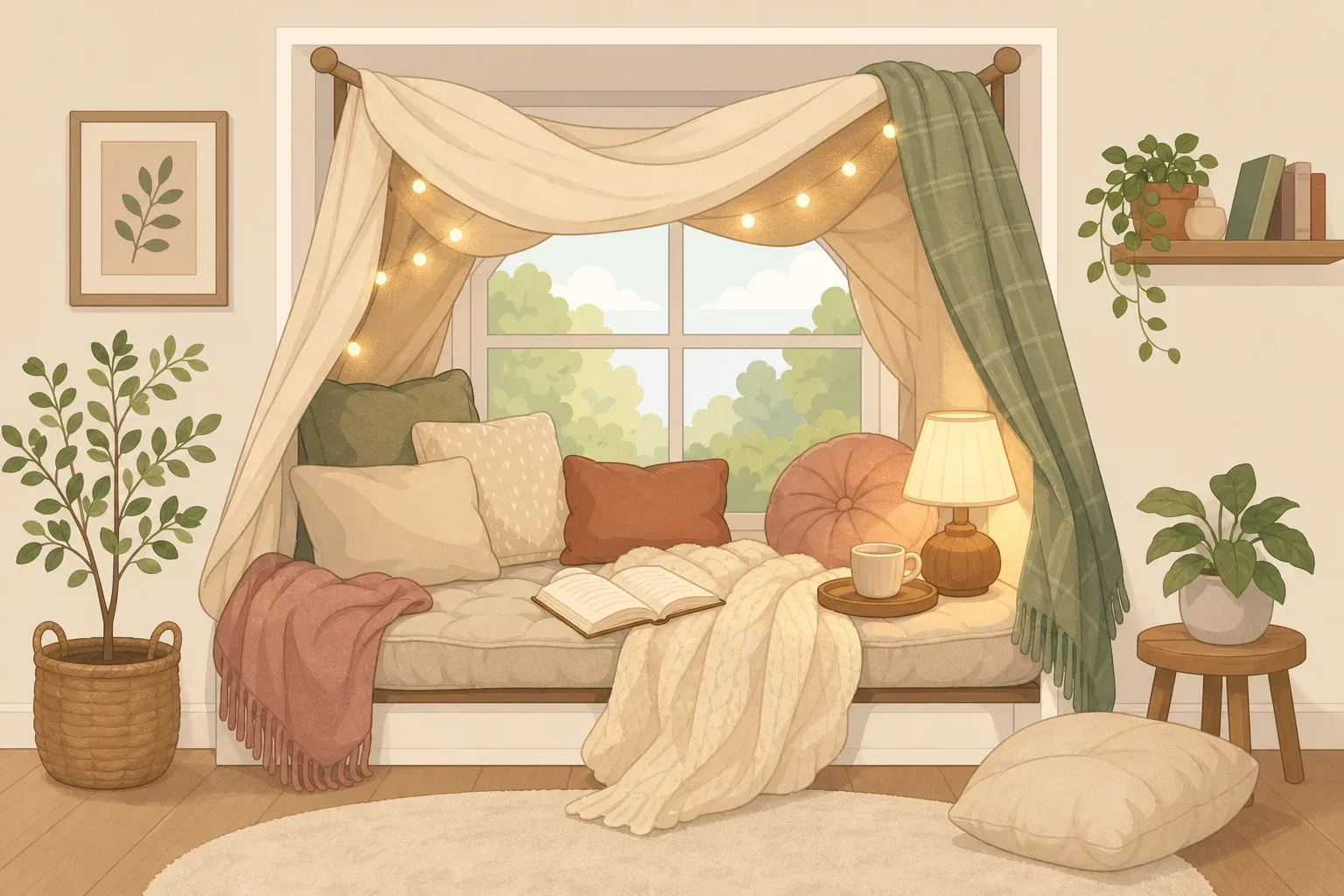
Pick one corner of your home, a reading chair, a window seat, or an underused armchair, and turn it into a space built for comfort instead of photographs. That's the whole project: no renovation, just rearranging furniture and objects you already own.
This look has a name now: the burrowcore aesthetic. Vogue Adria introduced burrowcore earlier this year as an interior-design trend built around the idea of a burrow, a den, a shelter, somewhere to retreat from the world rather than a stage you keep tidy for other people. The timing lines up with winter decor advice emphasizing layered lighting, substantial textiles, and spaces designed around comfort.
Burrowcore isn't an established design category with fixed rules, and its own definition warns against confusing it with plain mess. This guide sticks to that line: it walks through how to make a corner feel lived-in without letting it slide into clutter.
What is burrowcore? Burrowcore vs. cottagecore
Burrowcore is a styling idea built around the burrow: a shelter, a den, a safe place to retreat from the world, according to Vogue Adria. Unlike neatly ordered styles, it doesn't ask whether the blanket's folded, the book's back on the shelf, or the coffee mug made it to the dishwasher before anyone notices.
Vogue Adria sets the look up as an alternative to the idealized, highly curated version of rural life associated with cottagecore. Its description of burrowcore emphasizes layering, imperfection, and personal eccentricity instead of a carefully arranged scene.
The practical difference comes down to what you're optimizing for. Choose burrowcore if comfort, easy access to the things you actually use, and visible evidence of daily life matter more than coordinated furniture or a color-matched room. Lean toward a curated style like cottagecore if you'd rather the room look a specific way even when no one's using it.
Neither is right or wrong. They're built around different priorities, and burrowcore is simply the one that doesn't require tidying before you're allowed to relax in it.
What you'll need before you start a burrowcore corner
This is a rearranging project, one corner, nook, or chair, not a full room redo. Vogue Adria's own quick-start advice backs that up: stop matching furniture in sets, keep what you actually use instead of what just looks good, and mix old and new pieces without feeling like you need to justify it.
Budget for an afternoon, not a weekend. Gather:
A comfortable chair or a defined spot on a sofa
A light source you can place near the seat
One or two throws or blankets
A small table, tray, or basket to act as a landing spot for loose items
A handful of personal objects you already keep nearby, such as books or framed photos
None of this requires new purchases. A secondhand throw gives you the same layered look as a new one, and a plug-in or rechargeable lamp adds a light source without any wiring or fixture work.
Before you start: safety boundaries that matter
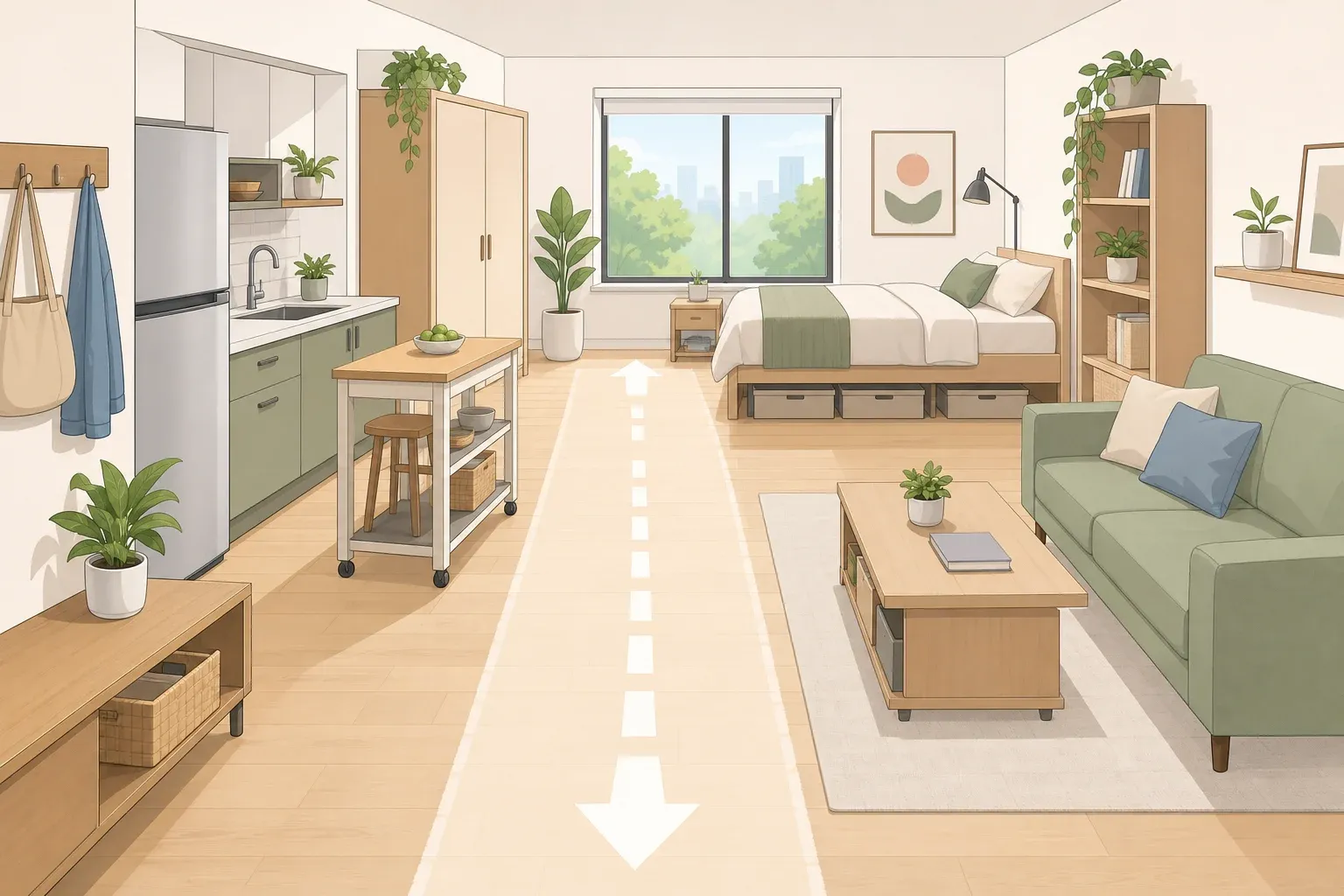
Keep walkways, doorways, and exits clear. A burrow corner shouldn't block the way through a room, and furniture, baskets, cords, and other objects shouldn't create a tripping hazard along the route through the space.
Vents and heating equipment need particular attention. Follow the clearance instructions for the specific space heater, radiator, fireplace, or other heat source in the room rather than assuming one distance is safe for every appliance.
Route lamp cords so they don't cross walking paths. If a cord has to run through an exposed area, secure or cover it using a product intended for that purpose.
Keep blankets, books, paper, furniture, and other combustible materials away from portable heaters. The US Consumer Product Safety Commission recommends keeping portable heaters at least 3 feet from combustible materials such as curtains, furniture, and bedding.
Avoid placing drinks where a spill could reach electrical equipment. A stable side table or tray can give drinks their own landing spot away from plugs, power strips, and other electrical connections.
Step-by-step: set up the zone and seating
Step 1: choose the zone and clear the path
Pick a corner, a window seat, or a single chair rather than trying to convert an entire room at once. Vogue Adria's description of the trend treats a corner for retreat as one of the central elements of the look, more important than any particular piece of furniture or color choice.
You've picked the right spot if you can walk to it without moving anything first and there's still a clear path through the room once you're done. If you have to shuffle a side table or step over a cord to sit down, choose a different zone or clear more space before moving on.
Step 2: arrange seating and place daily-use items within reach
Skip the pressure to match furniture. Vogue Adria points to mismatched chairs and blankets kept within reach as markers of the look rather than flaws to fix. An inherited armchair next to a secondhand side table fits the idea perfectly well.
Here's the mistake that sinks a lot of cozy corners before they ever get used: placing the item you'll reach for most, a book, the remote, or a water glass, somewhere that requires standing up to grab it.
Set those items within comfortable reach of the seat itself rather than on a shelf across the room.
Step-by-step: layer light, texture, and personal objects
Step 3: layer the lighting
Add another light source near the seat, such as a floor lamp or table lamp, instead of relying solely on the room's overhead fixture.
Layered lighting is a recurring recommendation in winter decorating advice because it lets different parts of a room serve different purposes. A plug-in or rechargeable lamp can provide local light without hardwiring a new fixture, which also makes it practical for renters.
Step 4: add one or two heavy textiles
Drape a throw over the arm of the chair or sofa rather than building the corner around decorative textiles you won't actually use.
Wool, chunky knits, bouclé, velvet, and other substantial textures can contribute to the layered effect, but none is required. The cozy burrowcore decor look doesn't depend on buying anything new.
Step 5: add personal, lived-in objects
Bring in two or three objects that show actual use instead of display: the books you're currently reading, the mug you reach for every morning, or photos arranged without worrying about perfect symmetry.
Vogue Adria's description of burrowcore emphasizes spaces that visibly reflect the people living in them rather than rooms arranged primarily for presentation.
Run a quick test on every object before it goes out: you should be able to say why it's there. You use it, you reach for it, or it means something to you.
If you can't answer that, it's a candidate to put back in a drawer.
Setting up a burrowcore corner by room
The reach-and-use test from Step 5 holds in every room, but the objects and furniture will look different depending on where you're working.
Living room. Treat the room as an archive of everyday life. A shelf of half-read books, the throw left near the seat where you use it, and mismatched side tables can contribute to the look without turning the room into deliberate clutter.
Bedroom. Treat it as your personal burrow. A reading lamp on a nightstand, a throw at the foot of the bed, and a stack of books within reach cover the same ground as a living room corner, just scaled to a smaller space.
Small rental or shared space. No spare armchair? A single chair pulled slightly away from a desk or dining set, paired with a lamp and a throw, works the same way. The corner doesn't need to be large or permanent. It needs a comfortable spot, useful light, and somewhere to put whatever you're using that day.
Run the clutter check and adjust for budget
The decision rule that separates this look from a messy room is simple: leave visible what you use regularly or what makes the space feel restorative to you.
Anything that blocks a doorway, covers a vent, takes up the seat you need, creates a safety hazard, or buries every usable surface gets contained, relocated, or removed. That's the line between the functional, lived-in quality Vogue Adria associates with burrowcore and ordinary clutter.
If budget is tight, none of this requires new purchases:
Use furniture you already own instead of buying a matching set
Swap in an inherited or secondhand throw instead of a new one
Choose a basket or tray already sitting in your home as the landing spot for loose items
Start with a single zone rather than every room in the house. One corner keeps the project doable in an afternoon, and it's easier to judge afterward whether the space actually gets used.
Troubleshooting a burrowcore corner that isn't working yet
It still looks cluttered. Reduce the number of visible objects first rather than adding storage. A few meaningful objects can look intentional, while too many can overwhelm the space even if every item passes the reach-and-use test. If that's not enough, add one basket, tray, or small side table as a designated landing spot for whatever accumulates day to day.
The corner is too dark. Add a local light source before assuming the spot doesn't work. A floor or table lamp near the seat can illuminate the corner without relying entirely on a bright overhead fixture.
There's no spare chair. Borrow one from a dining set or clear a defined spot on an existing sofa instead of buying new seating. The corner doesn't need dedicated furniture. It needs one comfortable spot with useful light and the things you regularly reach for nearby.
Finish and success check
The corner works when you can sit down, reach a light, a blanket, and something to read or drink without repeatedly getting up, while still walking safely through the room without rearranging anything.
Once it gets used regularly and resets in a few minutes of tidying, stop adjusting it. The idea, by Vogue Adria's framing, is ease over curation, not a new set of rules to follow perfectly.
If the result works and has you wondering how to create a burrowcore home beyond this one corner, the same layered-lighting, useful-textile, and personal-object approach can extend into other rooms. Treat those as optional additions, not requirements for the corner you've already finished.



Comments
Be the first, drop a comment!