



Reviewed by: Y. Garcia
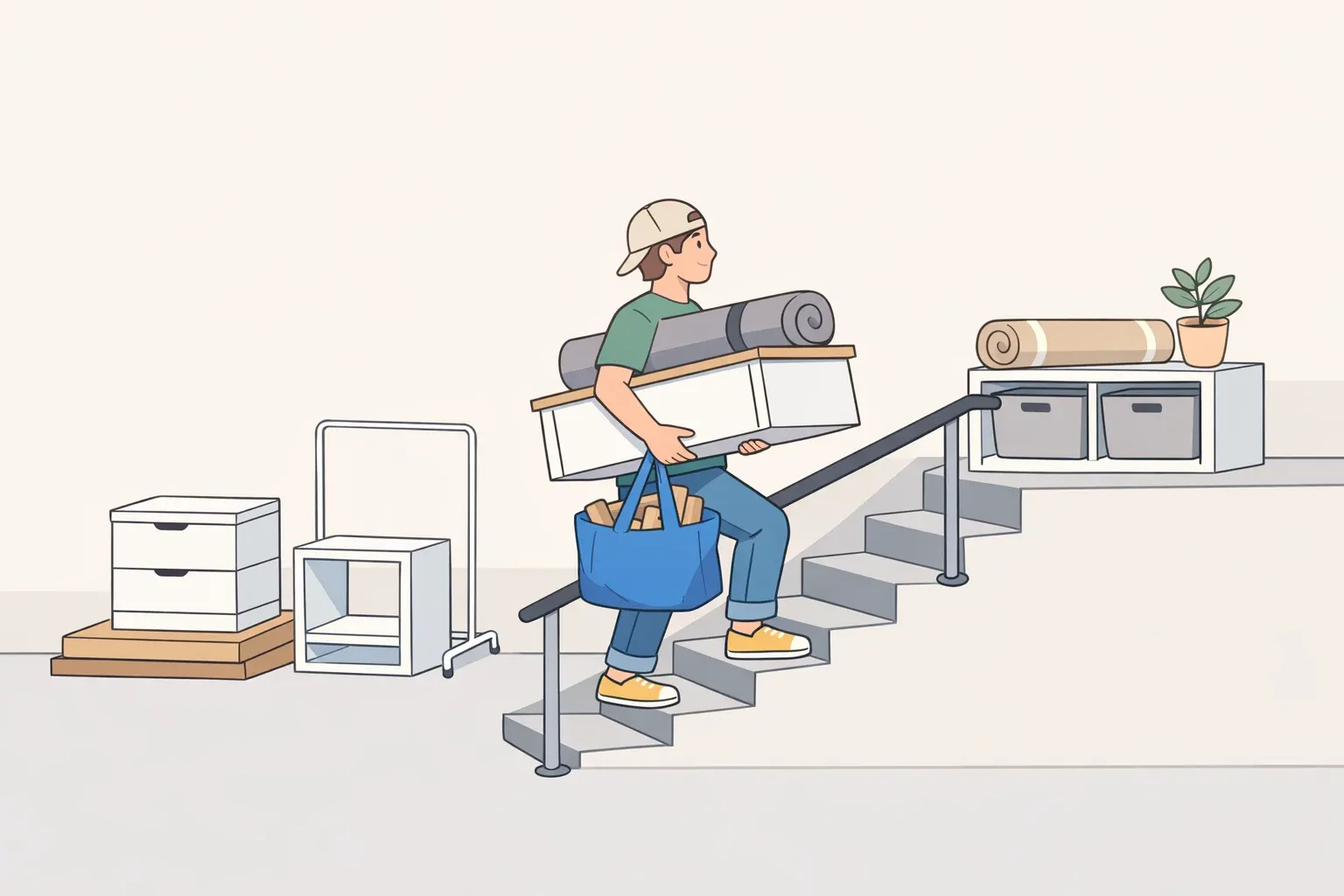
The hard part of IKEA furniture has never really been the assembly. It's been what comes next: the move, the roommate split, the third-floor walkup with no elevator and no van.
The IKEA KOMPISHÄNG collection, with 11 pieces launching in US stores on July 31 and online on August 15, is IKEA's attempt to redesign around that problem. None of the pieces require assembly or have separate components, and the collection is designed to be easily moved, Dwell reported yesterday.
Designer Wiebke Braasch put the design constraint plainly: "We wanted to create a collection that could be moved with your body alone. Without needing a car," per Dwell. That sentence defines what's actually new here. Not the aesthetic. Not the price point. The logistics.
Pricing, dimensions, and weight capacity are not included in Dwell's pre-launch reporting. Those details matter more to most buyers than the design brief, and they won't be available until the launch window opens.
Why the IKEA KOMPISHÄNG collection targets renters who move without a car
The name is an IKEA-ism for "hanging out with friends," according to Dwell, but the design research behind it is more specific than the name suggests. The collection grew out of conversations between IKEA staff and twentysomethings living in Central London. Two recent industrial design graduates interning at IKEA also contributed their own experience to the process, Dwell reported. They weren't studying the target demographic from a distance; they were it.
From those conversations, IKEA identified three recurring frustrations at that life stage: moving apartments frequently, dividing furniture among flatmates, and having no practical way to transport anything without a vehicle, Dwell reported. Each of the three maps to a different kind of friction. Moving often is a logistics problem. Sharing furniture with flatmates is a coordination problem. Getting around without a car is an access problem. KOMPISHÄNG tries to address all three with the same design constraint: no separate components, no tools, no reassembly.
That last decision changes more than the initial setup. Because none of the 11 pieces require tools or break into parts, there's nothing to disassemble before a move and nothing to rebuild at the next place, as Dwell noted. The implication, if the pieces hold up, is that the friction of every subsequent move is lower than the one before, not just the first time out of the flat.
Designer David Wahl made a larger claim about the foldable table specifically: "It's designed to accompany life's transitions equally at home in a first apartment, a family house, or even a retirement space," per Dwell. That's an appealing idea. It's also design intent, not demonstrated performance. The research clearly supports the renter use case; the multi-decade longevity claim is something the collection will have to earn over time.
How the IKEA KOMPISHÄNG small-space furniture solves specific moving-day problems
The range includes a side table, a foldable desk with a built-in handle, a rolling bag, a jute bag with handles, and stackable stools, among other pieces, Dwell described. Each one corresponds to a recognizable moment in the renter experience, which is a narrower design ambition than "perfect for small spaces" and a more defensible one.
The stools are probably the most carefully considered piece in the lineup, Dwell noted. They can nest tightly for compact storage, like the Artek 60, or stack atop each other to form a shelving display two distinct configurations, no tools, no spare hardware that needs to stay together between moves. The roommate split scenario is where that design logic pays off most directly: when someone moves out, each stool goes with them the same way it arrived. Nothing to unscrew, no bag of bolts to divide. The coordination problem that usually accompanies shared furniture largely disappears.
The foldable desk handles what is, for most studio renters, a daily negotiation with floor space. When dinner is over, the table folds flat and the stools stack cleanly on top of each other, Dwell reported. The built-in carry handle means it moves between rooms or between apartments the same way a bag does. That's not a workaround for a tight space; it's the intended daily pattern.
The rolling bag on wheels addresses the transport problem directly. The collection is low-profile by design, Dwell noted, and that compactness is the point. Moving out on public transit or on foot becomes a realistic option rather than a logistical compromise. The bag's design resembles the Hulken, per Dwell, which has become a shorthand for the kind of oversized, wheeled carry-all that urban renters have adopted precisely because vans are expensive and stairwells are narrow.
Then there's the jute bag with handles, which doubles as a plant pot cover at home and a moving carrier in transit. An IKEA designer said moving plants turned out to be a bigger problem than expected, and the bag was designed to handle both the carrying and the protection, per Dwell.
It's a small detail, but it's the kind that signals the team was drawing on actual moving-day experience rather than idealized scenarios. Plant transport doesn't show up on mood boards. It shows up at 7am when someone is trying to get a fiddle-leaf fig down two flights of stairs without destroying it.
Across all four pieces, the underlying logic is the same: remove the steps that make furniture hard to move, hard to share, or hard to store. That's a narrower claim than most furniture collections make, and it's more honest for it. The collection isn't trying to do everything well. It's trying to do one thing well, repeatedly, across 11 pieces.
Whether any of them hold up across the third or fourth move is a different question. A coherent design brief and a proven product are not the same thing. The brief is coherent. The product is untested.





Comments
Be the first, drop a comment!