



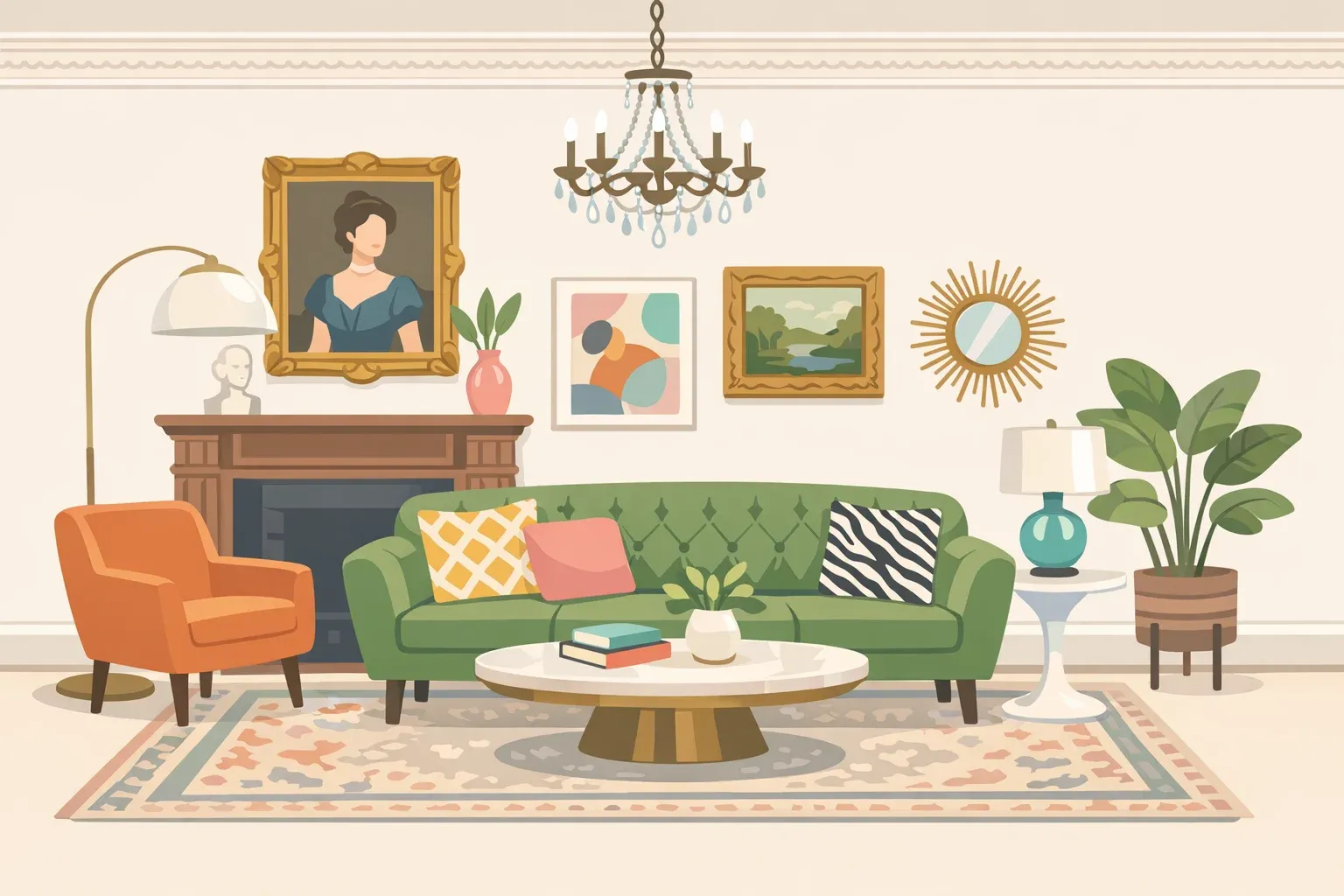
Victorian homes were built for accumulation. The carved woodwork, plaster cornicing, stained glass transoms, and elaborate ceiling moldings that define these houses were never meant to sit quietly in the background. They are the background, each room a layered argument about craftsmanship, material weight, and the social standing of whoever lived there.
For most of the past decade, that infrastructure sat buried under off-white paint and furniture sets chosen to coordinate rather than to mean anything. Designers are now starting to decorate these houses in ways that work with that density rather than against it.
Eclectorian style is the name Apartment Therapy coined to describe something already underway: pairing Victorian architectural bones, carved wood, stained glass, intricate moldings with colorful modern art, vintage finds from multiple eras, and furniture that mixes old and new without trying to coordinate.
The label is fresh. The underlying shift is measurable. In a survey of 643 interior designers, 1stDibs found maximalism and eclecticism each cited by a third of respondents as the styles they expect to define 2025, tied for first.
The argument here is architectural, not aesthetic. Victorian homes are the specific housing type where layered, expressive, historically grounded decorating makes native sense rather than imposed sense. What follows examines why that's true, what it looks like in practice, and what has to happen structurally before any of the decorating logic holds.
Why Victorian architecture is the right house for this moment
Designer Meghan Jay puts the core observation plainly: Victorian architecture high ceilings, carved woodwork, decorative plasterwork already embedded in the structure makes pattern layering feel like a natural extension of the building rather than a decorating choice grafted onto it. The same volume of visual information in a flat-walled open-plan reads as maximalism for its own sake. In a Victorian, it reads as a response to what's already there.
Pattern mixing was never foreign to these houses, either. Designer Celerie Kemble notes that Victorians mixed patterns deliberately, as a signal that a household could source goods from many vendors and distant origins.
A peer-reviewed Journal of Architecture analysis supports this view: eclecticism is often dismissed as random historical borrowing, but it has long connected architectural style with social identity. Kemble's observation makes the same point. Eclectorian design isn't imposing a new idea on these homes; it's restoring one that was already part of them.
Light is the variable all decorating logic must account for before anything else. Kemble describes working with how light moves through old houses: moody, directional, room by room, and responding not with a single overhead fixture but with varied sources: a ceiling light, reading lamps, table lamps, each creating its own moment. Start with light before committing to color. In a Victorian, the two are too closely linked to treat separately.
What Eclectorian style looks like in practice
Color: heritage tones as a starting point, not a constraint
Design preferences are clearly moving away from gray. In a 1stDibs survey, dark gray and slate fell from 10% to 5% as a top color choice between 2024 and 2025. Meanwhile, chocolate brown rose from 17% in 2023 to 32% for 2025, while burgundy and dark red increased from 7% to 20%.
These richer colors also suit Victorian interiors. Heritage design guidance notes that jewel tones work well with features such as plaster cornicing and dark woodwork, creating more depth than flat gray tones.
Kemble and Jay offer two valid translations of the same starting point. Kemble recommends leaning into traditional Victorian saturates without apology. She names "absinthe rich green" specifically and treats restraint as what she calls "a silly restraint" rather than a virtue.
Jay used Victorian ochre, burgundy, and forest green as a historical springboard, then reinterpreted those tones in a lighter, brighter, more contemporary register, Apartment Therapy reported. Deep immersion or lighter translation: both are rooted in the house's own chromatic history rather than borrowed from a trend board.
The Manchester case study shows what this looks like when applied room by room with purpose. Designer Jo deliberately moved away from what she described as a safe gray scheme, choosing navy, rust, black, and green throughout her Victorian. In a large, well-proportioned bedroom, she painted the ceiling black for grandeur and brought green through accessories and furnishings.
In the living room with a young baby and a need for warmth, she kept the walls neutral and let color arrive through the furniture. The principle is saturation calibrated to each room's light, scale, and purpose, not saturation applied uniformly across the whole house.
Furnishings: memory and provenance over coordination
Kemble draws the clearest distinction between what eclectic Victorian decor proposes and what it's replacing. A fully matched, catalog-style interior, she argues, is "a purchased identity rather than an evolved or grown identity." It solves the problem of an empty room quickly but offers no intimacy, no memory, no evidence of a life actually lived.
Jay frames the same idea differently: people want interiors that tell a story through meaningful collections, antiques, and objects with history. That's more than rhetoric. It describes what makes one Victorian room feel inhabited and another feel staged.
The sourcing trends tell a similar story. In the 1stDibs survey, 81% of designers bought vintage furniture and décor in 2024, while 62% planned to buy more artisan furniture in 2025. Only 35% expected to buy more from large manufacturers.
Interest in Murano-glass pendants and chandeliers also rose from 19% to 27%. Decorative lighting is an easy way to add Victorian-style character without changing the walls.
The Toronto case study shows what intentional layering looks like when it's working. Designer Denise Roy's Victorian features a checkered Moroccan stair runner, original circa-1890 floorboards preserved where possible and covered with new engineered oak where wear made them unworkable, and a dining table chosen, in her words, because "you can spend a long time around" it, House & Home documented.
The layers read as collected rather than chaotic because each object arrived with a reason — provenance, personal meaning, or a specific functional purpose rather than as part of a simultaneous full-room purchase. That's the working rule: Eclectorian interior design is built incrementally, not assembled.
One important boundary applies. The style only holds when the architecture stays visible under the layers. Strip the cornicing, remove the original fireplaces, paint over the dado rails, and the same palette becomes a dark space with a lot of things in it.
Victorian plasterwork and woodwork aren't a backdrop; they're the structural argument for why the layering makes sense. This distinction matters for reading the survey data correctly, too. "Bold designs" as a specific trend category fell from 21% to 15% in the 1stDibs survey, even as maximalism and eclecticism ranked first. Designers want expressive, historically grounded rooms, not novelty for its own sake.
The renovation sequencing that makes any of this possible
Victorian homes arrive with a hierarchy of problems, and the decorative vision sits at the bottom of it. When designer Jo and her husband bought their Manchester Victorian, a leaking roof, joists found to be rotten after water started tracking down interior walls, consumed the budget they had set aside for other renovation plans.
A handyman also walked off a job midway through, leaving a half-finished room weeks before Christmas, House Beautiful reported. Anyone who has bought a period home will recognize these situations. Structural surprises and unreliable trades are recurring features of Victorian renovation, not exceptional ones.
Sequencing is the practical discipline that makes the rest possible. Denise Roy compressed her Toronto Victorian's bathroom, flooring, kitchen, and behind-the-wall infrastructure into a focused two-month window before moving in specifically because, as she put it, "the momentum and tolerance for disruption" are highest before daily life depends on the space. Trade-heavy work first; decoration after. That sequence doesn't just keep the project manageable. It determines which architectural features survive to support the decorating logic later.
Thomas Wright, a chartered surveyor with more than 20 years of experience in UK period properties, recommends an 80/20 approach: treat architecturally significant rooms, entries, principal reception rooms, and dining rooms as fixed frameworks where original features are preserved, while private and functional spaces carry more latitude for intervention.
Jo preserved her original plaster corbels, dado rails, fireplaces, and arches throughout, treating their imperfect, handmade quality as the point rather than the problem. The bold color and layered decoration applied over that foundation works precisely because the architecture remained legible under it. The preservation decision and the decorating decision are the same decision, made at different stages.
What this convergence actually amounts to
"Eclectorian" was coined this week, and calling it an established movement would be premature. What the evidence does support is the convergence it names: designer color preferences are shifting toward heritage-adjacent tones, vintage and artisan sourcing is measurably up, and interest in layered and eclectic interiors is stronger than it was two years ago.
Among the 1stDibs respondents, 81% sourced vintage pieces in 2024 and 62% plan to increase artisan purchasing in 2025. Taken together, those numbers suggest a broader shift in how working designers are sourcing and building interiors away from catalog coherence and toward something more accumulated.
Whether "Eclectorian" sticks as a label is probably beside the point. Labels consolidate shifts that are already happening; they rarely cause them. The more durable question is whether the underlying move away from staged neutrality and toward historically responsive decorating has enough architectural logic to outlast the trend cycle.
For Victorian homes specifically, the answer looks like yes. Most housing types absorb maximalism as an aesthetic choice. Victorian homes absorb it as a response to what the building is already doing: the carved woodwork, the plaster detail, the directional light all ask for density rather than resist it.
Jewel-toned walls, Moroccan runners, ornamental pendant lighting, and furniture from three different eras don't impose on a Victorian room. They answer it. That's a more durable foundation than trend momentum alone.


Comments
Be the first, drop a comment!