



Stained glass dining nook makeover: film, salvage, or custom
A stained glass dining nook makeover solves a problem that paint and new cushions can't touch. The underlying issue with a dated nook isn't color or comfort it's that the space has no character built into its structure: flat light, no privacy, a corner that functions like a waiting room. Stained glass, the material most people associate with churches and Victorian vestibules, is appearing in ordinary residential kitchens and eating corners for exactly this reason.
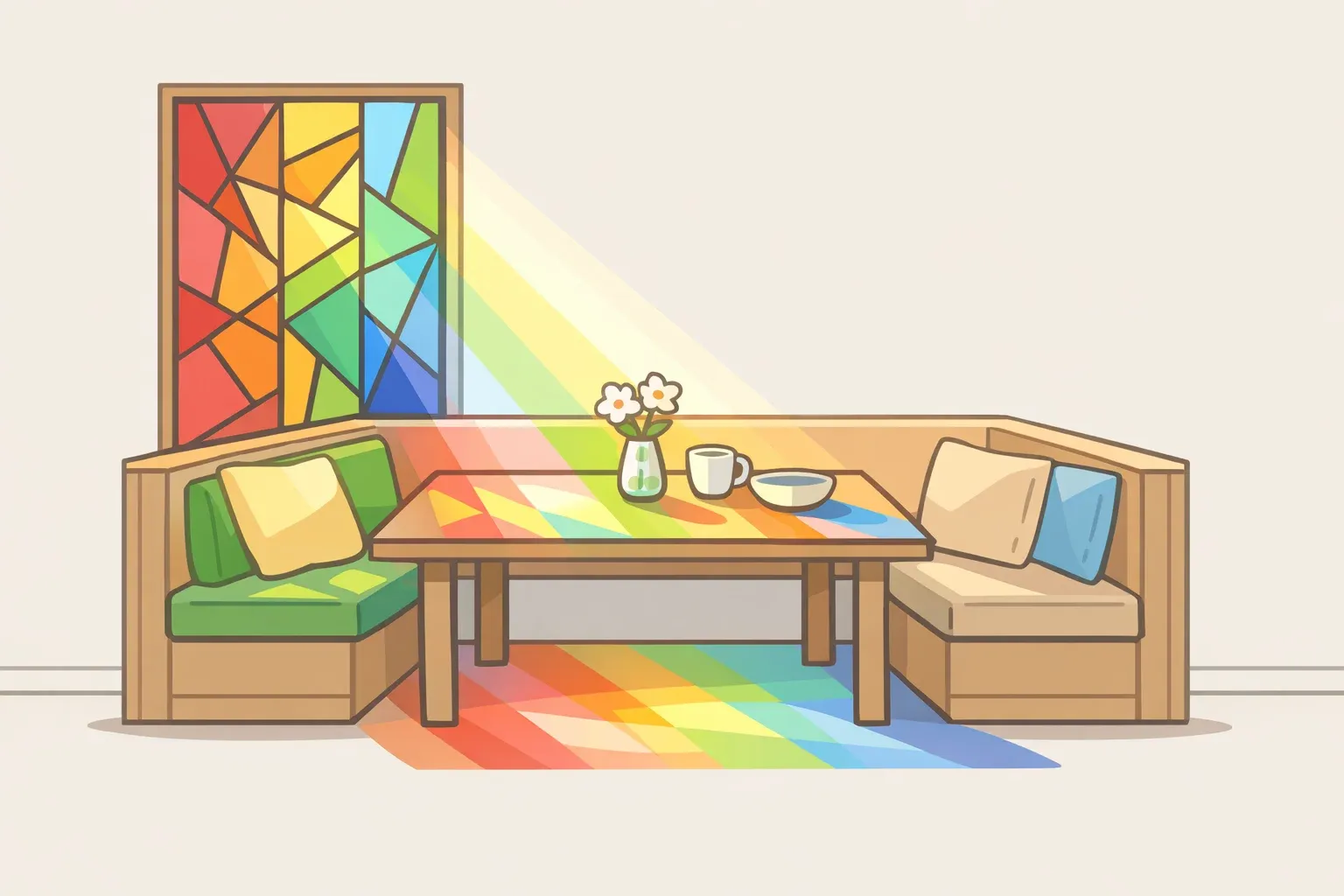
Architectural Digest covered the shift last month, pointing to a custom art-glass piece in a family reading nook and a pop of glossy handmade color near the ceiling of a refurbished Los Angeles dining room. Contemporary homes, not period-revival projects. Designer Gemma McCloskey explained to House & Garden in early 2024 that colored glass shifts the decorative work from accessories to the room's architecture, making "the foundation as fun as it can be." As daylight moves through the day, the glass throws shifting color across walls and surfaces what McCloskey calls "intrigue and movement." A corner that was static and dim changes character by the hour.
This guide covers where stained glass will actually work in a nook, which of three routes fits your situation, and what tradeoffs each one carries.
Where stained glass works in a nook and where it doesn't
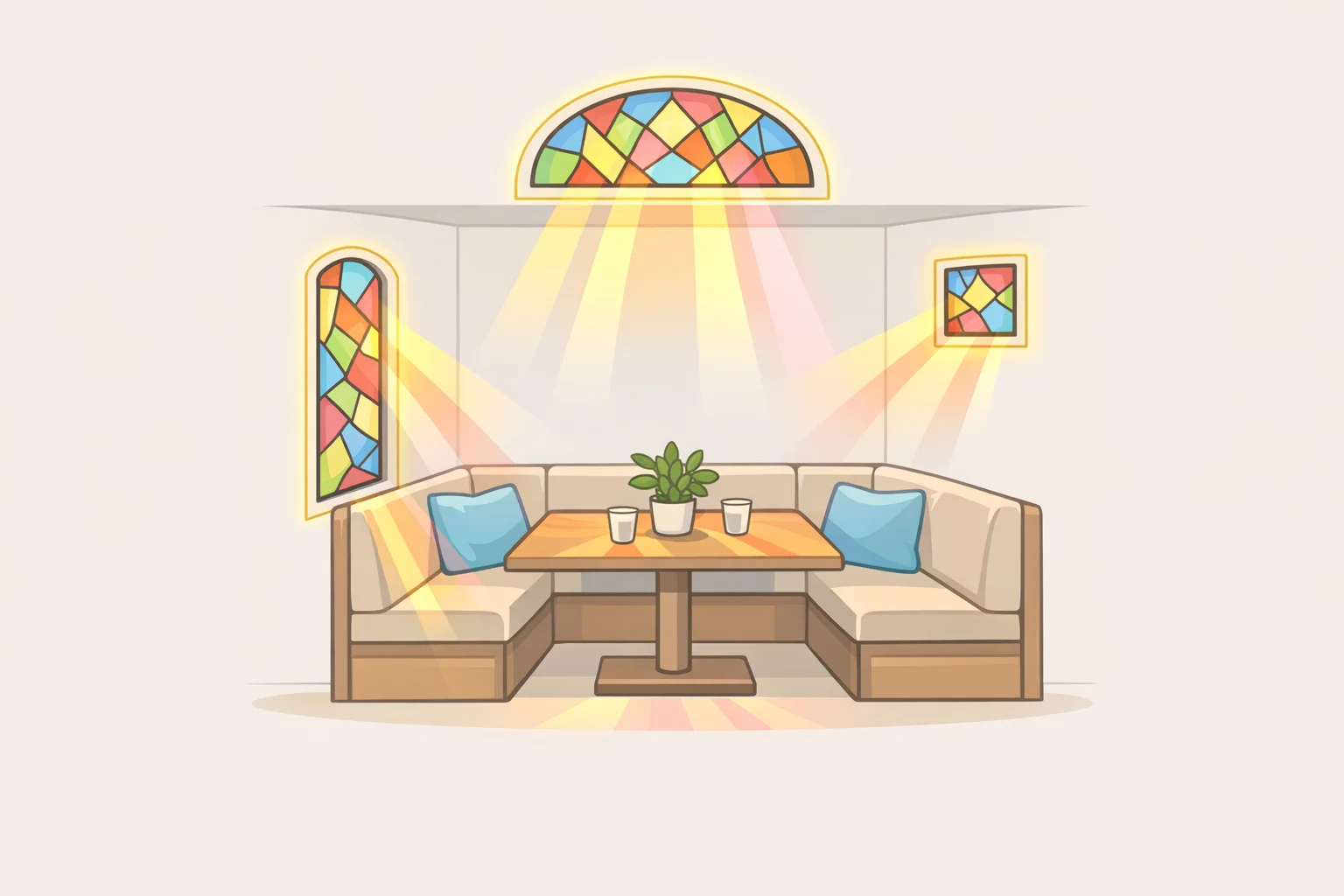
Before selecting a method or spending anything, get specific about your nook's geometry and light. Stained glass requires transmitted light to perform. Without a light source behind or beside the panel, the color effect disappears entirely. That single constraint determines which approach is viable and where it belongs in the room.
Assess your opening with four questions:
- Is there an existing window? This is optimal. An existing frame already admits light, and both custom and reclaimed panels can be sized to fit standard openings. Maximum color effect, minimum structural work.
- Is there a skylight or overhead glazing? Film on plexiglass works particularly well here. Designer Erin Zubot used exactly this setup plexiglass sheets with vinyl stained-glass film to convert a plain skylight into a convincing leaded-glass effect, as documented on Erin Zubot Design in December 2024.
- Are there cabinet doors or an interior partition? Small reclaimed panels or film inserts can be fitted into cabinet glass panes for a stained-glass effect without touching the walls. Works well in nooks that connect directly to a kitchen.
- Are you working with a solid wall and no natural light source? This is the hardest case. A backlit frame with film can simulate the effect, but it reads as illuminated artwork rather than architectural glass. Consider a different placement before committing to a workaround.
| Your situation | Best route |
|---|---|
| Renter, no permanent changes | Film on plexiglass |
| Owner, existing window, limited budget | Reclaimed panel from salvage yard |
| Owner, existing window, long-term investment | Custom commission |
| Interior partition or cabinet insert | Film or small reclaimed panel |
| No natural light source at preferred location | Backlit film frame, or reconsider placement |
One underused application: an internal stained-glass window between two rooms borrows light from an adjacent corridor while keeping the view obscured. Designer Angus Buchanan installed one in a laundry room specifically because it brought in hall light "but it's not so transparent that you can see our dirty laundry through it," as he told House & Garden in early 2024. A nook that sits between the kitchen and a living area has the same opportunity: light in, sightline blocked.
Before you choose a route: four placement questions
Route selection usually starts with budget and ownership status. It should start with the room. Work through these questions before style enters the picture.
Is there a real light source to put the glass near? If yes, custom or reclaimed glass at an existing window will produce a strong color-throw effect. If no, the question isn't which type of glass to choose it's whether the placement makes sense at all. Film on a surface without transmitted light reads as a decorative decal.
Is privacy the main problem? Stained glass solves it without sacrificing daylight the way a curtain or blind would. The Buchanans' internal window is the clearest example of this logic: light in, view blocked. For a nook that feels exposed to a garden or kitchen sightline, prioritize a placement that intercepts it.
Is this installation a focal point or a supporting detail? A single exterior window in a small nook can carry custom or reclaimed glass as the room's main visual event, with everything else deferring to it. Cabinet inserts and internal partitions work better as accents they contribute texture and light filtering without demanding the eye's full attention. One placement done well is more effective than several smaller interventions competing with each other.
How much pattern complexity can the space handle? Small nooks amplify visual noise. Ornate traditional designs that read well in a large Victorian hallway overwhelm a tight eating corner at close range. McCloskey's guidance is direct: "more modern, fluid lines" keep stained glass from reading as period decoration, per House & Garden (early 2024). One or two colors, clean geometry, enough clear or lightly tinted glass to avoid blocking the room's light source entirely.
DIY dining nook refresh: choosing between film, reclaimed glass, and custom work
Each route delivers the stained-glass effect. They differ on five factors that matter for decision-making: permanence, installation complexity, budget, light requirements, and what happens when something goes wrong. Evaluate all five before committing.
Route A: custom commission
Best for permanent architectural openings a fixed dining nook window where the glass will live for decades. This is the appropriate choice when you want a one-off result and are prepared to pay for it.
A bespoke panel costs substantially more than standard glazing, reflecting what House & Garden describes as "an exceptional level of creativity and craftsmanship" (early 2024). Studios like Judson Studios, recently profiled by Architectural Digest for fueling the current art-glass revival, source hand-poured glass and handle all fabrication in-house. Professional installation is standard. Expect long lead times; the current wave of interest in art glass has only increased studio workloads.
On thermal performance: in one documented installation, a custom stained-glass panel backed with a plain glass pane performed "just as insulating as ordinary double glazing," per House & Garden (early 2024). That's one project, not a universal guarantee, but it suggests the energy concern that stops many homeowners from pursuing this route may be overstated when the installation is done properly.
The main pitfall is timing. Contact studios before finalizing your renovation timeline, not after.
Route B: reclaimed panel from a salvage yard
Best for nooks with existing openings where a found piece can be custom-framed, and for homeowners who want the character of real glass without commissioning new work.
This is also the route for renovation discoveries. When Reath Design renovated a Los Feliz home, they uncovered a pair of original stained-glass windows sealed behind a wall and restored them through Judson Studios rather than replacing them, as Architectural Digest reported last month. That reuse logic is more widely applicable than it sounds.
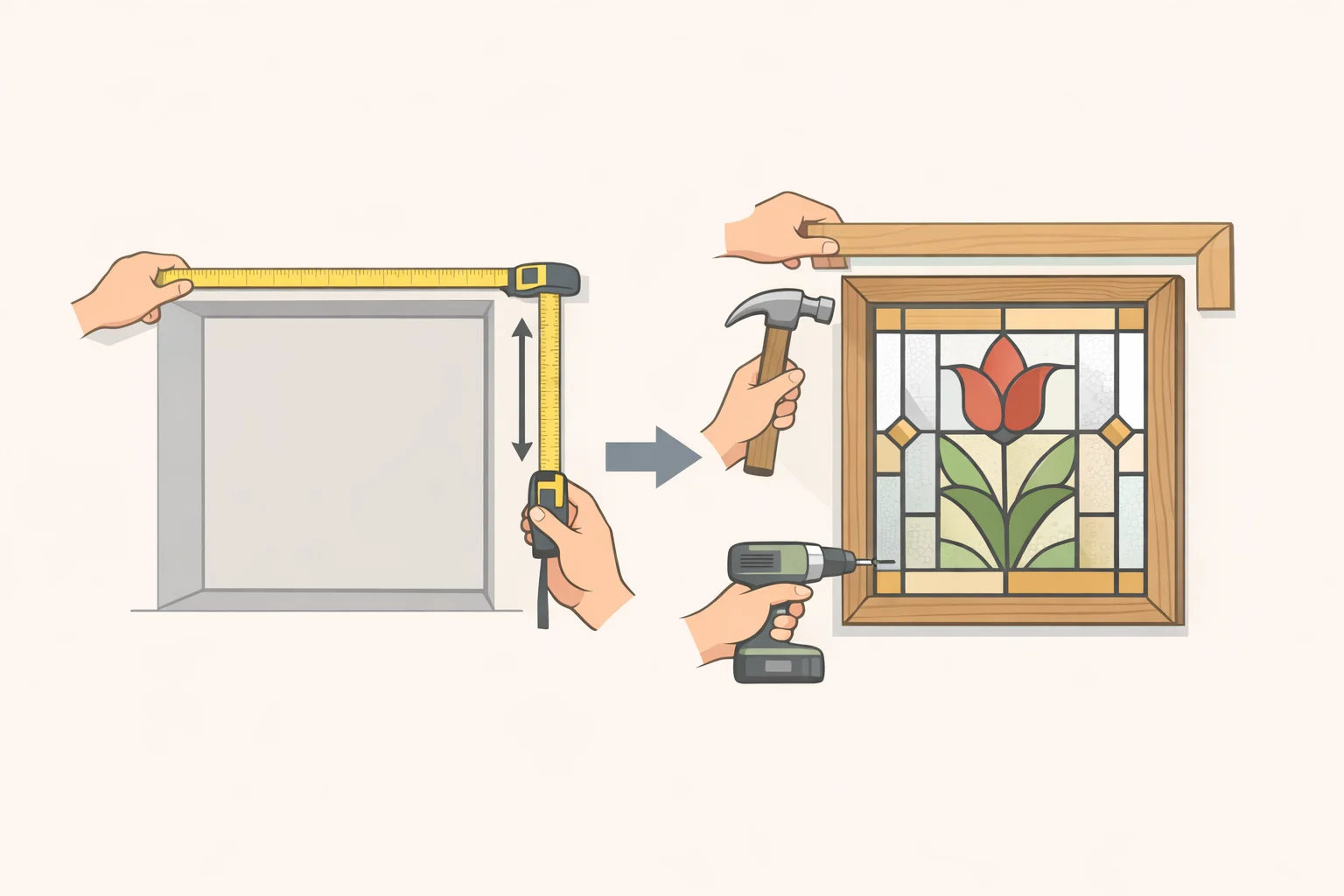
Cost and complexity are both unpredictable. Stained glass is "the sort of thing you'll find on a dusty shelf" at a reclamation yard, as Angus Buchanan put it to House & Garden in early 2024, and prices vary accordingly. A carpenter or glazier may need to build a custom frame to fit a found piece to your specific opening. Factor that in before you fall for a panel.
Measure your opening before shopping, not after. Inspect lead lines carefully before purchasing as well cracks are repairable but add cost and complexity that can erode the budget advantage over custom work.
Route C: DIY window film on plexiglass
Best for renters, cabinet inserts, interior partitions, and skylight panes, or any surface where reversibility matters and real glass isn't required.
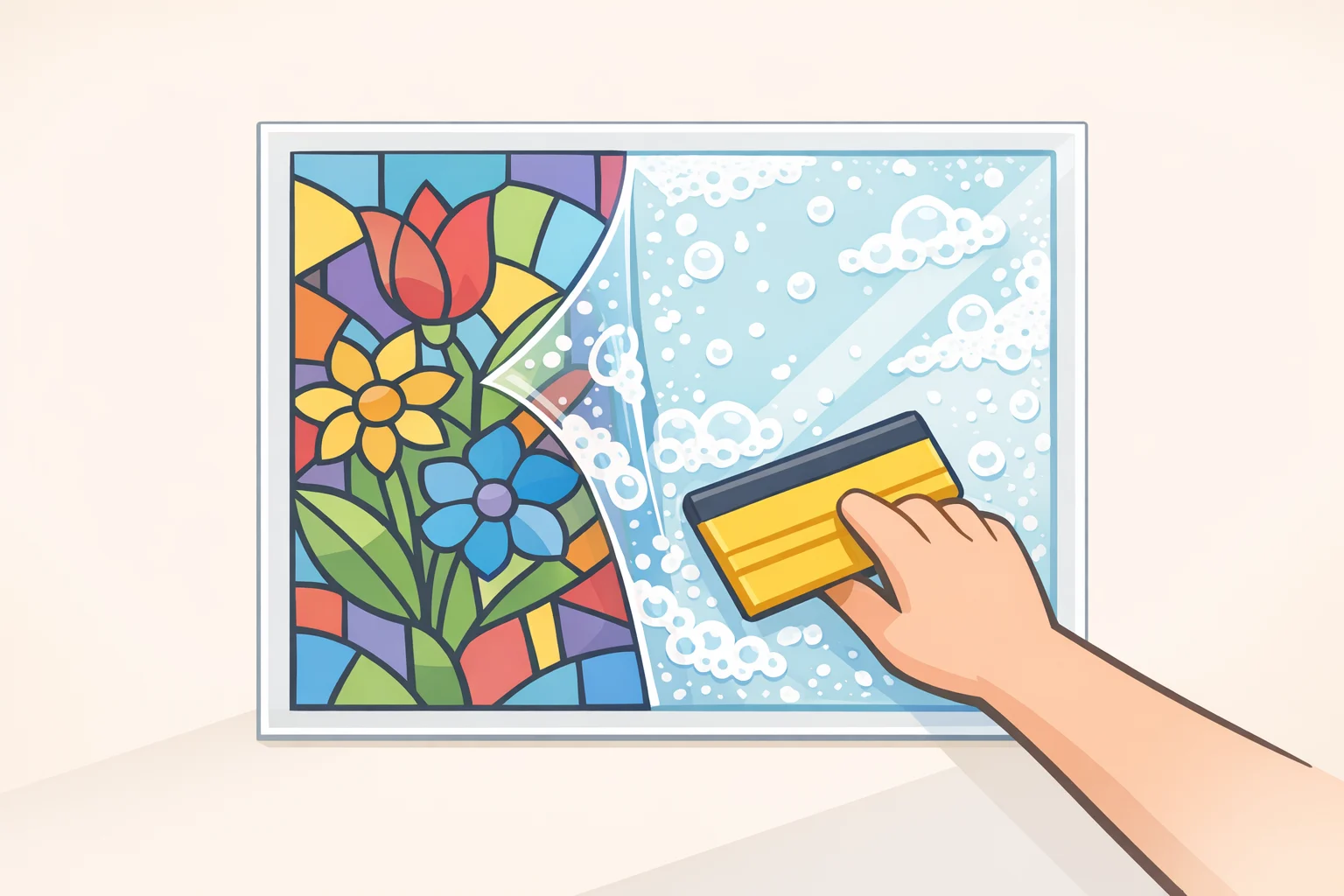
The full method is documented at Erin Zubot Design (December 2024): 2×4-foot plexiglass sheets sourced online for approximately $130 total, cut to fit panes in a frame built from 1×2-inch primed pine with brad nails and wood glue. The frame was clamped overnight, then lifted into place once solid. Film application runs three steps: spray the plexiglass with soapy water, apply the vinyl film, squeegee out the water. Total materials for a multi-pane installation came in well under $200.
Film is lower-durability than real glass prone to scratching, fading, and edge peel if not applied cleanly. The reversibility is also the point. Renters can remove it; owners can refresh it without calling a glazier.
Pattern selection matters more than people expect. Simpler, geometric patterns hold up better at close range and avoid reading as period decoration. McCloskey's guidance applies directly here: "more modern, fluid lines" keep stained glass from skewing Victorian, per House & Garden (early 2024).
One non-negotiable: confirm your surface has adequate transmitted light before purchasing anything. Test placement with a lamp before cutting.
The two supporting decisions that change how the glass reads
Once the route is chosen, two decisions determine whether the nook reads as genuinely transformed or merely decorated.
Color coordination between the glass and the room
Pull at least one tone from the stained glass and repeat it somewhere else in the nook the bench, the wall behind it, or the trim. This is what separates an installation that feels intentional from one that feels stuck to an otherwise unchanged room.
A Victorian-era door restoration documented by House & Garden (early 2024) made the surrounding paint do exactly this work: the chosen color "worked with both the red-brick exterior and the colours in the stained glass." One echo is enough. The glass carries the rest.
The same principle scales down to very modest budgets. A DIY nook build covered by Apartment Therapy in January 2025 is worth examining on this point: the builder painted her bench Farrow & Ball Duck Green and the wall behind it Farrow & Ball Pink Ground, landing a coherent color story in a tight corner for roughly £100 total (about $124 USD). The materials were inexpensive. The deliberateness of the color commitment was what made the transformation legible.
Seating positioned relative to the light source

Place bench seating so occupants sit within the colored light, not with their backs to it. This spatial decision turns a stained-glass window into a dining experience rather than a wall decoration.
A functional bench with concealed storage is worth building regardless of budget nook storage is consistently underused, and surface space in a small kitchen corner is already scarce. The same Apartment Therapy build (January 2025) used a wall-mounted support beam, paneling, and a hinged benchtop for hidden storage, completed as a first carpentry project. Both the seating geometry and the storage structure are worth replicating.
Placement first, style second
Decide where the glass goes before deciding what it looks like. A well-placed panel in a simple pattern will outperform a beautiful panel in the wrong spot every time.
Nail down your opening measurements and confirm the direction and strength of the light before selecting a route. That information makes the rest of the decisions straightforward the material, the pattern, the color echo in the room all follow from knowing exactly what you're working with.
The range is genuinely wide. Architectural Digest covered handmade residential glass going into permanent installations last month; Erin Zubot Design showed a credible leaded-glass look for under $200 in December 2024. What differs between those two outcomes isn't the quality of the result so much as how long it holds up. Measure first, then pick the route that fits your timeline.
Next steps by route:
- Film route: Confirm your surface has adequate transmitted light before purchasing anything. Source plexiglass first, choose a film pattern second.
- Reclaimed route: Arrive at salvage yards with your opening measurements. Budget separately for a glazier or carpenter to fit the found piece.
- Custom route: Contact studios before finalizing your renovation timeline. Lead times are long and the current interest in art glass is not shortening them.
Comments
Be the first, drop a comment!