



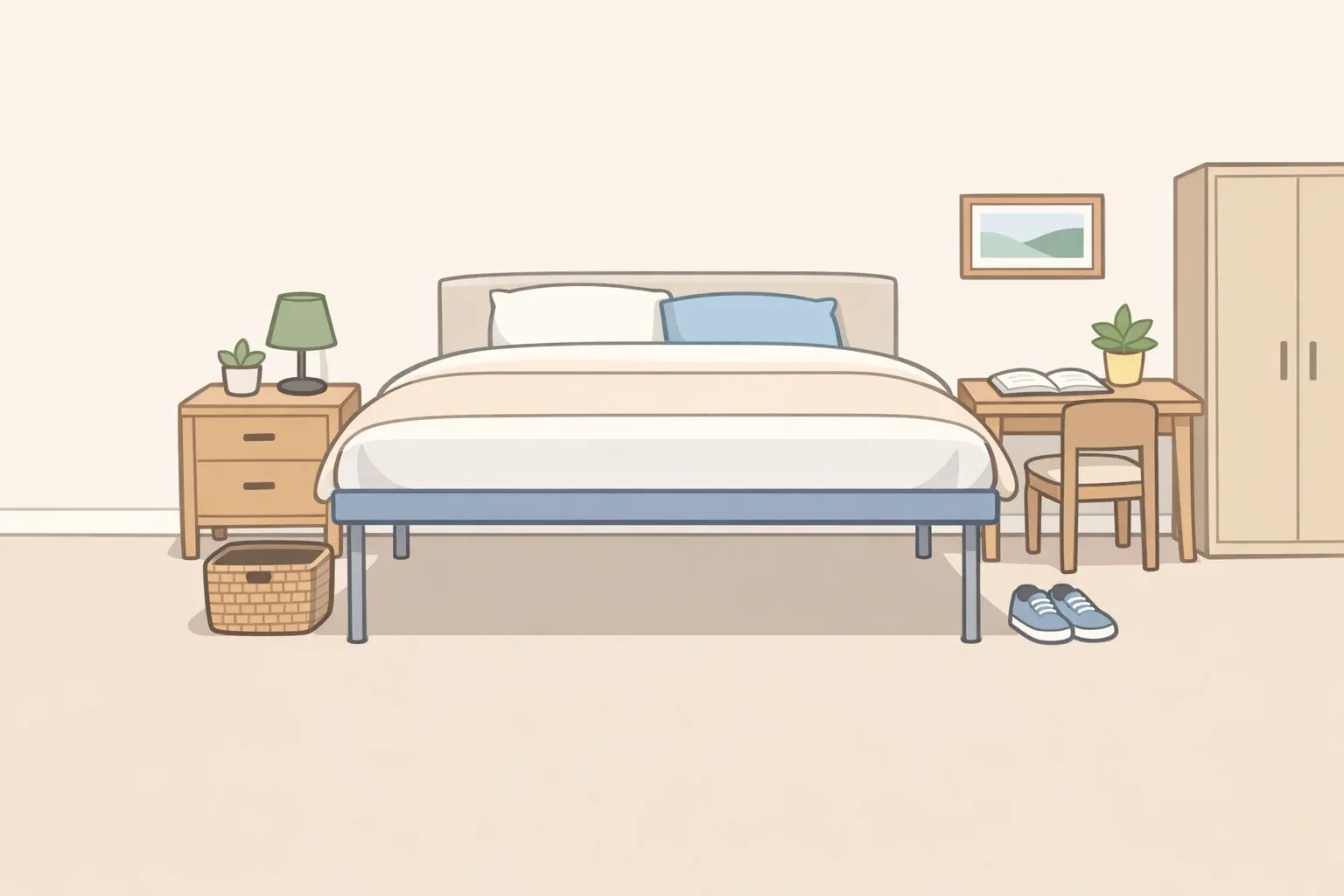
Crouch at your bedroom doorway and look at how much floor you can see beneath your furniture. If the answer is none, that's where this guide starts. Not with paint, not with a renovation. The fix is simpler: expose more floor, and the room's perceived size shifts with it.
Interior designer Lauren Saab describes the mechanism to The Spruce: raising a bed on slimmer legs with open space beneath "instantly doubles the visual floor area," and "that bit of negative space lets the room breathe and convinces the eye it's bigger and lighter."
Designer Bobby Berk independently calls platform beds and floor-hugging frames among the biggest offenders he sees in small bedrooms; they "eat visual space" by blocking the floor from view, Berk noted.
This guide covers practical decisions in priority order: bed frame first, supporting furniture second, surfaces and light third. No structural work required.
Step 1: Start with the bed clearance first, size second
Best bed for a small bedroom: choose legs, not a solid base
The bed sets the visual tone of the entire room. Not the mattress. The frame, and specifically how it meets the floor.
A frame with visible legs and clear space underneath reads as open. A solid-base platform bed, a storage bed with a full-perimeter base, or any frame with a dust ruffle reads as a block. Saab is plain about it: "Forget bulky platform beds and dust-ruffled frames" — the negative space beneath a raised frame is what allows the eye to read the room as larger and lighter.
Fatima Silva, principal of FDG Design Group, makes a distinction worth keeping in mind in Architectural Digest: low-profile furniture with a slim silhouette enhances negative space. The key phrase is "low visual bulk," which is not the same as "low floor clearance." A sleek frame on tapered legs has low visual bulk with high clearance. A platform base has neither.
A good small-bedroom bed is both: modest headboard, tapered or angled legs, open base. A bad one is either a towering upholstered frame that dominates the wall or a floor-level slab that seals off the floor entirely. Different problems, same result.
Once the frame type is settled, consider the mattress scale. Saab identifies the upgrade instinct as a consistent mistake: "A king size may feel like a luxury, but if it eats the entire footprint, the room closes in," and "scaling down to a queen or full can free up walking space and instantly make the bedroom feel bigger and less claustrophobic." Berk's rule is practical: pick the largest piece you actually need, then scale everything else around it with breathing room, Berk noted.
Gotcha: Don't let storage needs push you back toward a platform base. A sealed base solves storage while eliminating the spatial benefit entirely. The under-bed clearance you're trying to create is the point at which trading it away defeats the exercise. If storage is the need, low-profile rolling bins that slide out preserve the clearance while keeping things off the floor.
Action: Before replacing anything, slide out whatever is stored under the bed and look at the gap. If the frame sits flush to the floor, that's the first thing to fix.
Step 2: Edit every other piece of furniture on the same principle
How to make a bedroom look bigger with furniture
Jennifer Jones, principal designer at Niche Interiors, describes a thoughtfully edited layout with minimal pieces as the most accessible route to an instantly larger-feeling bedroom. The operative word is edited, not minimized. The goal is fewer visual stops, not fewer possessions.
Saab applies the visible-floor standard to nightstands specifically: "Bulky nightstands drag a small bedroom down, while slim wall-mounted shelves keep the floor clear," and "even a few inches of visible flooring instantly makes the room feel bigger, brighter, and more open." Berk's test for every object is binary: it's either earning its place or stealing space, Berk noted.
Space-saving bedroom furniture decisions, in priority order:
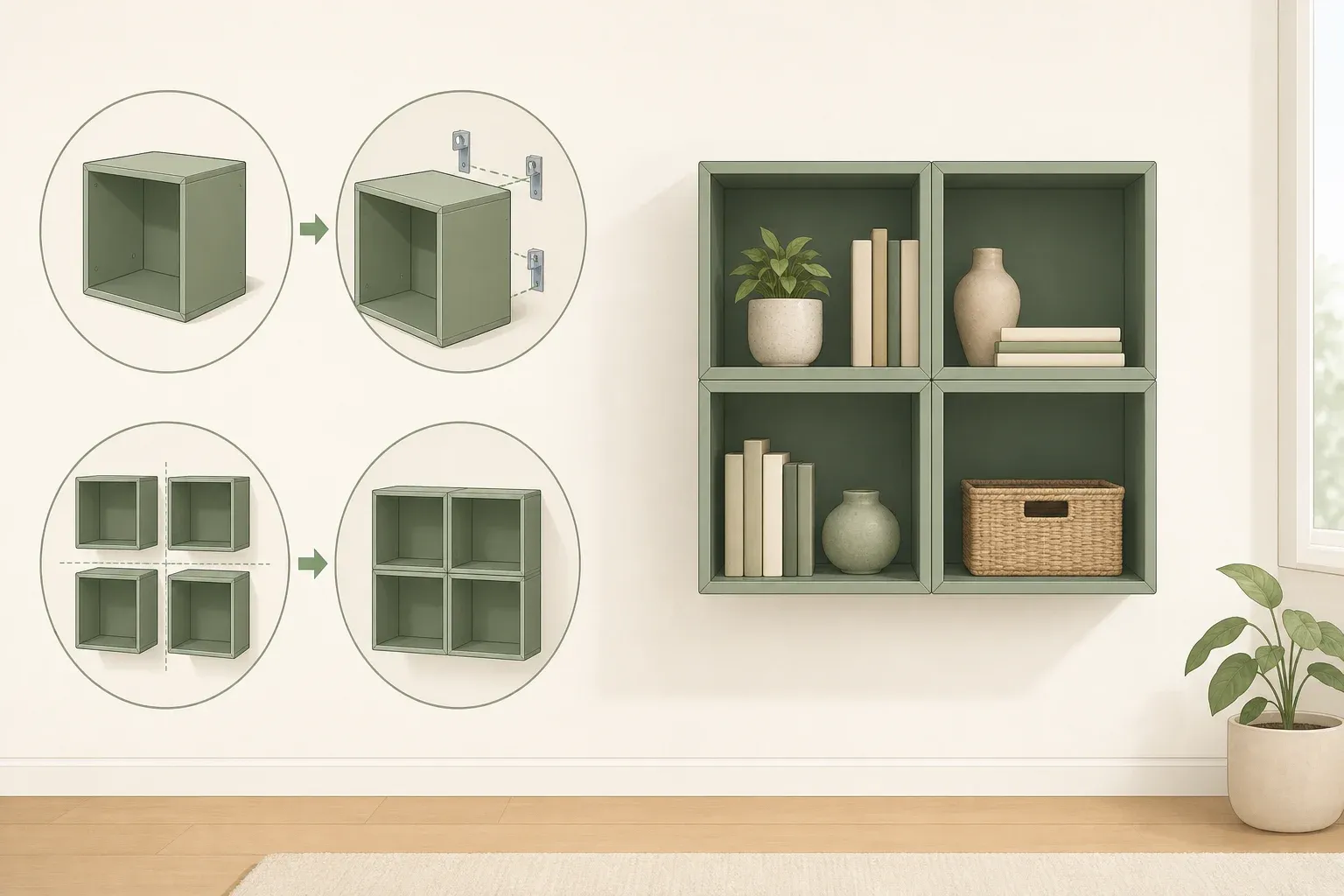
Nightstands: Replace floor-standing units with wall-mounted shelves or narrow-legged floating alternatives. If a nightstand must sit on the floor, choose one with four slim tapered legs rather than a solid base or apron.
Dresser: Ask whether it belongs in the bedroom at all. It's often the largest floor-blocking piece after the bed. Relocating it to a closet or hallway removes a significant visual mass. If it has to stay, placement matters more on that below.
Additional seating or storage: A chair, bench, or storage ottoman at the foot of the bed adds appeal but also adds floor coverage. If it stays, it needs legs. Not a skirted base, not a solid slab.
Bedding: "Overstuffing the bed with layers and pillows makes the whole room feel heavier," Saab cautions, and "mountains of cushions and bulky duvets swallow square footage and turn the bed into a barricade instead of a retreat." Stick to crisp bedding with two or three well-chosen pillows so the bed reads as open and proportionate.
Berk warns against the opposite error: miniaturizing every piece. A room where everything is deliberately undersized reads as a dollhouse, not a spacious room. One or two pieces at proper scale anchor the space; the goal is strategic clearance, not universal downsizing.
Small bedroom layout ideas: think in paths, not just pieces
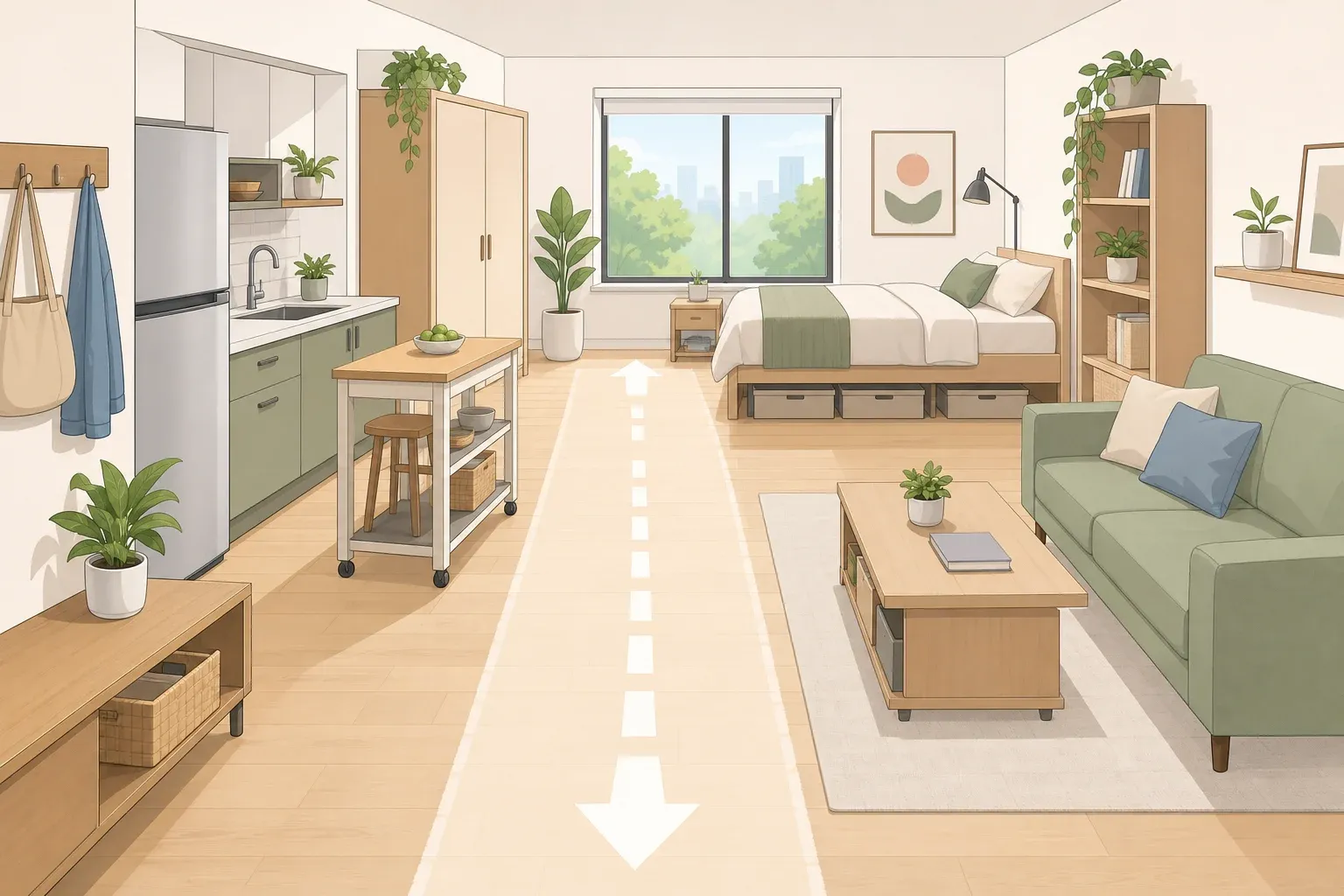
Furniture profile matters, but so does how pieces relate to each other in the room. The clearest test is walking clearance: you should be able to move from the door to each side of the bed without turning sideways. If you can't, the layout is working against you regardless of what the legs look like.
The foot of the bed controls the room's most important sightline, the one you read from the doorway. A bench or ottoman there can work visually, but it interrupts the longest uninterrupted view in the room, which is also what gives the space its sense of depth. When in doubt, leave that wall clear.
For the dresser: if it stays in the bedroom, place it on the wall perpendicular to the bed rather than directly opposite. A dresser facing the foot of the bed stops the eye at the room's most prominent view. Move it to the side wall, and it shifts to the periphery, where it reads as part of the room rather than its endpoint. That's a real difference even when nothing else changes.
Step 3: Reinforce the effect with surface continuity and light
These surface changes build on what the furniture arrangement has already established. None of them substitute for clearing the floor, but once the floor is clear, they extend the effect to every surface in the room.
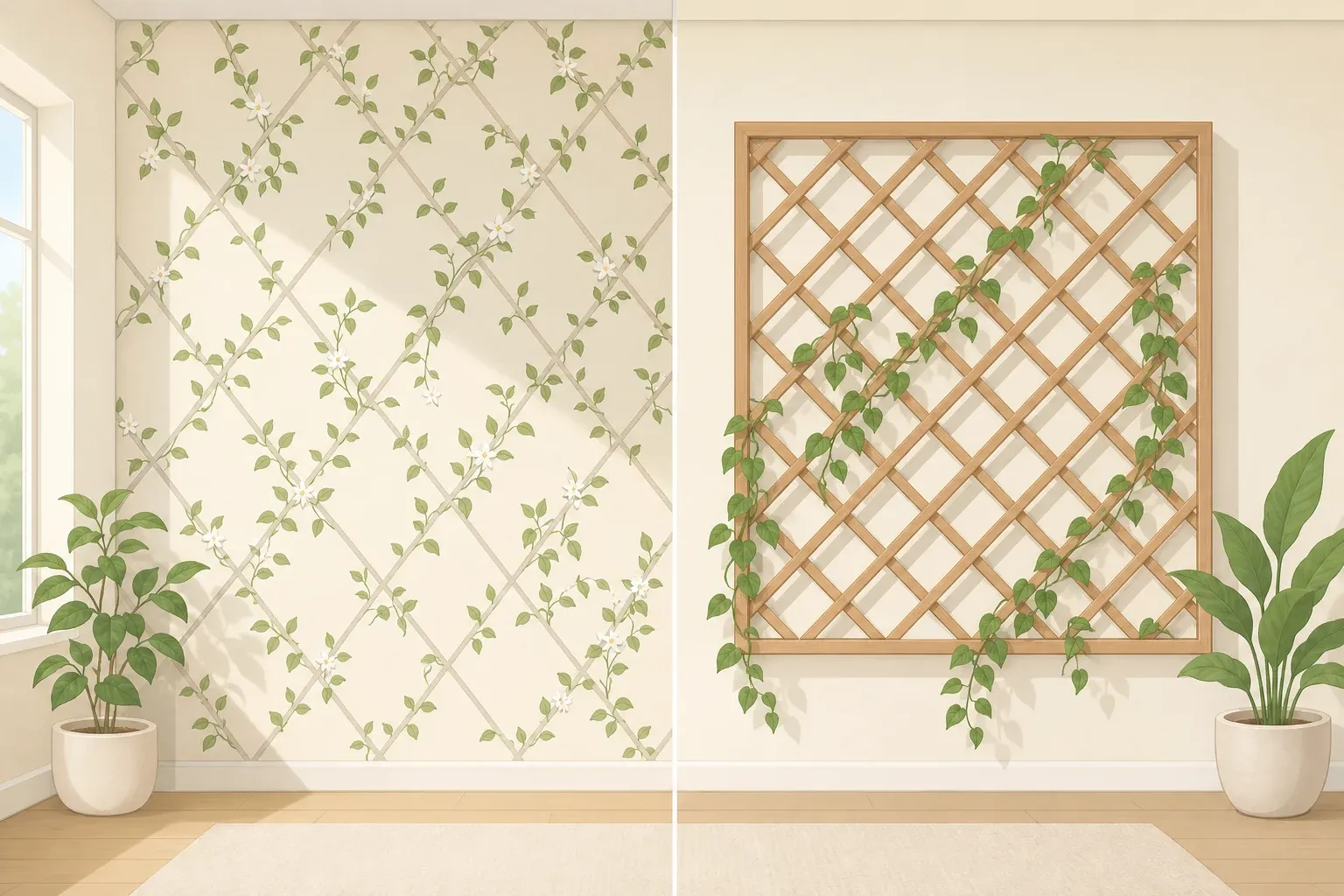
The same logic that governs furniture applies to walls and ceilings: when the eye encounters fewer stopping points between surfaces, the room reads as more continuous. Jones puts it directly: "A room with minimal contrast feels much more expansive since there are no stopping points for your eye to register between walls and ceilings."
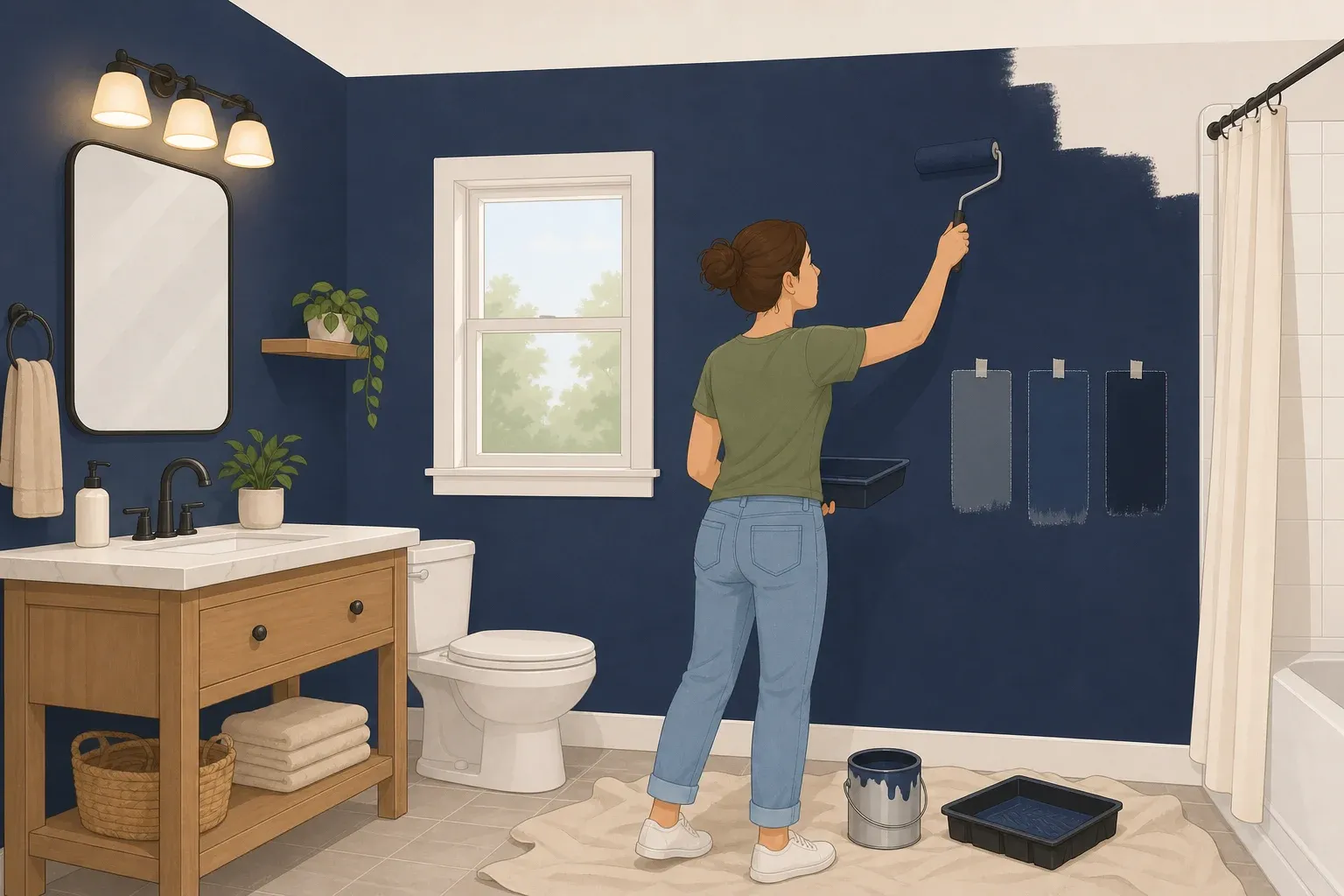
Designer Natasha Willauer recommends running a single color across all surfaces — walls, ceiling, and trim, particularly in rooms with sloped or peaked ceilings, where color breaks typically emphasize the constraint rather than dissolve it.
Saab advises tone-on-tone layering across all textiles, bedding, rugs, and upholstery so the room reads as a unified whole rather than a collection of objects, The Spruce noted. Research on spatial perception supports the broader principle: a 2024 study in Frontiers in Psychology found that rooms with natural and textured materials were rated significantly more spacious than those with hard concrete surfaces (mean scores 4.46 vs. 3.46, p = 0.004), suggesting that tactile warmth contributes to perceived openness beyond color value alone, the study found. The study used simulated environments with 35 participants, so treat those numbers as directional rather than definitive.
On lighting: "A single overhead light is the fastest way to make any room feel flat and small," Berk noted. Replace it with layered sources: ambient ceiling light, sconces or a reading lamp at bed height, and optional accent lighting inside a closet or along a shelf. Multiple sources create depth and draw the eye to different parts of the room. The same Frontiers study found larger windows correlated with significantly higher spaciousness ratings, with mean scores rising from 4.86 with no opening to 5.66 with full glazing, a reminder that light volume and perceived space move together, the study showed. For bulb choice, Berk specifies warm-toned 2700K bulbs, which read as more expansive and inviting than the cool-white defaults most rooms carry.
On mirrors: A large mirror placed across from a window bounces natural light deep into the room and essentially doubles its visual depth. No window to reflect? A full-length mirror leaned against a wall creates a sense of architectural depth in its own right. One mirrored statement surface per room is the limit; more than one tips the room toward instability rather than openness, per the same guidance. Saab adds that catching a reflection right at the doorway "stretches the entry and makes the whole room feel bigger from the start," which makes mirror placement a decision worth thinking through before you hang anything.
Lowest-cost move: If repainting isn't on the agenda right now, paint just the ceiling the same color as the walls. It removes the room's most prominent visual boundary. Consistently underestimated.
The order of operations
Lifted furniture, clear floor lines, continuous surface tones, and well-distributed light aren't separate tricks. They're expressions of the same idea: reduce what stops the eye, and the room reads as larger.
Berk frames the underlying philosophy plainly: making a small bedroom look bigger "isn't about illusions" but about designing with intention. Saab adds the affirmative case: "larger bedrooms often slip into chaos, while a smaller one done right becomes a sanctuary where nothing feels wasted, and everything feels considered."
For readers acting in stages:
First: Replace or raise the bed frame, the single highest-impact change for visible floor area.
Second: Swap floor-standing nightstands for wall-mounted alternatives.
Third: Relocate or reposition the dresser if it dominates a sightline.
Fourth: Unify the color palette across walls, ceiling, and textiles.
Fifth: Layer the lighting and add one large mirror opposite a light source.
Start with the furniture. Then stand at the doorway again. If the floor reads as more open than before, you'll have a clear sense of which remaining steps are worth the time and money and which ones can wait.



Comments
Be the first, drop a comment!