



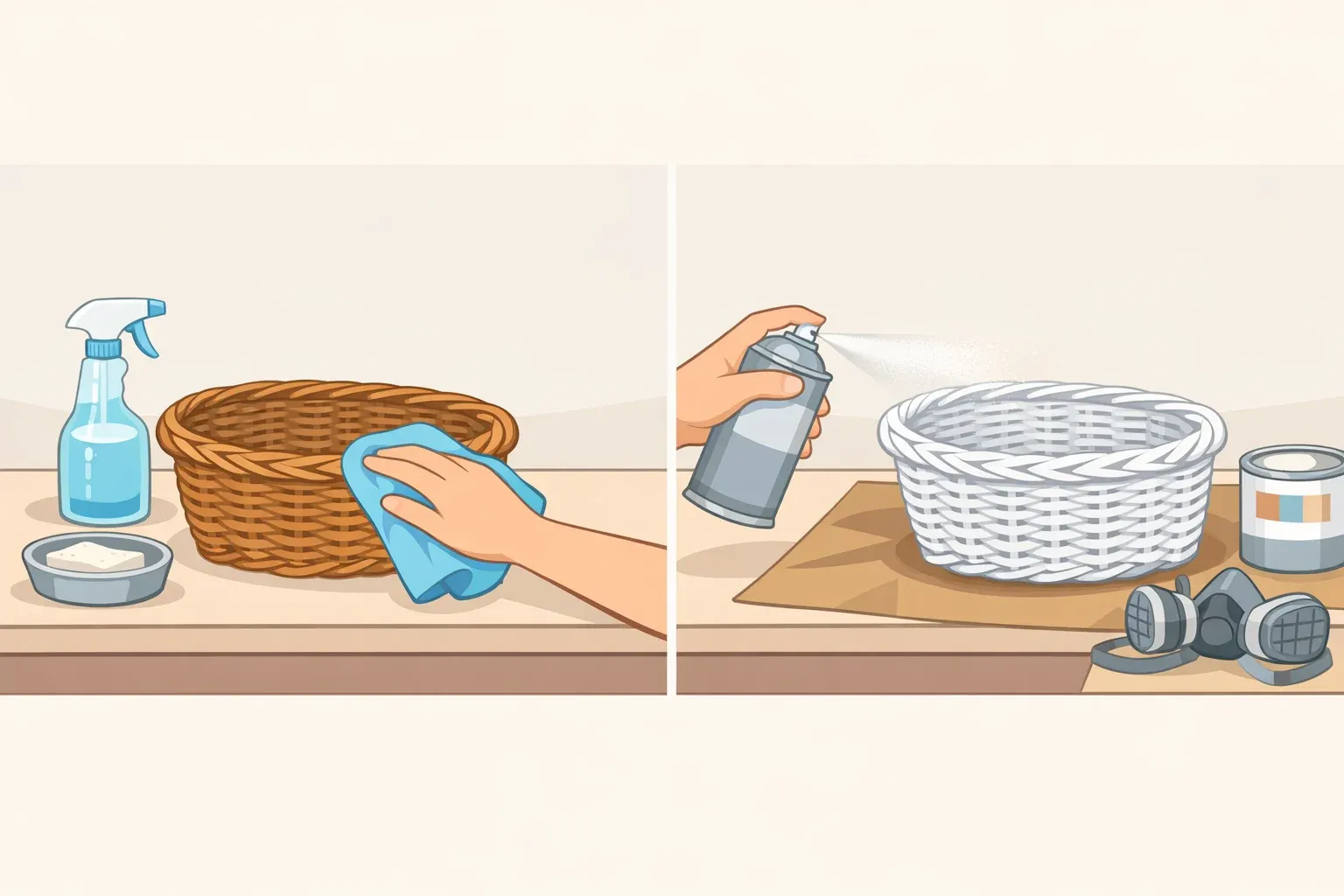
A structurally sound thrift store basket, properly cleaned and finished in a matte neutral, can sit on a shelf next to things that cost ten times more and hold its own. This guide walks through selecting, cleaning, repairing, and painting a thrifted wicker basket from start to finish. The hands-on work spans a few hours across two days. The full timeline is closer to a week, because prep and cure time aren't optional.
Here's what to know before committing:
Basket cost: $3 to $13 at most thrift stores and yard sales
Materials: One to two cans of matte spray paint, wood glue, dish soap typically under $15 additional
Hands-on time: A few hours, spread across two days
Wait time: 24–48 hours after washing (mandatory), plus 3–5 days to cure after painting before the basket goes into use
Wicker ages unevenly. The weave stays structurally sound long after the finish has gone dull, yellowed, or chalky. A basket with good bones and proper prep reads as intentional. Skipping prep is what produces the craft-project result.
What you'll need before starting: pruning shears or a sharp utility knife (if removing handles), an old toothbrush and soft-bristled brush, mild dish soap, wood glue, paper clips, and matte spray paint. A well-ventilated space, ideally outdoors, is essential for painting.
Step 1: Find a basket worth buying and know when to walk away
The project starts at the thrift store, and the decision made here determines everything. A basket that looks rough may be a perfect candidate; one that looks passable might not be.
What to look for:
Squeeze the sides and base firmly. A structurally sound basket holds its shape under pressure. Dramatic flex, crumbling, or soft spots signal weave degradation that no cosmetic makeover can fix.
Inspect the weave closely. Loose or frayed individual strands are repairable: soak the affected area in warm water for 15–20 minutes to restore pliability, then re-weave the strand back into place. Missing sections, collapsed walls, or large gaps are a different project entirely.
Check the handles last. If you plan to remove them, their condition doesn't affect the buying decision. If handles are awkward or broken, trimming them off converts the basket into clean, shelf-ready open storage.
Identify the material before leaving the store. "Wicker" describes a weaving method, not a specific material. It can be woven from natural rattan, willow, or bamboo, or from synthetic resin fibers designed to mimic the look. Natural and synthetic wicker need different prep and take paint differently, so knowing which one you have is the first real decision in the project. Natural rattan has visible fiber variation and behaves more like wood; synthetic resin is smoother, more uniform, and has a faint plastic quality when you press it.
The skip-it threshold: If the basket flexes dramatically, has large structural failures, or would require re-weaving to be functional, set it back on the shelf. Replacement wicker cane runs roughly $5–$30 per roll, and the time investment quickly outpaces the value of a $6 basket. This guide covers cosmetic makeovers, not rebuilds.
Step 2: Remove the handle (if applicable) and make minor repairs
Handle removal is optional. Skip this step entirely if your basket doesn't have handles or you want to keep them. For handled baskets being converted to shelf storage:
Locate where each handle reed meets the basket body. On most wicker baskets, handle reeds are tucked into the weave or wrapped at the attachment point.
Cut the reeds as close to the base as possible. Pruning shears are the cleanest tool for this job; a sharp utility knife works as a backup. Experts recommend the pruner specifically; a dull blade will split surrounding weave rather than cut cleanly through it.
Run your fingers over the cut points and note any protruding reed ends. Those get addressed in the repair stage below.
Gotcha: Don't pry or pull handles free. That risks tearing the weave at the attachment point and creating a larger repair than you started with.
Minor repairs (do these after handle removal, before washing):
Protruding or broken reeds: Apply a small amount of wood glue, press the reed back into place, and clamp it with a paper clip until dry. Wood glue dries transparent, so thin applications disappear under paint. Keep dabs thin; a thick application can take up to two days to cure.
Loose or frayed strands: Soak only the affected area in warm water for 15–20 minutes to restore pliability, then re-weave or tuck the strand back into place. Let it dry completely before moving on.
Allow all repairs to cure fully before washing.
Step 3: Clean and dry the make-or-break stage
Painting over residual dust, oils, or moisture produces bubbling and poor adhesion. The problems can look fine for a week, then peel. Both steps below are required, and the drying window isn't negotiable.
Vacuum first. Use a soft brush attachment across the entire basket, working into the gaps in the weave rather than just across the surface. This removes loose debris that soapy water will otherwise push deeper into the structure.
Scrub with warm soapy water. Use a soft-bristled brush for the main surface and an old toothbrush for tight weave gaps. Get into every crevice; surface-wiping alone leaves residue behind. Rinse thoroughly.
Wait 24 to 48 hours before touching the basket again. Moisture trapped inside a tight woven structure evaporates far more slowly than it appears from the outside, especially in natural rattan. Skipping ahead is one of the most common causes of bubbling on this specific project.
Set the basket in a dry room with good airflow, ideally near a vent. Skip the heat gun; uneven heat can warp natural reed.
Step 4: How to paint a wicker basket for storage
Color and finish are what make a budget basket read as intentional rather than improvised. The choices are simpler than they look.
For natural wicker: Warm white and soft cream have remained the most popular choices for painted wicker through 2026, valued for how well they brighten a space without going stark and for how forgiving they are of the texture variation that natural fiber inherently shows. A single thin coat of matte white over natural honey-toned reed shifts the color toward a cooler neutral without fully obscuring the weave texture. That tends to read as more refined than a thick, opaque application. Matte finish is the right call for this material; satin or gloss amplifies surface imperfections.
For synthetic resin wicker: The smoother, more uniform surface holds saturated colors more evenly than natural fiber, making it a better candidate for charcoal, deep navy, or black, per Spray Painter Guide. Check whether the paint manufacturer recommends primer for synthetic surfaces; on resin wicker, it may be necessary for adhesion.
Natural vs. synthetic at the store: If you're unsure which material you have, run a fingernail along an inconspicuous reed. Natural rattan will show a slight fiber catch; synthetic resin stays smooth and consistent. The distinction matters because synthetic wicker may need primer where natural wicker generally doesn't.
Application:
Work outdoors or in a well-ventilated space. Spray fumes accumulate quickly in enclosed areas.
Hold the can 10–12 inches from the surface. Closer causes drips; farther causes dry-spray texture.
Apply 3–5 thin, overlapping passes. Woven structures demand coverage from multiple angles, significantly more than you'd use on a flat panel. Thin coats prevent paint from pooling in the weave gaps.
Rotate the basket between passes to reach the underside of each reed. An upturned bucket or lazy Susan makes this easier.
Let each pass become touch-dry, typically 20–30 minutes, before applying the next.
After final coverage, leave the basket completely undisturbed for 3 to 5 days. Woven structures hold solvent vapor longer than flat surfaces do, and pressing weight onto a still-soft finish leaves permanent indentations.
On a topcoat: For indoor baskets handled lightly, a clear coat isn't necessary. For anything used regularly in a high-humidity space like a bathroom or laundry room, a clear topcoat adds meaningful durability.
Thrifted basket storage ideas: where each configuration works best
A basket that has been properly cleaned, repaired, and painted in a matte neutral is already doing most of the decorative work. Placement closes the loop.
Shelf storage: Handle-free baskets sit flush and look purpose-built. Two or three in the same color and different sizes, grouped on a shelf, look collected rather than thrifted.
Bedroom floor storage: A larger basket with a folded woven blanket draped over the rim functions as both a blanket holder and a textural accent.
Laundry room and entryway: On open shelving, painted baskets do the same organizational work as store-bought bins without the visual uniformity of mass-produced plastic. Thrift-store finds, baskets included, contributed to a full laundry room overhaul completed for roughly $300 total.
Wrap-up
Four steps: find a structurally sound basket, clean it thoroughly, wait out the full drying window, finish it in matte. The weave texture and neutral tone do the visual work; the prep sequence is what lets them.
The same logic transfers directly to trays, small crates, and other natural-material thrift finds. Once the sequence is clear, the thrift store starts looking less like a gamble and more like a materials run.














Comments
Be the first, drop a comment!