



Most kitchen renovations start in the wrong place. Cabinet finishes, island shapes, and hardware trends — these are the last decisions a professional makes, not the first. A designer's first question is: how does this household move through this space?
That shift in starting point is what separates a kitchen that photographs well from one that works well every day. These nine kitchen design rules cover how to plan your zones, choose the right layout, protect critical clearances, and store things where you'll actually use them. Follow them in order, and you'll be thinking the way a designer thinks: workflow first, fit second, safety and longevity built in from the start.
Before reading further: Measure your kitchen's overall footprint, note how many people regularly cook at the same time, and mark where the main entry traffic flows. Several of these rules require that information before you can apply them.
A few things worth knowing up front:
The kitchen work triangle connecting sink, refrigerator, and cooktop was developed in the 1940s as a single-cook efficiency model. It remains useful in some configurations, but was never designed for open-plan layouts or multi-cook households.
Professional standards have shifted toward zone planning, which groups storage and surfaces by task sequence rather than by appliance position, with measurable clearances that determine whether a kitchen is genuinely usable.
The 2023 revision of NKBA's Planning Guidelines added dedicated sections on mechanical systems, interior environment, and inclusive design — a signal that professional kitchen design now covers the full lifecycle of a space, not just its appearance at installation.
Kitchen design rules 1–2: map your zones before you place anything
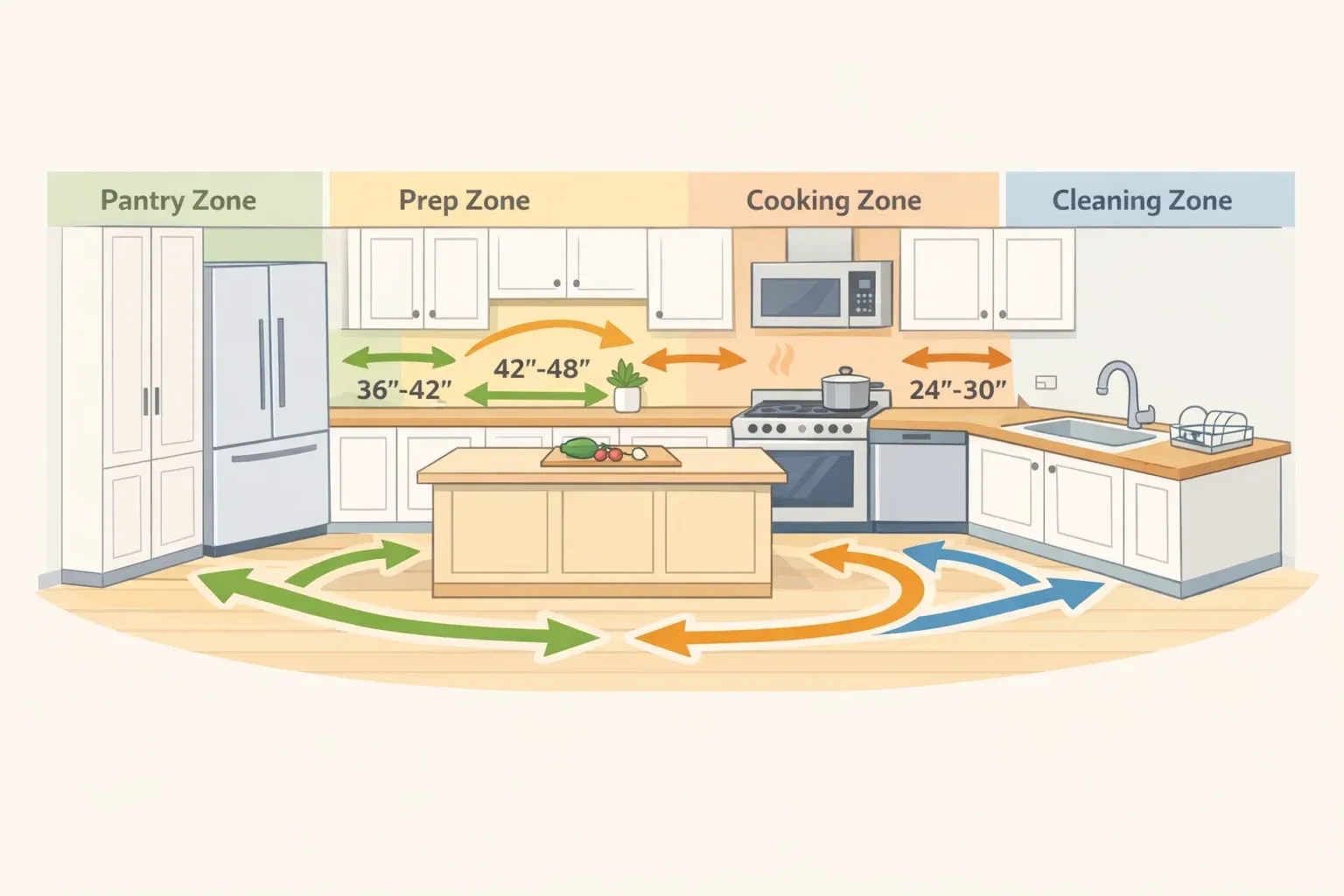
Zone-based planning answers a question the triangle can't: what happens when two people are cooking? Zones group tools, surfaces, and storage by task sequence, so each cook can operate without cutting through another person's workspace.
Rule 1: Sketch five task zones before opening a single cabinet catalog.
The five zones every functional kitchen requires:
Consumables: Pantry, refrigerator, dry goods positioned closest to the entry door so groceries don't travel across the kitchen to be stored
Non-consumables: Dishes, glassware, serving pieces placed adjacent to the dishwasher so unloading is a pivot, not a walk
Cleaning: Sink, dishwasher, trash, recycling — the operational center of daily workflow
Preparation: Continuous counter space between the sink and cooktop — the longer the uninterrupted run, the better
Cooking: Range or cooktop, hood, and the oils, pans, and spices used at the stove
Once zones are mapped, the work triangle often falls into place on its own. Practitioners who use this approach sketch zones first and let the triangle emerge from those decisions, rather than forcing appliance placement to satisfy a 1940s efficiency model.
Rule 2: Plan a one-direction food flow: prep → wash → cook, no backtracking.
Directional zone sequencing has a food safety dimension, not just an efficiency one. Research examining kitchen layouts and hygiene practices found associations between longer sink-to-countertop distances and increased cross-contamination risk, and proposed keeping the wash zone tightly integrated with the prep zone. Zone planning formalizes that principle: raw ingredients move in one direction through the kitchen, never crossing back over prep surfaces.
When the triangle still applies: In kitchens under roughly 100 square feet, or in single-wall and galley configurations, zone planning adds complexity without adding value. NKBA's triangle guidance total travel distance no more than 26 feet, each leg between 4 and 9 feet, no major traffic path crossing through, is the right framework for compact single-cook spaces. Match the planning model to the room.
Accessibility checkpoint: If anyone in the household uses a mobility aid or may in the future, confirm during zone mapping that traffic paths are clear and that the cleaning zone has enough floor space for a parallel approach to the sink. Knee clearance at the sink and a minimum 60-inch turning radius in U-shaped configurations are NKBA access standards worth building in from the start.
Rules 3–4: choose the layout that fits the room, not the one that's trending
Five layouts cover nearly all residential kitchens. Designers choose among them based on footprint, traffic patterns, and how many people cook, not on what appears in renovation magazines. Here's what each requires and what it delivers:
Galley: Best for narrow rooms, single-cook households, and maximum efficiency per square foot. Works in almost any kitchen width, but the aisle should be 42–48 inches wide.
L-shape: Best for open-plan spaces and homeowners who want flexibility to add an island later. Space requirements vary by room size and layout.
U-shape: Best for dedicated kitchen rooms that need maximum storage and counter space. A 10×10-foot room is usually the minimum for this layout to feel comfortable.
G-shape / peninsula: Best for homes that need bar seating or extra prep space without room for a freestanding island. Space requirements are similar to a U-shaped kitchen.
Island / open layout: Best for new construction, full gut remodels, and multi-cook households. The room should be at least 12 feet wide to allow enough clearance around the island.
Rule 3: If the room is under 12 feet wide, use a peninsula instead of a freestanding island.
This is the layout decision most DIY renovators get wrong. A peninsula attached to the L can recover roughly four feet of usable floor space compared with a freestanding island, and it eliminates the aisle compression problem that turns an island from a prep asset into a daily bottleneck. Same function, better fit for the room.
Three questions to ask before committing to a layout:
Is the room under 12 feet wide? Skip the island.
Do two or more people cook at the same time regularly? The layout must create parallel, non-crossing work paths.
Does traffic pass through the kitchen to reach other rooms? The layout must route that traffic around the work zones, not through them.
Rule 4: Give an island one function. Measure aisles before ordering.
Islands that try to serve as prep surface, cleanup sink, cooktop, and seating area simultaneously don't do any of those things well. Assign one primary function prep, cleanup, or seating and build the island around that.
For sizing: a 4-foot island is the minimum useful prep length; 6 feet adds seating for two; 8 feet handles seating for three or four with a usable prep zone alongside. For aisles around the island: NKBA requires at least 42 inches for one cook and 48 inches for multiple cooks, measured from counter frontage or appliance face to the island edge, and at least 36 inches for any walkway in the kitchen. For U-shaped kitchens specifically, plan a minimum of 60 inches between opposing counter runs to meet access standards. Measure with a tape before finalizing the plan. These numbers are non-negotiable.
Rules 5–7: Protect your clearances and landing zones
Clearances and landing zones are where layout decisions become physical consequences. A missing 15-inch landing beside the cooktop means carrying a hot pan across the kitchen. A dishwasher positioned too far from the sink means walking with wet dishes every single day.
Rule 5: Every appliance gets a landing zone. Confirm it before the layout is finalized.
NKBA specifies the minimum landing areas required beside each major appliance:
Refrigerator: 15 inches on the handle side (or 15 inches on either side of a side-by-side)
Cooktop: 12 inches on one side, 15 inches on the other, at the same counter height as the cooking surface
Primary sink: 24 inches on one side, 18 inches on the other
Oven: 15 inches immediately adjacent or within 48 inches across a walkway
Microwave: 15 inches above, below, or adjacent to the handle side
Landing zones tend to be the first thing cut when space gets tight. Don't let that happen at the cooktop. Based on practitioner observation, burn and spill incidents tend to drop when landing spaces flank the hob — a transfer point that doesn't require twisting or crossing an aisle is simply safer to use.
For prep specifically, NKBA recommends a continuous counter section at least 36 inches wide immediately beside the sink as the primary work area. This is distinct from the sink landing requirement and represents the minimum functional prep run in any kitchen.
Rule 6: Put the dishwasher within 36 inches of the sink. Build in standing clearance when the door is open.
NKBA's guideline is precise: the nearest edge of the dishwasher should be within 36 inches of the nearest edge of the cleanup sink, and there must be at least 21 inches of standing space between the open dishwasher door and any perpendicular cabinet or appliance face. This is a proximity rule, not a preference. Every extra inch of distance is an extra step with wet dishes, repeated daily.
Rule 7: Match counter height to the primary user. Offer two heights where possible.
The ergonomically correct prep height sits roughly 5–10 centimeters below elbow height for the person doing most of the cooking, reducing shoulder lift and wrist strain; slightly lower works better for heavy kneading or mixing tasks. NKBA's access standards recommend at least two counter heights in any kitchen, one between 28 and 36 inches above the floor and one between 36 and 45 inches to accommodate users of different heights and anyone who may be seated. Building in variable height from the start costs less than retrofitting it later.
Rule 8: Store by task the design choice that determines daily friction
Rule 8: Store things where they're used, not where they fit. Use drawers for almost everything at the base level.
Task-adjacent storage is the principle: pots and pans in deep drawers beside the cooktop, tableware in drawers adjacent to the dishwasher, and pantry storage within four steps of the refrigerator. If groceries don't have a quick, obvious home within reach of where they're used, countertops become the default storage surface. That's a design failure, not a housekeeping problem.
For base cabinets, full-extension drawers outperform door-and-shelf cabinets in nearly every practical measure: items are visible, accessible without crouching into a dark cabinet, and with soft-close slides rated for the load, durable through daily use. The "golden zone" for everyday storage sits roughly between mid-thigh and shoulder height, where reach is natural, and lifting is controlled. Heavy cookware belongs in that zone. Seasonal items go above it.
Two waste receptacles are the baseline: one pull-out drawer beside the cleanup sink, one for recycling either in the kitchen or nearby, integrated into cabinetry so they stay within the task zone and out of the traffic path.
Rule 9: ventilate properly, then build for the household you'll have
Rule 9: Install a ducted exhaust hood rated for at least 150 cfm, vented directly outdoors.
Ventilation is the rule most commonly skipped when ductwork routing is inconvenient, particularly on island cooktops. If installing a hood over the main cooking surface, NKBA recommends a ducted system vented outdoors; the code floor is 100 cfm, the recommended minimum is 150 cfm, and the duct must exhaust to the outside rather than into an attic or soffit.
Current design practice also considers appliance positioning relative to cross-ventilation paths. High-BTU equipment positioned to maximize hood capture efficiency keeps airborne pollutants out of adjacent living areas. One important caveat: systems rated above 400 cfm require makeup air at a roughly equivalent rate. More CFM is not always better without addressing what replaces the air being exhausted.
Designing for the long term.
The 2023 NKBA guidelines consolidate barrier-free, accessible, and universal design under a single framework covering door clearances (32-inch minimum recommended clear opening; 34 inches for the access standard), knee spaces at sinks and prep counters, and the turn radius and aisle requirements covered in earlier sections. These aren't provisions for someone else. Kitchens serve households through recovery periods, aging, and changing physical ability. Building in adaptability at the design stage costs far less than retrofitting it.
Where to go from here
These nine rules move kitchen planning from a surface exercise, what looks good, what's trending, to a spatial one: how does this household actually move through this room?
Apply them in sequence: zones first, then layout, then clearances, then storage, then ventilation. Each layer builds on the one before it.
Start with what costs nothing. Verify aisle clearances before ordering an island. Confirm landing zones on paper before the cabinet order is placed. If the layout is already fixed, converting two base cabinets to drawer stacks is a low-disruption change that doesn't require moving plumbing. Small decisions, made in the right order, add up to a kitchen that works and keeps working.











Comments
Be the first, drop a comment!