



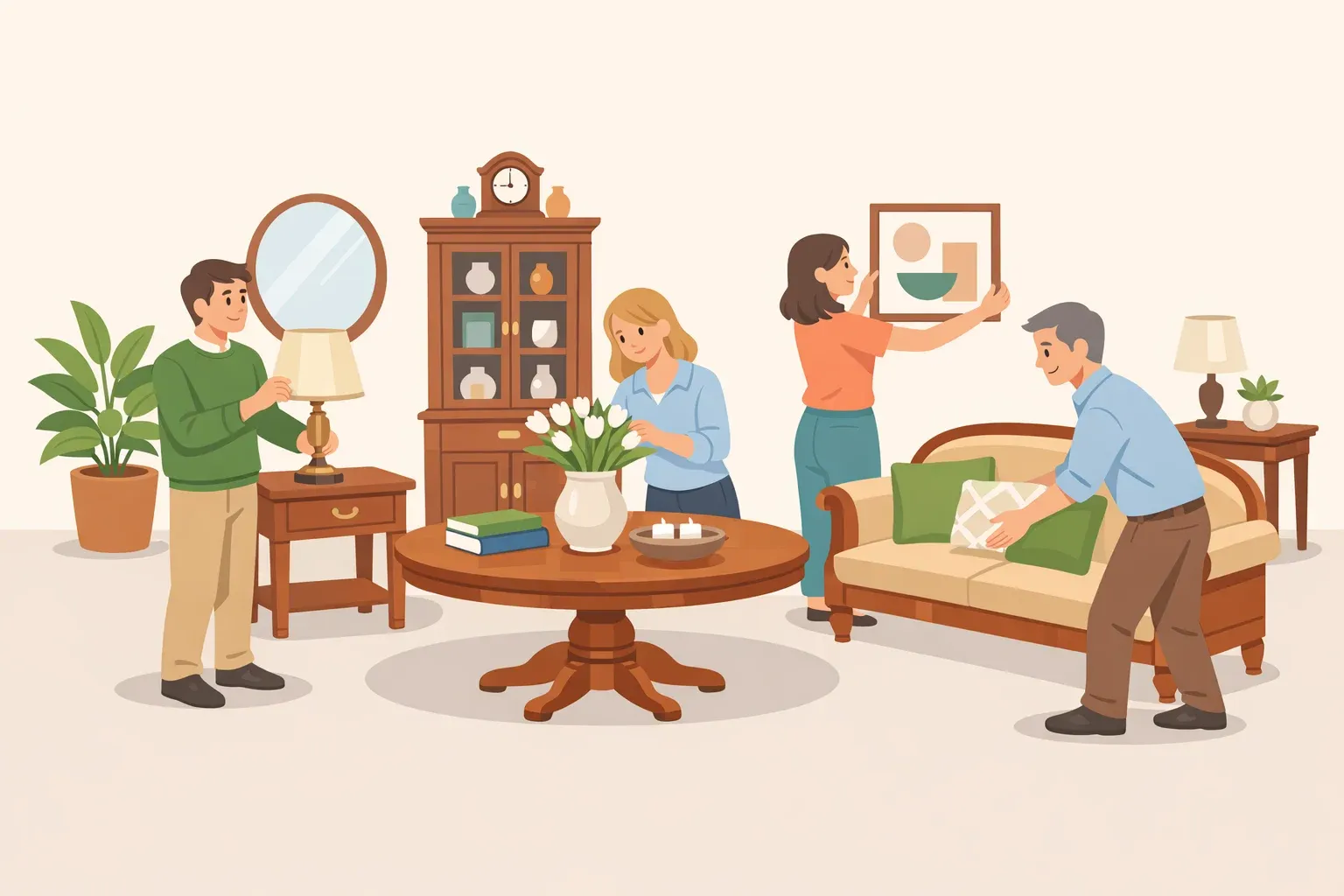
In late 2023, Architectural Digest documented something quietly revealing: contemporary designer rooms built around 200-year-old Central European furniture. Eight mismatched Biedermeier chairs reupholstered in colorful corduroy around a 1980s Paul Mayen table.
A cherrywood pedestal table anchoring a Brooklyn apartment. A marble-topped chest standing as the quiet focal point of a bedroom in upstate New York. None of these were period rooms. They were modern interiors that happened to contain antique furniture, and the furniture looked entirely at home.
That comfort is not accidental.
The reason Biedermeier furniture style keeps appearing in design-aware rooms has less to do with mid-century fatigue than with a more fundamental logic. Biedermeier helped establish a room-centered domestic layout that still feels modern: furniture arranged at the center of a space, organized around gathering and daily use, rather than displayed against the walls. That principle is so thoroughly absorbed into contemporary interiors that most people have never considered where it came from. The furniture that established it is worth a second look.
What is Biedermeier furniture? It is an early 19th-century style originating in Austria, southern Germany, and Bohemia, flourishing from 1815 to 1848. Where aristocratic furniture performed status, Biedermeier pursued comfort: simplified Neoclassical forms, fruitwood veneers, restrained ornament, and pieces designed around family life and intimate gathering.
It became, the same source notes, a descriptor for an entire domestic lifestyle, not merely a furniture category. Design historians draw a direct line from its spread into Scandinavia to the Nordic modernism that would later produce mid-century's most celebrated furniture.
One honest note on scale: the 1stDibs 2025 luxury market report names Art Deco and Y2K as the dominant design movements by search and sales volume. Biedermeier does not register in that data. What exists is sustained, visible interest among design-aware decorators. This piece examines why that interest is grounded in something more durable than novelty.
What is Biedermeier furniture style, and why does it feel modern?
The most consequential thing about Biedermeier is not how it looks. It is the domestic shift it was built to serve, and that shift turns out to be permanent.
Before 1815, furniture in European interiors stood against the walls. Rooms functioned as formal backdrops, designed for the performance of rank rather than for actual use. The Biedermeier period marked a notable shift away from that arrangement.
Furniture moved to the center of the room, organized around a concept called the Wohninsel, the living island: a grouping of pieces designed for use and conversation. This is how most people arrange their homes today, without knowing there was a name for it or a moment when it became the norm.
The social cause was precise. During the Vormärz period, the politically repressive decades before the 1848 revolutions, clubs, civic societies, and public assemblies across Central Europe were shut down and their members sometimes imprisoned.
People withdrew into private homes, and intimate domestic gatherings became the primary social outlet. The furniture followed: rooms organized around how a family or circle of friends actually lived, not around the display of status. Contemporary interiors operate on the same logic, though the political conditions that produced it have long since dissolved.
The visual language served that logic directly. Light European fruitwoods, cherry, walnut, birch, ash, and pearwood replaced imported exotics like mahogany, selected for the warmth and figure of their grain rather than their prestige value.
The bookmatching technique, laying consecutive veneer slices as mirror images across a surface, made the grain itself the primary decorative element. Hand-applied shellac, built up over multiple coats, creates surfaces that develop depth with age in a way modern synthetic finishes cannot replicate.
Key visual markers: clean rectilinear profiles that grew increasingly curved by the late 1820s; tapered legs; symmetrical compositions; minimal applied ornament. Where decoration appears, sparse ebony accent lines at edges and restrained gilded bronze mounts, it functions architecturally. This design philosophy extended beyond furniture into Meissen porcelain and glassware, reflecting a coherent domestic sensibility rather than a single product category.
Two clarifications worth making. Biedermeier grew out of Neoclassicism but is not the same thing. Neoclassicism reproduced classical motifs with ornamental ambition; Biedermeier simplified and domesticated them, prioritizing use over display. And contrary to a persistent assumption, the heavy use of veneer is not economy. It is the primary vehicle for visual richness, and fine veneers are central to authentic Biedermeier craftsmanship.
The Wohninsel principle runs through everything that follows. Biedermeier was designed for exactly the kind of room contemporary decorators are trying to build.
Mid-century vs Biedermeier furniture: shared values, different outcomes
The comparison between Biedermeier and mid-century modern is not a contest. It is a study in what happens when the same underlying values, functional form, honest materials, and furniture designed around use are expressed in different materials and reach very different levels of market saturation.
The connection is historical, not metaphorical. Biedermeier's spread into Scandinavia in the 19th century foreshadowed the Nordic modernism that directly produced mid-century's most celebrated furniture. Both styles prioritize clean silhouette over ornament, functional form over decorative performance, genuine materials over applied finish. Choosing a Biedermeier piece over a mid-century classic is not a departure from that design tradition. It is a step further back along the same line.
The most immediate difference is material character. Mid-century furniture, particularly in teak and walnut or lacquered and molded finishes, tends toward cooler, denser surfaces. This is an observation about material behavior rather than a ranking.
Biedermeier's cherry and birch veneers with hand-rubbed shellac read differently: they shift with light and develop depth over time in a way that period pieces demonstrate clearly, as Antiqueria Breitling describes of authentic circa-1825 Austrian examples. This is often the first thing a designer notices when a Biedermeier piece enters a room furnished with mid-century work.
Silhouette diverges more in cultural coding than in formal character. A mid-century Eames chair or tulip table announces its decade as clearly as a typeface. A Biedermeier pedestal table or pair of armchairs carries no equivalent timestamp. The style's period ambiguity is now a practical decorating asset. It anchors a room without locking it into a decade.
Then there is market saturation, the less romantic but arguably more decisive factor. Authentic mid-century pieces have been extensively sourced; reproductions are widespread. Biedermeier has no equivalent exposure in the mainstream market, which means its design quality is not discounted by familiarity in the way mid-century has been.
The Architectural Digest dining room is the clearest illustration: eight mismatched Biedermeier chairs in colorful upholstery around a 1980s contemporary table. Not a period room. It trades the uniformity of a matched mid-century dining set for something older, more varied, and materially warmer. The chairs do what clean-lined dining seating does in any period, but with grain and finish that respond differently to light.
There is no quantitative evidence that Biedermeier is displacing mid-century modern at scale. The honest case is narrower: among design-aware decorators who have already worked through the mid-century repertoire, Biedermeier is increasingly legible, appealing because it is less familiar, more materially present, and rooted in the same domestic design logic that mid-century inherited from it.
How to use Biedermeier furniture in a contemporary room
Biedermeier integrates most effectively when treated as a material anchor rather than a period statement. The Wohninsel principle still applies: one strong piece at the center of a room's activity, not displayed at its edge.
Where to start
For most decorators making a first move, the answer is a round pedestal table or a pair of chairs. The circular pedestal table is the most common Biedermeier form overall, as Antiqueria Breitling notes.
It was the Wohninsel's gravitational center, designed to pull a room inward. It functions in a contemporary dining room or living room the same way a tulip table does, but with warmer grain and more material individuality. Biedermeier chairs, with their clean profiles and scrolled lyre-form backrests, mix naturally with modern tables precisely because they carry no particular decade's cultural stamp.
Chests and low cabinets work equally well in bedrooms and hallways. A Viennese cherrywood chest with bookmatched veneer does the same horizontal grounding work as a walnut mid-century credenza, with more material depth and less competition from reproductions. The Architectural Digest examples show this consistently: a chest in an upstate New York bedroom, a pedestal table in a Brooklyn apartment. These are working rooms, not period recreations.
How to mix it
Use Biedermeier as an anchor piece, not a full-room theme. One strong piece, a chest, a table, a pair of chairs, does more than a larger collection of lesser things. The style's visual restraint means it settles into a contemporary room rather than dominating it.
Pair the warm cherry or birch grain with cooler contemporary surfaces: linen, plaster, stone, matte painted walls. The contrast works because the materials read against each other rather than competing in the same register. Biedermeier sits comfortably alongside contemporary furniture and pieces with clean profiles from other periods. It sits less well next to maximalist Victorian or heavily ornamented styles, where the contrast reads as collision rather than conversation.
Mismatched is fine. The eight-chair dining room is evidence enough. Biedermeier chairs do not need to match each other. Reupholstered in solid fabrics, they read as a cohesive set through shared form alone.
What to look for when buying
Authentication begins with the veneer. Original Biedermeier veneer was hand-sawn, producing slices of three to five millimeters, and the quality of an original shellac surface is immediately apparent to the touch. Condition and provenance both matter significantly for valuation.
Collectors should assess veneer condition, original finish, and construction details when evaluating authenticity. When the finish has been replaced with synthetic varnish, the piece loses much of what makes the original material compelling.
A market framework
Revival pieces from the late 19th and early 20th century offer the full Biedermeier visual language at accessible prices: pairs of chairs typically at €400–€1,500, chests at €2,000–€8,000. These are the right choice for decorators prioritizing look and livability over provenance. Budget for reupholstery on seating. Note that later Swedish revival pieces exist in this category and are worth distinguishing from Austrian originals, which tend to show more refined proportions.
Period originals from Austrian workshops circa 1820–1825 are collector-grade purchases. Viennese cherrywood chests run €8,000–€35,000; round pedestal tables command €3,000–€12,000, with condition and original finish integrity driving value. Early 19th-century Austrian pieces, particularly those dating to around 1820 to 1825, are among the most sought-after in the category. Buy from a specialist dealer.
Industrial reproductions offer the silhouette without the material substance. A starting point for understanding the forms, not a substitute for what makes the originals and revivals worth the premium.
The buying decision and the room-planning decision are the same decision. Biedermeier pieces were designed for the center of a room, around gathering. Place a pedestal table or a pair of chairs where a mid-century piece currently anchors the space, and the principle becomes apparent on its own terms.
A style built for the room we already live in
The case for Biedermeier in 2026 is not that it is a fresher antique than mid-century. It is that the domestic design logic it helped establish — furniture moved to the center of the room, organized around daily use and gathering — is the same logic that governs contemporary interiors. The style did not arrive at this by coincidence; it developed under precise social conditions in which the home became the primary site of social life.
It is the combination of light woods, clean lines, balanced proportions, and refined functionalism that makes Biedermeier feel "timeless." That word is usually content-free in design writing. Here it means something specific: no single decade claims it. A room cannot be dated by the presence of a Biedermeier chest the way it might be by a molded plywood chair or a tulip table, and in furniture, that kind of temporal neutrality is genuinely rare.
Whether Biedermeier becomes a mainstream trend is a less interesting question than whether it belongs in the conversation about what design-aware interiors look like once mid-century has been fully digested. The room-planning logic, the material quality, and the design lineage all suggest it does, less as an emerging trend than as a permanent resource that most Western decorators have simply not gotten around to yet.










Comments
Be the first, drop a comment!