




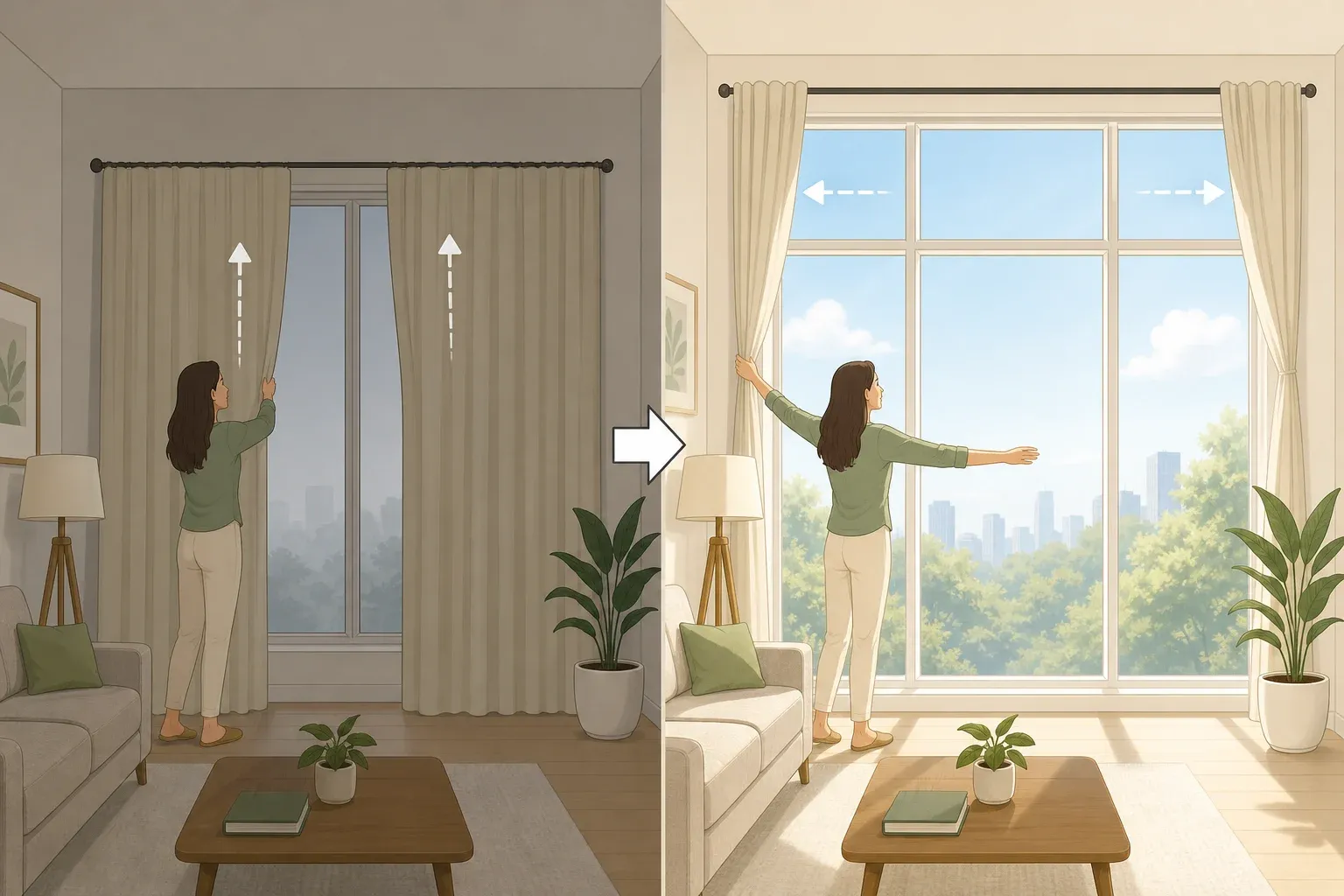
A sheer curtain looks like the simplest window treatment there is: hang it, let daylight in, done. But the modern sheer curtain ideas turning up in design coverage this year treat that panel as half a system, the daytime component of a two-part setup that also includes drapery, a Roman shade, or a blind, chosen for what the room needs once the sun goes down.
New York designer Sarah Lederman says layering this way adds "depth and visual richness" to a room without eating into floor space. Architect Suzanne Lovell draws a sharper line between the two jobs involved: shades and blinds handle the practical business of limiting light, while drapery "accentuates the quality of our architecture." One layer manages function. The other manages atmosphere.
That division of labor is the whole logic behind the trend: pick a sheer for daytime light, then choose a second layer, drapery, Roman shade, or blind, based on what the room needs after dark, whether that's privacy, blackout, insulation, or just less glare. Everything below — fabric pairing, hardware, whether a room needs a third option at all — comes back to that one decision.
What sheers actually solve, and where they stop
Before choosing fabric or hardware, it helps to know what a sheer panel is actually good for. It's a daylight tool. It isn't a privacy solution, and it isn't a blackout solution, however convincing it looks in a showroom photo.
Sheers work best hung closest to the glass, according to Everhem cofounder Haley Weidenbaum, because that placement lets them flood a room with daylight during the day. That's the one job an open-weave sheer does reliably.
The trouble starts after dark. Open-weave sheers flip their effect once interior lights switch on: occupants lose the ability to see outward, while anyone on the street can see straight in. A curtain consultant writing for House & Garden three years ago advises checking weave tightness before counting on any sheer for after-dark privacy, since the more open the weave, the more visible a room becomes once the lights come on.
That's the real tension behind sheer curtains for privacy and light: the tighter the weave, the more daylight performance a sheer gives up in exchange for holding onto some coverage after sunset.
Blackout performance follows a similar pattern. A full curtain still outperforms a Roman blind layered over a standard roller blind, and even a purpose-built blackout blind needs side channels, typically a zip-frame design, to stop light leaking around the edges. A sheer panel on its own was never going to solve either problem.
That gap between bright and open during the day, exposed at night, is exactly what a second layer exists to close. What fills it depends on the room, which is the practical core of most modern window treatment ideas circulating right now.
Layered sheer curtains and drapes: three pairings, and which one fits the room
Once the daylight layer is settled, the decision narrows to three practical combinations. Each answers a different question about what a room needs once the sun goes down, rather than trying to be one universal fix.
Sheer plus heavier drape adds coverage and a sense of formality. A thinner cotton layer set under a heavier velvet or patterned panel creates balance and structure, a pairing suited to rooms where evening privacy needs to feel deliberate rather than improvised.
Sheer plus Roman shade trades formality for texture. Studio Peake founder Sarah Peake pairs sheer linen with a Roman blind set into the window reveal, deliberately choosing a soft-fold style so the result reads as relaxed rather than stiff, describing the effect as "cozy, full of texture and light." That's a fair description of what many people actually want from sheer curtains for a living room or reading corner that gets used daily, not just admired from the doorway.
Sheer plus privacy or blackout blind suits rooms that swing between bright and fully dark. Media rooms need to kill glare on demand, and nurseries need to adapt to a newborn sleep schedule that keeps shifting, exactly the kind of flexibility a double layer provides. Recessed privacy blinds paired with a sheer do something similar in bedrooms and bathrooms, letting daylight through while keeping passers-by from seeing inside.
However the two layers get matched, they shouldn't match too closely. Boston designer Nina Farmer says materials and opacities don't need to be dramatically different, but should carry some contrast so the pairing reads as intentional rather than an accident of coordinating fabric. When the second layer is a shade instead of drapery, the advice flips: aim for a similar light-filtration level between the two.
Laid out side by side, the choices look like this:
Daytime goal: Daylight, no real privacy concern
After-dark need: Minimal; the room isn't overlooked
Best second layer: Sheer alone
Installation watch-out: Check the weave tightness anywayDaytime goal: Daylight plus evening structure
After-dark need: Privacy with a formal look
Best second layer: Sheer plus heavier drape
Installation watch-out: Mount high and wide so the extra fabric doesn't bulk up the windowDaytime goal: Daylight plus relaxed texture
After-dark need: Some privacy with a softer feel
Best second layer: Sheer plus Roman shade
Installation watch-out: Match the light-filtration levels between the two layersDaytime goal: Daylight plus full control after dark
After-dark need: Blackout or total privacy
Best second layer: Sheer plus privacy or blackout blind
Installation watch-out: Blackout blinds need zip-frame side channels to work effectively
How to layer sheer curtains: placement and stack space
A layered sheer setup can look sharp in a photo and still look bulky on an actual wall if the hardware and clearance are off. Fabric pairing gets most of the attention, but installation is what makes or breaks the result.
Weidenbaum's installation advice starts with mounting hardware high and wide, using either a thin double rod or an inside mount paired with an outside mount, which keeps the layered fabric from looking bulky or shrinking the window visually. Placement matters just as much. Setting a blind or shade inside the window trim while hanging curtains outside, near the ceiling, elongates the room's visual line and creates the illusion of higher ceilings without covering up architectural detail.
Clearance is where home installations often go wrong, mostly because it looks like a minor detail until the curtain won't hang right. Pole-mounted curtains need a minimum gap of 10 to 15 centimeters between the top of the window and the top of the curtain. Ceiling-recess setups need more still, somewhere between 15 and 35 centimeters, so the fabric sits properly without swallowing too much wall space.
Heading style adds its own space requirements on top of that. Fuller headings such as the triple pinch pleat or an 80mm wave need extra stacking room at the sides, which matters most in rooms with a narrow wall return next to the window.
Any hardware operated by a pull cord needs genuine clearance too, or the fabric ends up dragging against the sill or a radiator every time it's opened. Get the mounting height or the stack space wrong, and even a well-chosen fabric pairing ends up looking like an afterthought instead of the system it was meant to be.
Choosing fabric without overcomplicating maintenance
Fabric choice should follow drape quality and how much upkeep a household can realistically sustain, not a search for one correct material. As Ffabb Home cofounder Celina Dalrymple puts it, "there's so much nuance to how a fabric behaves, its weight, drape, lining, and even how it moves when you open or close the panels," which is as good an argument as any for testing a swatch before committing to something elaborate.
Linen shows up often in current design coverage as a breathable, tactile option, but the specific case made for it is narrower than "works year-round." One branded piece frames its appeal as running from late summer through the holiday season, not as an all-season fabric. Worth reading as one material option among several, not proof that linen has quietly displaced synthetic sheers across the wider market.
There's a practical reason fabric choice matters more than nostalgia for elaborate curtains might suggest. Textile historian Natalie F. Larson points out that most modern households have lost the dedicated laundry and ironing space that once made elaborate curtain care a routine part of running a home.
That loss of dedicated care space is part of why mass-market blinds and ready-made panels now compete directly with custom textiles, for households that don't have the room, or the time, to maintain fabric the way a household with dedicated staff once did.
Before you order
The decision matrix above covers the pairing logic. Before buying or installing anything, it helps to walk through a shorter set of questions specific to the actual window:
What daylight goal does the sheer need to hit during the day
What privacy does the room need once the lights are on at night
Does the room need true blackout, or just reduced glare
How deep is the window recess
How high is the ceiling
How often will the curtains actually be opened and closed on a normal day
The broader curtain revival extends well past the window itself. At Milan Design Week last year, one installation lined its entry in cinema-red curtains, and a design studio swathed an entire apartment's walls in deep green fabric. At NYCxDesign, a new flagship store used floor-to-ceiling silver curtains to define separate zones within a single open room.
Dalrymple frames the wider shift plainly: fabric is increasingly used as "a spatial tool," for room dividers and acoustic panels as much as for windows. Sheers fit into that same shift, less a finished look on their own, more one deliberately chosen piece of a larger, more flexible system for handling light and privacy at home.











Comments
Be the first, drop a comment!