




Most expensive furniture mistakes happen before anyone sits on the couch or opens a drawer. They happen at the tape measure, the price tag, and the fine print. Knowing what to check before buying furniture, and doing it in the right order, catches problems while they're still cheap to fix, before delivery, not after.
A rookie mistake trips up shoppers again and again: forgetting to measure the front door before buying a large sofa or dining table, designers told The Spruce. Consumer Reports has documented the predictable result. One contributor's friend had a couch hauled up three flights of stairs, only to find it couldn't be maneuvered past the door. Quality isn't just visual, designers add. It's structural, meaning what's hidden under the finish matters as much as the color or style on display.
This guide walks through what to check before buying furniture in the order experienced buyers actually check it: what the room needs, then fit and access, then construction, then comfort and lifestyle fit, and finally the paperwork that protects you if something goes wrong.
Define what the room needs before you shop
Before choosing colors or finishes, decide what a piece has to do. Designers interviewed by The Spruce two years ago recommended thinking through how a space should function and feel before fixating on a specific item, so smaller decisions serve the bigger goal rather than working against it.
That means identifying actual requirements first: storage capacity, seating count, durability for kids or pets, rather than shopping from an inspiration photo alone. It also helps to set a budget for the whole room before shopping piece by piece, which lets buyers splurge on high-use items, like a primary sofa, while spending less on occasional furniture or lighting, the same designers noted.
Measure before you fall in love: fit, access, and scale
Once the room's needs are clear, measurement is the cheapest insurance in furniture shopping.
Measure the destination spot and every access point. Front door, hallway width, stairwell, elevator, all of it, before anything goes into the cart.
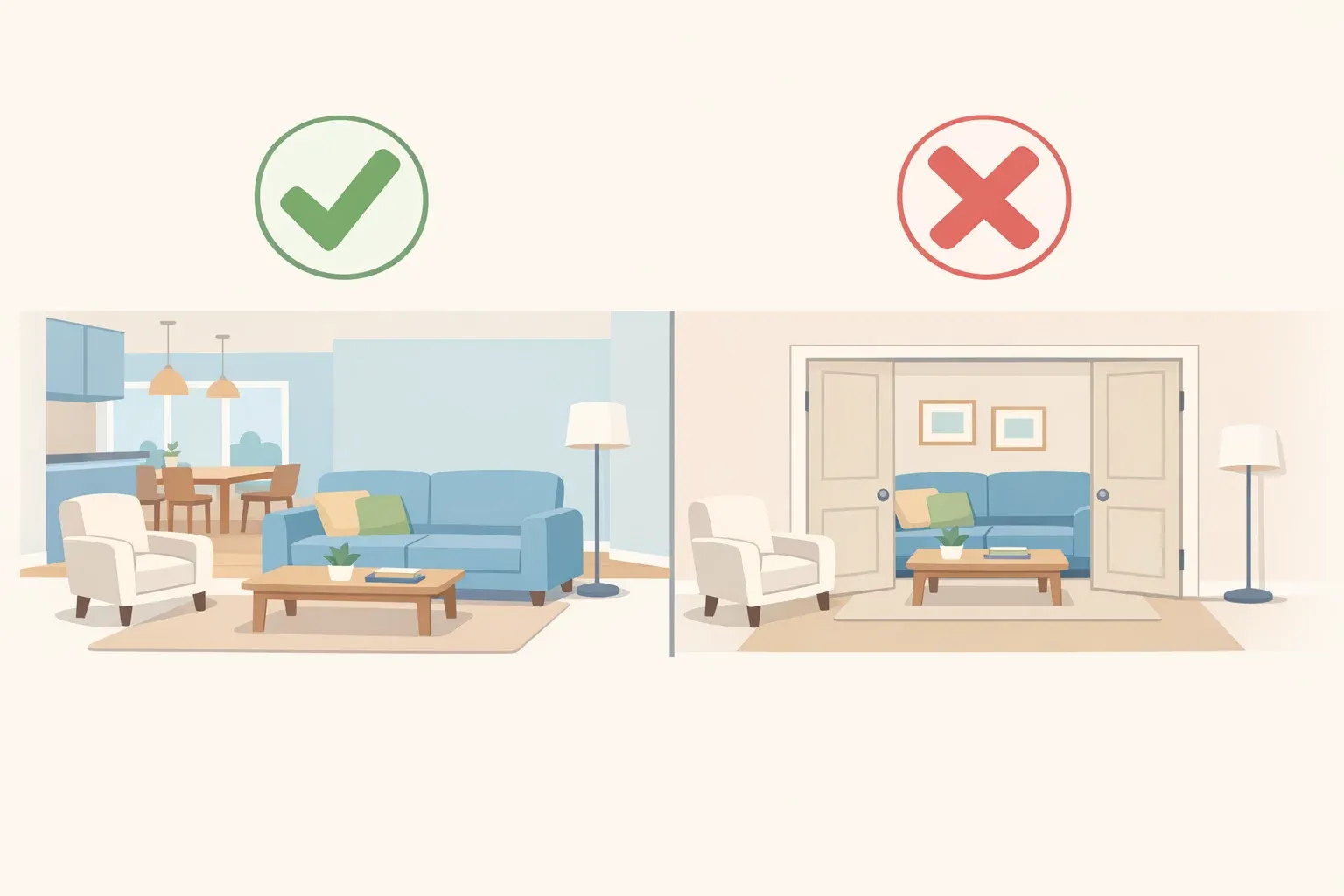
Account for obstructions beyond floor space. Windows, mantels, and built-in millwork affect traffic flow just as much as the piece's footprint does.
Tape out the exact footprint before ordering. Oversized furniture chokes circulation; undersized furniture creates what one designer calls a "dollhouse effect."
Check proportional details. Side tables should sit 2 to 5 inches below a sofa or chair arm; sofas under 80 inches suit smaller rooms, while larger rooms can carry pieces over 90 inches.
Inspect the construction and check furniture quality before buying
Furniture construction isn't really four separate materials to memorize. Veneer is a surface treatment, not a structural material, and what sits underneath it, plywood, MDF, or particleboard, does most of the work in determining how long a piece actually lasts.
Solid wood is milled from natural lumber, oak, maple, cherry, or walnut among the common choices. It's the only construction that can be sanded, refinished, and structurally rebuilt across multiple generations: a scratched solid-oak tabletop can be sanded back and refinished, while a chipped panel on an engineered core generally can't be repaired without replacing it entirely.
Veneer over plywood is a different animal from veneer over a cheaper core. Plywood is 100% wood, built from bonded layers, and shows up legitimately even in furniture marketed as solid wood, since it adds stability to large surfaces; its presence alone isn't a shortcut. Veneer over that kind of core is comparatively stable and can sometimes be refinished once or twice before the layers beneath start to show.
Veneer over MDF or particleboard, by contrast, is a shorter-lived product. Once that core is damaged, there's often no repairing it.
Painted MDF or particleboard, with no veneer at all, is the entry tier. Particleboard, made by compressing wood chips and sawdust with resin, is the cheapest and lightest option, and it's also the most prone to moisture damage and sagging under weight over time. MDF is built from finer wood fibers and resin, which makes it sturdier and smoother than particleboard, and it's the usual choice for furniture meant to be painted rather than stained.
Sorting solid wood vs veneer vs engineered wood furniture on a showroom floor takes a few minutes, not an expert eye.
Check the underside, the back, and inside drawers. Solid wood shows continuous grain and visible end grain at the cut edges, while veneer shows a thin face layer with a different material visible where it meets the edge.
Lift a corner and knock on the surface. Solid wood is heavier and rings differently than a hollow engineered core, though weight and sound are clues rather than proof, so ask to see the product specification or cut sheet if one exists.
Ask directly whether upholstered frames use kiln-dried hardwood. Ask about joinery too, rather than judging a piece by its finish alone.
Comosum, an online furniture retailer, estimates that solid hardwood furniture built with FSC-certified timber and water-based finishes typically lasts 50 to 100 years with normal use. The company also runs a hypothetical comparison: a $4,000 solid-wood dining table lasting 60 years works out to roughly $67 a year, versus about $100 a year for a $700 MDF table replaced every 7 years, with that MDF table generating roughly eight times the landfill volume over the same span.
Treat that math as one seller's illustrative argument rather than an independently verified rule; the more defensible takeaway is that a repairable core avoids full replacement, not that every solid-wood purchase beats every engineered-wood one on cost.
There's also a U.S.-specific question worth raising about indoor air. Composite wood products can off-gas formaldehyde, particularly in the first year or two, and buyers can ask a retailer whether a piece complies with the EPA's TSCA Title VI or California's CARB Phase 2 standard, or carries a GREENGUARD or GREENGUARD Gold label. That's a purchasing question to raise, not a verified claim about any specific item on a showroom floor.
Match materials and comfort to how you live
Construction quality answers whether a piece will hold up. It doesn't answer whether it'll work for the household buying it, and for upholstered furniture in particular, that means judging more than color.
Cushion construction affects comfort directly: high-density foam feels firmer, while foam-and-down blends feel softer and plusher. Seat depth and back height change how a piece feels day to day, too. A low, deep seat suits lounging, while a higher, narrower seat with a taller backrest favors upright posture and neck support.
Fabric durability, specifically a Wyzenbeek or double-rub count, and lightfastness matter for anything placed near a window. None of that replaces a test-sit in person, since comfort claims in a product listing don't always hold up once someone's actually sitting in the piece.
Households with kids or pets, and rooms that get heavy sun, call for a few extra checks. Durable, easy-clean fabrics like microfiber resist pilling better than some alternatives. Removable, washable covers are worth considering over chemically stain-resistant fabric, since PFAS compounds are common in water- and stain-resistant treatments. Requesting a physical fabric swatch and viewing it in the room's own light, at different times of day, catches color differences that a product photo won't show, The Spruce advised.
Before you pay: warranty, returns, and seller reputation
A written warranty isn't the only protection available. State implied warranties may apply even when there's no written warranty at all. Still, if a seller does offer a written warranty, federal law requires that you're able to read it before purchase, whether in-store or online.
Before buying, review the length of coverage, what's explicitly excluded, and whether the company will repair, replace, or refund a failed product. Check the claims process too: whether a claim goes through the manufacturer or the original seller, and who pays for labor or return shipping.
Protecting yourself doesn't end at checkout. Get any verbal promise from a salesperson, free repairs, or extended coverage, in writing, since a business may later refuse to perform a service that was never put on paper. Save the warranty and receipt together; the receipt is what proves the purchase date and original ownership if a claim comes up down the line.
The seller deserves as much scrutiny as the product. Search the company's name alongside "complaint" or "review" rather than relying solely on testimonials posted on its own site, the FTC recommends.
Fake reviews are a documented concern with online retailers generally, so treat suspiciously glowing or suspiciously harsh reviews with some caution. Checking a reviewer's own history helps too; one with no history behind it may be untrustworthy.
Putting it together
Bring this furniture buying checklist along, whether shopping in person or scrolling a listing:
Room and access measured, including doorways and stairs
Footprint taped out and checked against traffic flow
Core material identified (solid wood, plywood, MDF, or particleboard) and asked about directly
Joinery, frame material, and finish inspected or asked about
Fabric durability and lightfastness checked for heavy-use or sunlit spots
Comfort tested in person where possible
Warranty read in full, including exclusions and claims process
Seller reputation checked independently
One more low-cost step is worth trying before buying anything new: check whether an underused piece already in the home would solve the problem instead, as one interior designer put it to The Spruce.
None of this requires becoming a furniture expert. It just means asking whether a piece fits, what it's made of, whether it suits how the household actually lives, and what happens if it fails, before it leaves the showroom rather than after it arrives.












Comments
Be the first, drop a comment!