



IKEA KALLAX banquette hack: built-in bench with hidden storage
Alexis didn't set out to build furniture. She needed a place for her family to actually eat, and to host friends without everyone crowded around a too-small table. What she ended up with was a corner banquette that seats 10, built from two IKEA KALLAX units at roughly $50 each, turned on their backs so the cubby openings face up and a wood lid caps the storage underneath. The whole room transformation came to about $350, per Apartment Therapy.
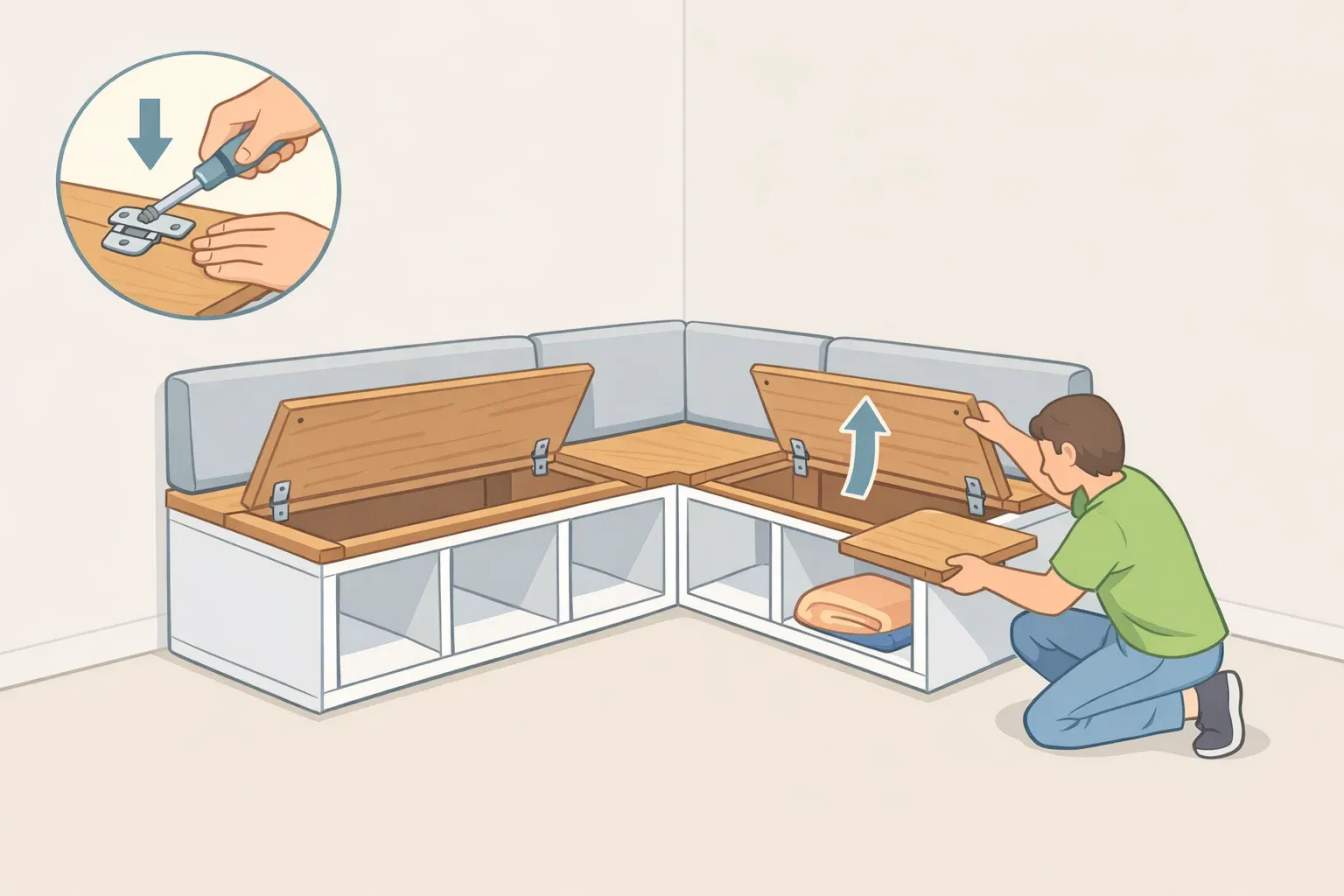
The logic of this IKEA KALLAX banquette hack is in that orientation. "I've seen several IKEA hacks turning the bookcase on its side for storage baskets to sit behind your legs, but we wanted the storage to be entirely within the bench," Alexis explained. So she flipped the units onto their backs, capped the cubbies with a hinged plywood lid, and added trim to hide raw edges. The finished piece reads as carpentry, not a storage cube with a cushion dropped on top.
The single KALLAX unit as a straight bench is the primary path this guide teaches. The L-shaped corner configuration Alexis built is addressed at the end. You'll also find honest notes on where the project punishes skipped measurements.
Who this is for: Anyone with an underused dining corner who needs seating and storage in the same footprint, with basic tool comfort: a drill, staple gun, and tape measure. Sewing is not required for the primary build path.
Is the IKEA KALLAX banquette hack right for your space?
Most IKEA hack failures are measurement failures. The KALLAX has fixed dimensions and will only work if your space and table meet it on its own terms.
1. Does your table height match? A kitchen or dining bench should land around 18 inches tall to pair correctly with a standard 28 to 30-inch table, according to this YouTube build. When the KALLAX is laid on its back, the unit stands approximately 15¼ inches. Add a 3-inch foam cushion and the finished seat lands at roughly 18¼ inches, right inside that target range, per At Home with Ashley. Measure your actual table before ordering anything. A 2-inch mismatch is uncomfortable and not fixable without cutting the unit down.
2. Do you have a wall to anchor it against? This build requires a solid wall behind the bench. Check that your wall has no baseboard heating vent or outlet placement that would complicate flush positioning.
3. Is your wall run long enough? A KALLAX unit covers just under 58 inches in length when laid on its back. Tape the footprint on the floor before ordering. For the L-shaped corner configuration, tape both runs simultaneously and check the inside corner for baseboard trim conflicts.
What this build will cost: Ashley's fully documented single-unit build KALLAX at $53, piano hinge at $14, 3-inch foam from Home Depot at $22 (the same size at craft stores runs around $50, so buy it at the hardware store), velvet fabric at $40, quilt batting at $10, and thread at $2 totaled $141, per At Home with Ashley. Skip the gathered fabric skirt and use simpler upholstery fabric and the number drops below $115, though the exact figure depends on your fabric choice.
What you can simplify: The painted front with no skirt is the easiest finish and often the better-looking one. No sewing required, and the clean horizontal line reads more like built-in furniture than an upholstered skirt does.
What you need before you start
Gather everything before assembly begins. The plywood dimensions are specific to your KALLAX top, so have the hardware store make the cut rather than attempting it at home.
Required materials:
- IKEA KALLAX unit, 2×2 configuration, about $50–$53
- ¾-inch plywood cut to KALLAX top dimensions; Ashley's measured 16½ × 57⅞ inches, per At Home with Ashley
- Piano hinge for lid access, about $14
- 3-inch upholstery foam cut to seat dimensions; Ashley paid $22 at Home Depot, per At Home with Ashley
- Quilt batting, approximately 28 × 70 inches
- Upholstery fabric, 2 yards minimum for cushion only
- Wood trim strips for exposed plywood and KALLAX edges
- Wood filler, sandpaper (medium and fine grit)
- Paint or primer, polyurethane sealant (two coats minimum)
- Spray adhesive, staples
Additional materials for the fabric skirt option:
- 4 yards of upholstery fabric total
- Sewing machine and thread
Tools:
- Drill
- Staple gun
- Electric knife (for cutting foam; scissors compress foam and produce beveled, uneven edges)
- Tape measure
- Two people for the piano hinge installation
Step 1: Confirm dimensions, orient the unit, and anchor it to the wall
Tape the bench footprint on the floor and verify every measurement before opening the KALLAX box.
The KALLAX goes on its back, cubby openings facing up. The unit's former depth becomes the bench height, approximately 15¼ inches before the cushion. Storage is accessed by lifting the seat lid. Confirm the finished height against your actual table before proceeding.
Check for feet and glides. If your unit ships with small plastic feet, they add roughly ¼ inch to total height, as noted in this YouTube build. That fraction matters when you're threading a needle between 18 and 20 inches. Account for them or remove them. Getting this wrong costs hours: one builder discovered only after full assembly that her storage units were 4 full inches too tall and had to disassemble all three to cut them down before proceeding.
Assemble the KALLAX per IKEA's included instructions, then lay it on its back with the cubbies facing up.
Anchoring to the wall. Before finishing the frame, secure the bench so it can't tip forward. Screw a horizontal cleat a 1×3 or 1×4 strip of lumber to the wall studs at bench height, then fasten the back of the KALLAX to the cleat. Locate studs first; a stud finder takes two minutes.
If your wall has baseboards, the KALLAX back won't sit flush. For a straight bench run, notch the baseboard at the front face where the bench meets the wall using a sharp chisel or an oscillating tool. For a full run, cutting the baseboard out behind the bench and touching up the paint line is cleaner.
Step 2: Build the lid and finish the frame
Cut ¾-inch plywood to match the KALLAX top dimensions and have the cut done at the hardware store. This piece becomes the lid, hinged at the back edge so it lifts toward the room when you need to get into the storage.
Attach the piano hinge along the back edge of the plywood and the corresponding back edge of the KALLAX frame. This takes two people: one to hold the lid level while the other drives the screws, per At Home with Ashley. The lid will bind or gap along its length if the hinge mounts unevenly. Check alignment before setting each screw. Once the hinge is set, close the lid and confirm it sits flush across its full length.
Hinging the lid from the wall side means it lifts toward the room when opened, not into the wall which matters for clearance and everyday usability.
Finishing the frame: Attach wood trim strips along all exposed plywood edges and along the visible KALLAX faces where the laminate meets the new wood. Trim hides raw panel edges and visually ties the plywood lid to the laminate carcass, which is what makes the finished piece read as furniture rather than an improvised storage box. Fill any gaps and fastener heads with wood filler, sand smooth with medium grit then fine, and paint or prime the full assembly including the bench sides and the underside lip of the lid.
On the front face: Once trim and paint are complete, the front is done. The KALLAX sides are sealed under paint; the cubbies are accessed entirely from the top. That's the default path, and it produces the cleanest built-in look.
For a fabric skirt: cut the skirt fabric twice the bench width and about 2 inches longer than bench height. Sew two gathering stitches along the top at stitch length 5, leave long thread tails on both ends, and pull to gather before stapling to the bench front, per At Home with Ashley. The gathering alone takes about two hours. Pre-wash the fabric before cutting if you plan to ever remove and launder it.
On the cushion and the lid: Because the lid opens, a permanently stapled cushion won't work. Build a removable cushion with a zipper closure (see Step 3), or make a loose cushion that simply lifts off when you need to access the storage.
Step 3: Upholster the seat cushion
Cut the foam to match your plywood lid dimensions using an electric knife. Work slowly. An electric knife follows the foam and leaves a clean, straight edge; scissors compress foam as they cut and produce a beveled surface that shows through fabric.
Apply spray adhesive to the top surface of the plywood, press the foam into place, and let it tack. Apply a second layer of spray adhesive over the foam, then drape quilt batting over it and wrap the edges down around the sides rather than cutting them flush. Wrapped edges produce a rounded cushion profile. Cut-flush edges produce hard corners that identify a DIY build from across the room.
Lay your upholstery fabric face-down on a clean, flat surface. Center the foam-batting-plywood assembly face-down on top. Pull fabric taut to one long side and staple it to the plywood underside at 2 to 3-inch intervals. Work from the center outward on each side, not corner to corner, to keep tension even. Fold corners like wrapping paper, then staple.
Build a zippered removable cover rather than stapling the fabric permanently. The lid needs to open, and the cover needs to come off when it does. A zippered case also goes in the wash, useful if a toddler uses the bench daily which Alexis's does. "Spills, crayons, dirty feet it gets the brunt of it," she told Apartment Therapy. A separate builder designed her entire cushion system around zippered, machine-washable poly suede covers for exactly the same reason. Pre-wash fabric before sewing to prevent shrinkage that would make the cover too tight after the first laundering.
Step 4: Seal everything before the bench goes into use
Apply at least two coats of polyurethane sealant to all painted and raw wood surfaces. Sand lightly with fine-grit paper between coats to knock down any raised grain or dust that settled while the previous coat dried.
Two coats is what Alexis recommends from direct experience with a toddler at the table, per Apartment Therapy. Pre-treat any exposed fabric surfaces with spray-on fabric protector before placing the cushion.
Building the L-shaped DIY banquette bench with storage
The two-unit corner version is the same build executed twice and joined at a right angle. Every step above applies to each unit individually. What changes is the planning and the corner join.
Before buying a second unit, measure both wall runs from the corner outward and confirm that two KALLAX units, each just under 58 inches long, fit without blocking doors, vents, or switches. Tape both footprints on the floor at the same time. Check the inside corner for baseboard conflicts; two units meeting at a right angle create twice the notching work described in Step 1.
The corner join requires a short filler panel cut from ¾-inch plywood to bridge the inside corner and create a continuous seat surface at the same height as the two lids. Attach trim along its exposed edges, paint and seal it to match the rest of the bench, and cut a separate removable cushion piece to cover the corner section. That corner cushion meets the two main cushions at their joints, keeping the seating line visually continuous across the full L-shape.
This is what Alexis built. The finished bench paired with a World Market table sourced for about $100 via Facebook Marketplace, secondhand chairs at roughly $10 each that she de-glossed and spray-painted black, a pendant light found on a resale platform for $20 against its $190 retail price, and curtains she made from a $9 drop cloth by drawing a windowpane plaid pattern using a 1×4 piece of wood and a black marker. "We had 10 people around our dining room table just last week," she told Apartment Therapy. The whole room came to about $350.
What you get and where to be careful
Three things hold regardless of which version you build: confirm seat height before assembly, apply two coats of sealant before use, and use an electric knife on the foam. Every other decision adapts to budget and skill level.
The choices that cause the most trouble are all made before any cutting begins: seat height against your actual table, wall anchoring and baseboard plan, and whether the cushion will be removable. For this build, it has to be. Settle those three points before opening any boxes and the rest follows the steps above.
Build one unit first and confirm it works in your space. The L-shape is the same project at a right angle, not a harder one.



Comments
Be the first, drop a comment!