




How to Double Bookshelf Storage With Simple Height Sorting
Most shelves waste vertical space above shorter books. It happens automatically: one tall hardcover sets the shelf height for an entire row, and every paperback beside it gains a column of dead air that serves no one. Across four or five shelf levels, that wasted clearance can add up to meaningful capacity and on well-spaced shelves with a mixed-height collection, this method can come close to doubling usable space. On shelves that are already loosely configured, the gain will be smaller. Either way, it costs nothing and requires no new furniture.
This guide walks through how to double bookshelf storage by sorting books into height groups and repositioning each shelf level to match. The dead air disappears, books stay upright and undamaged, and the shelf holds more than it did before.
A note on sourcing: the preservation logic here draws on Cornell University's Library Preservation and Conservation Tutorial, which is written for institutional storage settings. The standards there are stricter than most home readers need. The practical takeaways are simple: avoid moisture and heat swings, keep books properly supported, and don't force them into configurations that trade condition for density.
Before you start: check your shelf and gather what you need
Look at the inside panels of your bookcase for rows of small holes, bracket rails, or peg slots. Those indicate repositionable shelves. If the shelves move, this method works fully. If they're fixed, size-sorting still reduces leaning and improves support, but you won't recover vertical clearance because the shelf heights can't change.
Two other checks worth making before you empty everything:
- Shelf depth: Books should not overhang the front edge. Cornell's shelving guidance is clear that shelves must be wider than the objects they hold, with uprights firmly secured.
- Bookcase placement: If your bookcase sits against an outside wall or below pipes, Cornell flags both as concerns for long-term condition temperature swings and moisture risk respectively. Neither is a hard blocker for this reset, but they're worth knowing before you invest the time.
What you need:
- An adjustable bookcase (the more shelf levels, the better the potential gain)
- Two or more bookends with smooth surfaces and broad edges Cornell specifies this design because it supports spines without abrasion
- A cleared, flat staging area next to the bookcase, large enough to hold your books in sorted piles while you work
- For one medium-size bookcase, expect about an hour
The one tradeoff: Height-sorting means books are no longer grouped by subject or author within each level. The final section covers a quick fix for that.
Step 1: Empty the shelf and sort books into height groups

Clear the staging area first, then remove every book. Having that surface ready prevents the floor pile problem books stacked in no particular order that become their own retrieval obstacle.
Sort everything by height only. Subject, author, and format don't matter here:
- Group A: Small paperbacks and pocket-sized volumes (a working range for home use: roughly under 9 inches tall)
- Group B: Standard hardcovers and trade paperbacks (roughly 9–11 inches)
- Group C: Oversized volumes art books, atlases, thick reference books (anything taller than about 11 inches, or significantly thicker than a standard hardcover)
These height bands are practical sorting ranges, not sourced standards. Three groups covers most home collections; add a fourth only if you have a large number of very small pocket books or unusually tall folios.
The sorting step is diagnostic. Once the books are in piles, you can see what format mix you actually own how many levels each group needs, and where the biggest gains are sitting. A collection that's two-thirds standard hardcovers tells you how to distribute shelf levels before you touch a single bracket.
Cornell's preservation guidelines are explicit that bound volumes should be grouped by size and type, with stability taking priority over browsing order. Libraries do this because mixed-height rows create physical stress problems. At home, the same sorting also happens to reclaim space.
After this step: Three sorted piles on your staging surface. The bookcase is empty and ready.
Step 2: Reposition each shelf level to maximize bookshelf space
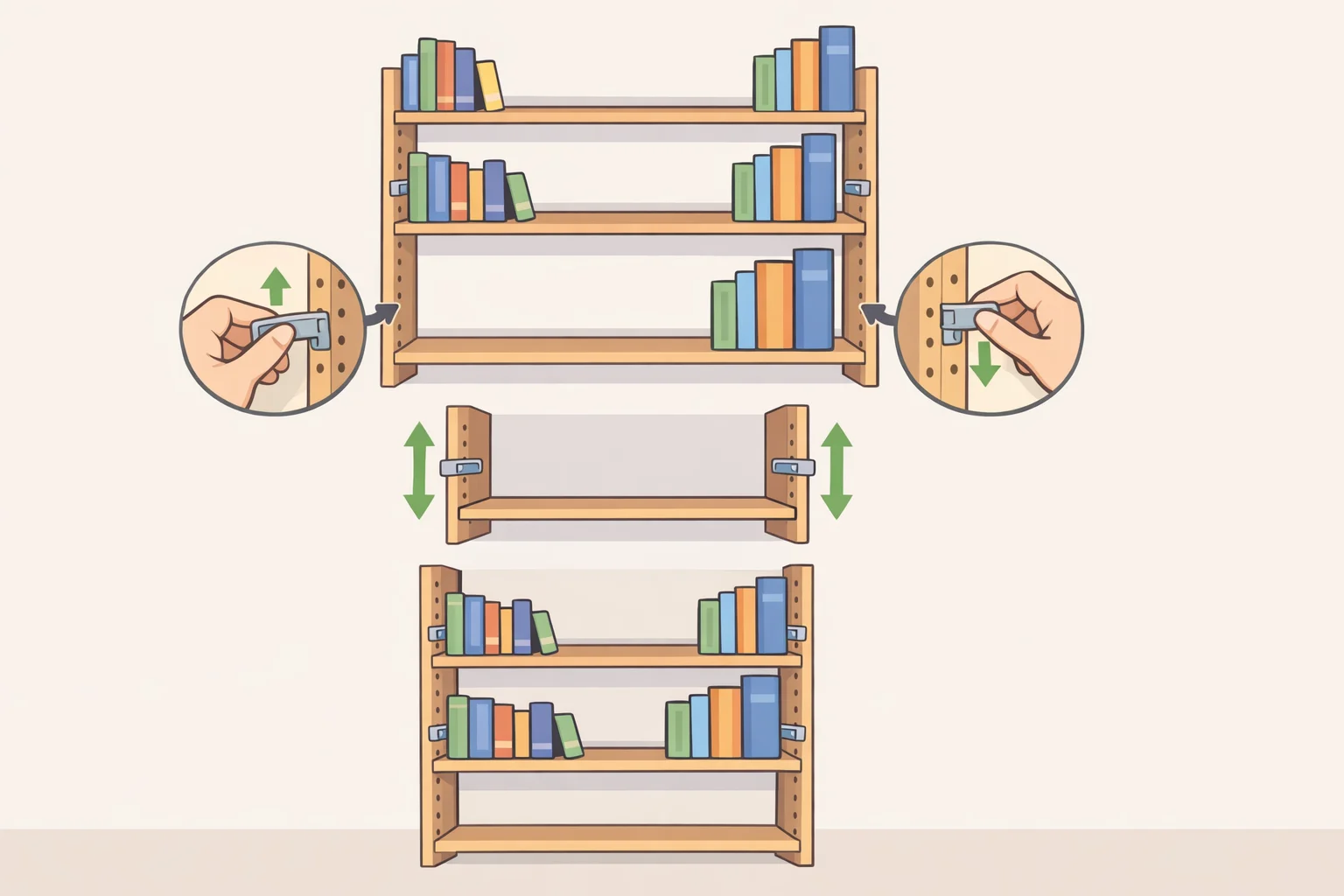
With the bookcase empty, move each shelf to fit the tallest book in its assigned group, plus just enough clearance to slide a book in and out without scraping roughly a finger's width above the tallest spine. Not more. The goal is snug, not airless.
Assign shelf levels from the bottom up:
- Bottom shelf(ves): Group C oversized volumes, stored flat. Large books shelved upright on levels sized for standard hardcovers are a common source of both bent spines and lost space. Cornell's shelving guidance recommends very large books be stored flat with no more than three volumes per stack, and positioned so they can be lifted out cleanly without abrasion or overhead reaching. Set the shelf height to fit that stack, and keep it low.
- Middle shelves: Group B standard hardcovers and trade paperbacks. Most people will want their standard-size books at the easiest reach height, since those tend to be what gets pulled most often.
- Top shelves: Group A smaller paperbacks. Lighter and manageable at arm's reach above eye level.
This is where the space actually appears. Closing excess vertical clearance across multiple shelf levels the gap above every short paperback on a shelf calibrated for a tall hardcover can free meaningful capacity. The exact gain depends on your shelf spacing and book mix. A shelf with a lot of standard-height books beside a few tall outliers will show the biggest improvement. Sorting the books without moving the shelves does not produce that gain. Both steps are required.
Cornell treats shelf height adjustment as standard practice for different book formats, and also notes that shelves should be partially filled to allow for expansion a reminder that the goal is efficient density, not maximum compression.
After this step: The bookcase looks visibly different. Each level sits close to its group's height rather than the tallest book you happened to own.
Step 3: Load the shelves and set the right density
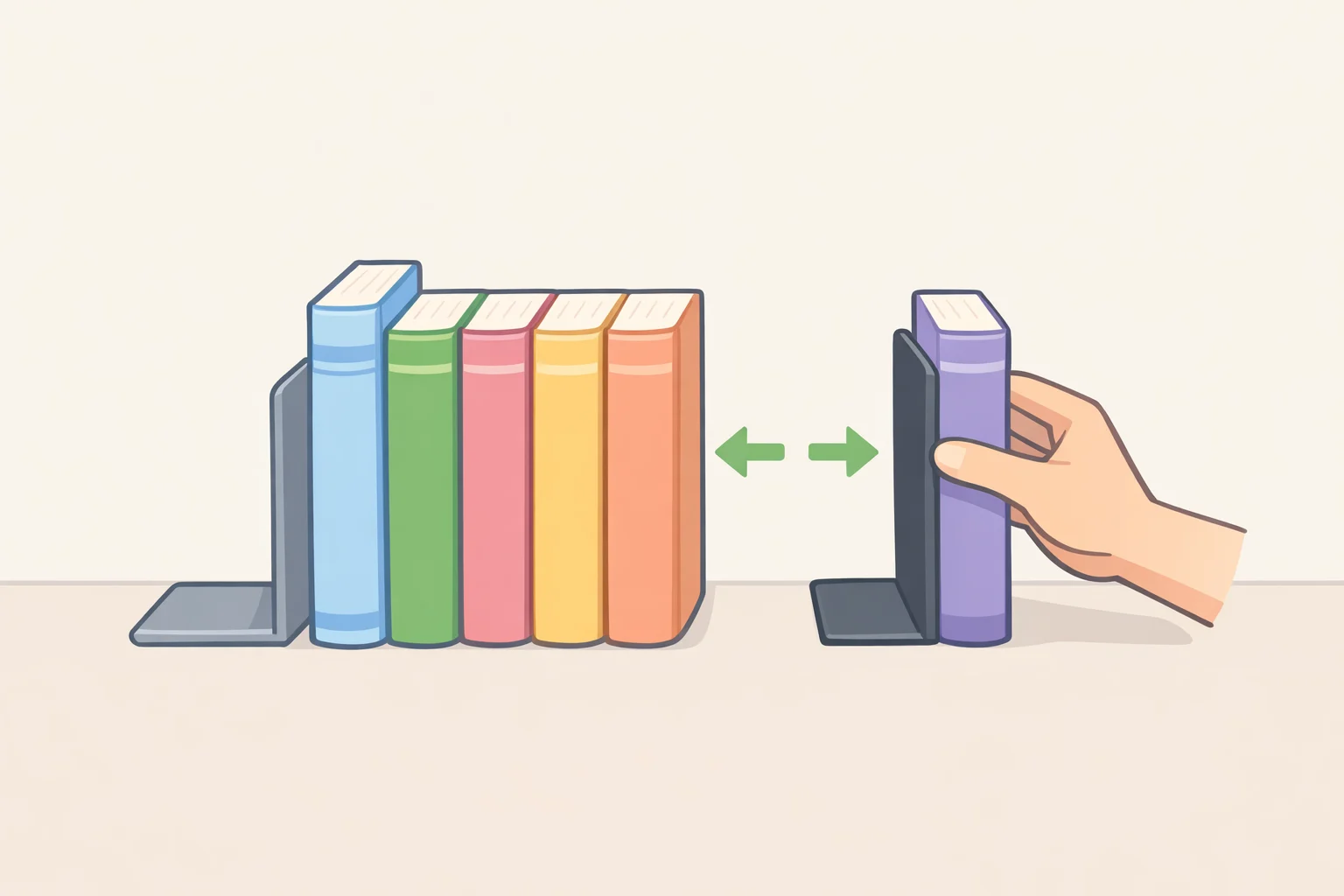
Load each shelf with its assigned group. Stand every book upright on its spine, snug against its neighbors. Where a row doesn't fill a shelf completely, place a bookend at the open end. Cornell's guidelines specify bookends with smooth surfaces and broad edges because a leaning section applies stress to bindings and tends to pull adjacent books over time. Books should not lean, and storing them on their fore-edge causes the same kind of progressive damage to spines and text blocks.
Stop loading a shelf when pulling a single book out requires tugging its neighbors. That's the signal you've crossed from organized into overpacked. Cornell addresses this directly: tightly packed shelves cause abrasion, and excessive compression makes safe removal difficult. A shelf with some breathing room isn't wasted space it's room for the next book you buy.
If your shelves have significant front-to-back depth: A second row of Group A paperbacks placed behind a taller front row can add density for books you rarely need. This is a convenience-versus-capacity tradeoff, not a preservation best practice use it only once the front row is fully upright and stable, and only for books you seldom reach for.
If the shelves are full and books are still left over: The honest answer is a second bookcase. The space recovered here comes from eliminating inefficiency, not from compressing books more tightly. Pushing past the density limit doesn't create capacity it shifts the cost onto the books.
After this step: Every book stands upright, each shelf level fits its group with minimal clearance above, and oversized volumes lie flat at the bottom. The bookcase holds more than it did before.
Keeping track after you sort by height
Height-sorting means books are no longer grouped by author or subject within each level. That's the real tradeoff, and it needs a deliberate solution.
The simplest one for most collections: keep broad subject categories intact within each height group. All Group B fiction together, all Group B nonfiction together. You give up exact alphabetical order but preserve the zones most people actually look for genre and general subject. That's usually enough.
For larger collections, photograph each completed shelf before you start using it. A quick scroll through those images is faster than searching shelf by shelf, and it doubles as a record of what you own.
Either approach removes the main reason people resist this kind of small bookshelf organization: the fear of losing track of books. Pick one, spend two minutes on it, and the method sticks.
What a successful reset looks like
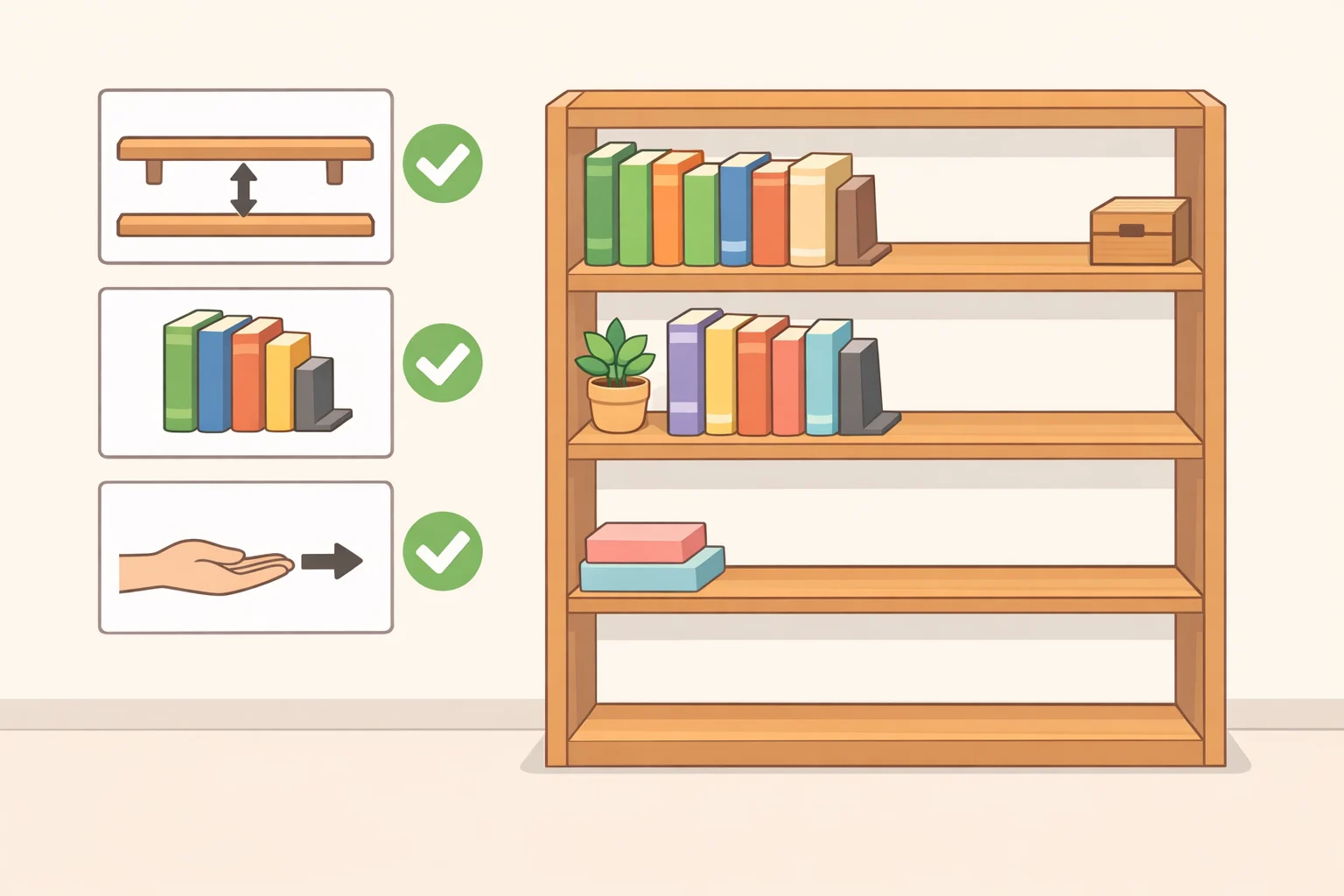
Three checks confirm it worked:
- Every shelf level was physically repositioned not just repopulated with sorted books
- Every row stands upright and is supported at both ends no leaning sections anywhere
- Pulling a single book out does not require tugging its neighbors if it does, the shelf is overpacked
If all three are true, the shelf is working as well as it can without adding furniture. The concrete measure is simple: count how many books fit now versus before, or check whether books that were sitting in overflow piles elsewhere now have a place on the shelf.
The method scales. Apply the same logic to a second bookcase and you start consolidating books currently scattered across rooms one height-sorted shelf at a time, until the collection has a home rather than a territory.


Comments
Be the first, drop a comment!