



How to Make a Guest Bedroom Feel Like a Hotel: A Practical Guide
Most guest bedrooms fail the same way: they look fine but sleep badly. Wellness-focused hotel operators have found evidence-based design strategies associated with sleep-quality improvements of around 30–35% in guest surveys, driven by targeted changes to bedding, light, and room environment not to decor (Design for Travel reported earlier this year). Knowing how to make a guest bedroom feel like a hotel, it turns out, is less about aesthetics and more about removing friction.
The changes that drive those numbers are all replicable at home: darker windows, warmer bulbs, better pillows, a place to put a bag. This guide works through them in order of impact sleep environment first, then bedside convenience, storage, and finally presentation. Readers with limited time or budget will find the minimum-viable version clearly marked at each stage. A hotel-quality guest room doesn't require renovation or a large budget; it requires thinking like a hospitality operator rather than an interior decorator (Good Housekeeping UK noted this earlier this year).
What the room needs before you start
A quick audit before the first step. The room needs a bed that fits at least a full mattress (queen whenever space permits), a power outlet within arm's reach of the bed, and at least one drawer or closet section that can be cleared entirely. No renovation required.
The one condition that overrides everything else: personal belongings need to leave the room. Guests should not feel like they are invading personal space (The Cozy Canvas observed this past June). A spare room still full of the host's things signals borrowed space, not hospitality no amount of hospital corners fixes that.
Step 1: Fix the sleep environment first darkness, light, sound, and the bed itself
What you'll accomplish: A room where guests actually sleep well, which is the single highest-return improvement available.
Hotel designers treat sleep quality as the primary performance metric for any guest room, ahead of aesthetics, layout, or amenities (Design for Travel earlier this year). The three environmental factors most responsible for that metric are darkness, light temperature, and noise. Each has a different ceiling for what's fixable at home, but all three have a practical version.
Darkness the most underdelivered element
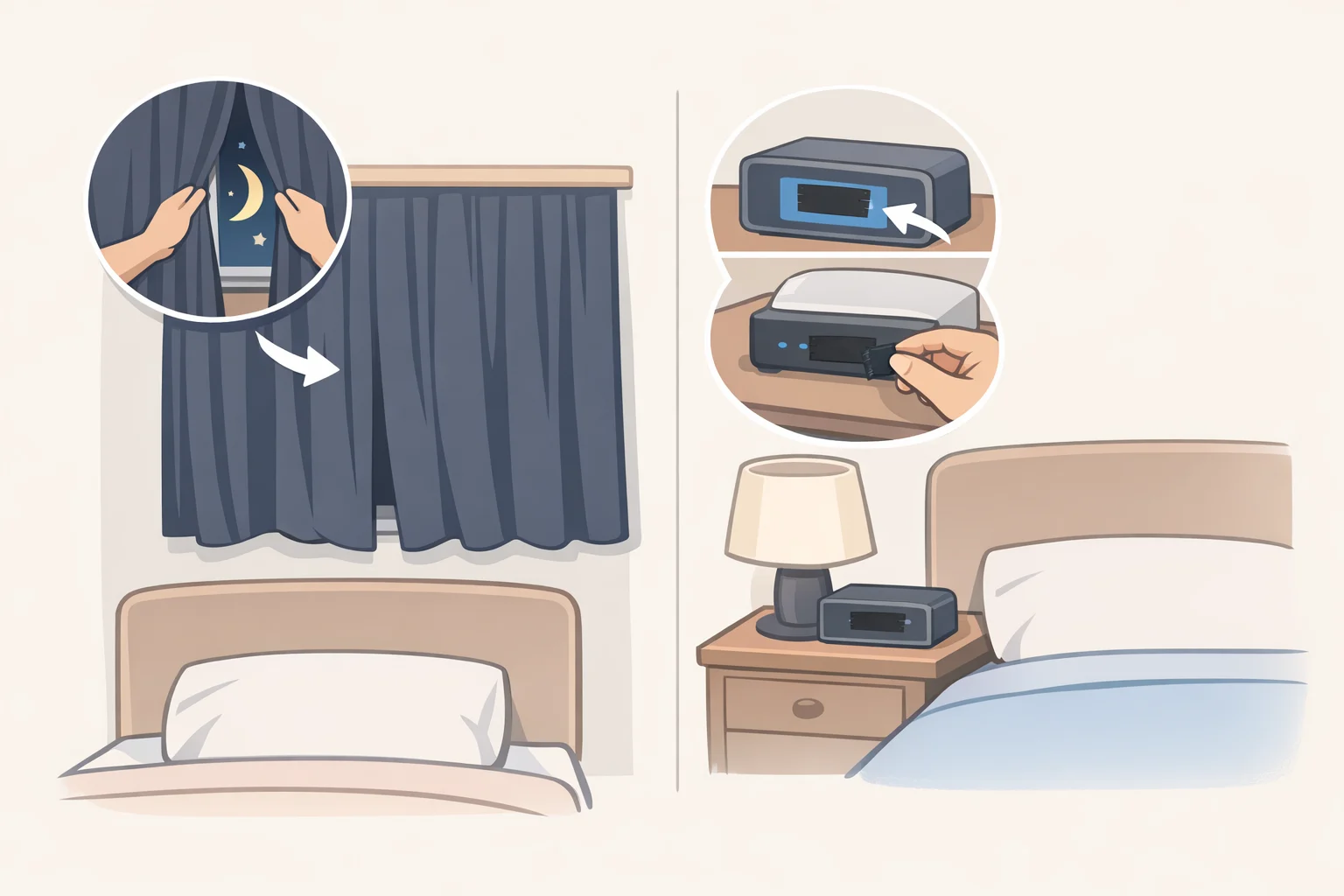
Blackout is the second pillar of sleep-first room design, and it's where even well-resourced hotels routinely underperform (Design for Travel earlier this year). For a home guest room, the practical fix is blackout curtain liners clipped or sewn behind existing curtains inexpensive, rental-friendly, and far more effective than heavy decorative drapes that still leak light at the edges.
Cover or remove any blinking LEDs in the room: standby lights on TVs, charger indicators, router lights. Hotel night-mode design specifically eliminates blue light spill from switches and blinking sensors because these sources keep vertical illuminance at the eye high enough to suppress melatonin (Design for Travel earlier this year). They seem trivial. They're not.
Light temperature a quick fix with outsized impact
Replace any cool white bulbs in the room with warm-toned alternatives before guests arrive (The Cozy Canvas this past June). Current hotel design practice has moved toward circadian lighting logic: cooler light during the day, warmer light in the evening, nothing blue near the bed at night with the goal of keeping illumination low enough to avoid melatonin suppression (Design for Travel earlier this year). Swap to warm-toned bulbs throughout the guest room. It takes two minutes and makes the room feel immediately calmer.
Noise address what you can
Luxury hotel standards target background noise at the pillow of around 30 dB(A), roughly the level of a quiet library (Design for Travel earlier this year). Walls can't be soundproofed on short notice, but rattling HVAC vents can be closed, a white noise app or compact machine can mask irregular sounds, and a rug reduces noise reflection in hard-floored rooms. These are partial solutions worth doing, not worth pretending they solve everything.
The bed itself
Go queen over full whenever the room allows (The Cozy Canvas this past June). For bedding, quality cotton sheets percale or sateen both work matter more than thread count marketing (The Cozy Canvas this past June). For anyone who wants tested benchmarks: Good Housekeeping's sleep-expert review named the Brooklinen Luxe Core Sheet Set, The Company Store Legends Hotel Premium Alberta Down Comforter, and the Coop Home Goods Original Adjustable Pillow as hotel-quality options (Good Housekeeping this month). Use those as a quality reference, not a required shopping list.
Stock at least one firm pillow and one soft pillow, both visible and available without guests having to ask. Hotels do this because everyone sleeps differently, and no guest should spend the night fighting a pillow that doesn't work for them (The Cozy Canvas this past June). Leave a lightweight cotton waffle-weave or thin knit throw at the foot of the bed out in the open, not in a drawer so guests can grab it without wondering whether that's allowed (The Cozy Canvas this past June).
Minimum viable version: If only one thing gets done in this step, fix the darkness. Blackout liners and covered LEDs are inexpensive and address the environmental factor most responsible for poor guest sleep.
Step 2: Set up the bedside for zero friction
What you'll accomplish: A guest who can charge their phone, turn off the light, and get a drink of water without leaving the bed or solving anything.
A proper bedside setup is where the low-friction principle becomes most visible and most often missing in home guest rooms (The Cozy Canvas this past June). The goal is simple: guests should not have to figure out a complicated system just to turn off a light or charge a phone.
The non-negotiables:
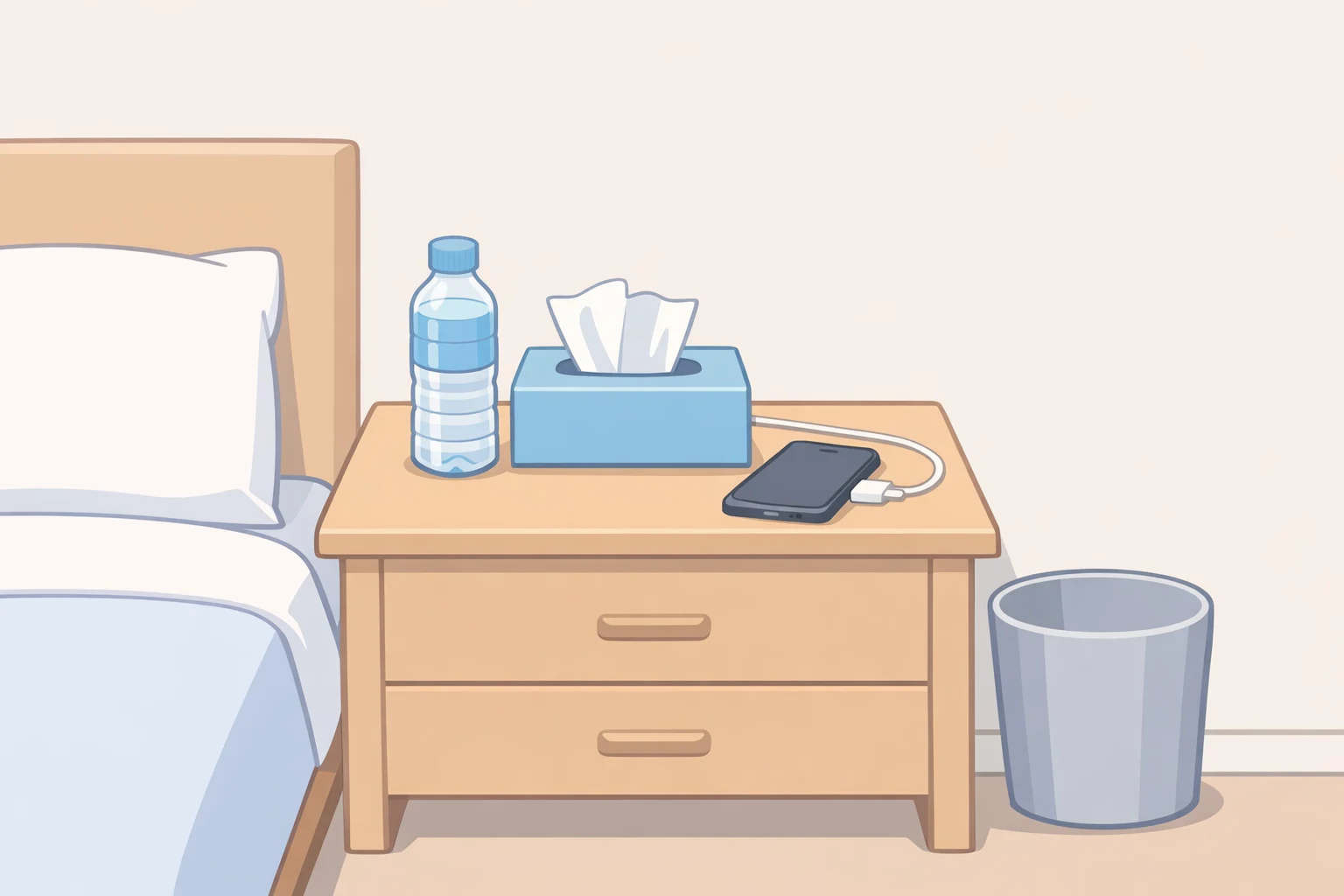
- A nightstand within easy arm's reach compact is fine, a stool or small tray table works if there's no furniture, but something must be there
- A bedside lamp with a switch reachable from the pillow; no guest should have to cross the room to kill the overhead light before sleep (The Cozy Canvas this past June)
- A phone charger plugged in at the nearest outlet to the bed (Good Housekeeping UK earlier this year)
What goes on the nightstand:
- A sealed bottle of water, placed fresh before the guest arrives not one that's been sitting there for a week (The Cozy Canvas this past June)
- A fresh box of tissues, not the three-quarters-empty one left from the host's last cold (The Cozy Canvas this past June)
- A small waste basket within reach; guests generate small rubbish and shouldn't have to pile it on the nightstand (The Cozy Canvas this past June)
For small rooms with no outlet near the bed: a short extension cord or a bedside charging station tucked behind the nightstand solves this without any wiring work. Prioritize this over nearly any decorative addition.
Step 3: Give guests real storage enough to actually unpack
What you'll accomplish: A room that signals preparation, not afterthought the functional gap between a hotel-inspired guest bedroom and a spare room.
A guest without a dedicated place for their bag spends the entire stay living out of a suitcase on the floor. That single condition is what makes a room feel like borrowed space (The Cozy Canvas this past June). The fix costs almost nothing.
Luggage rack or bench
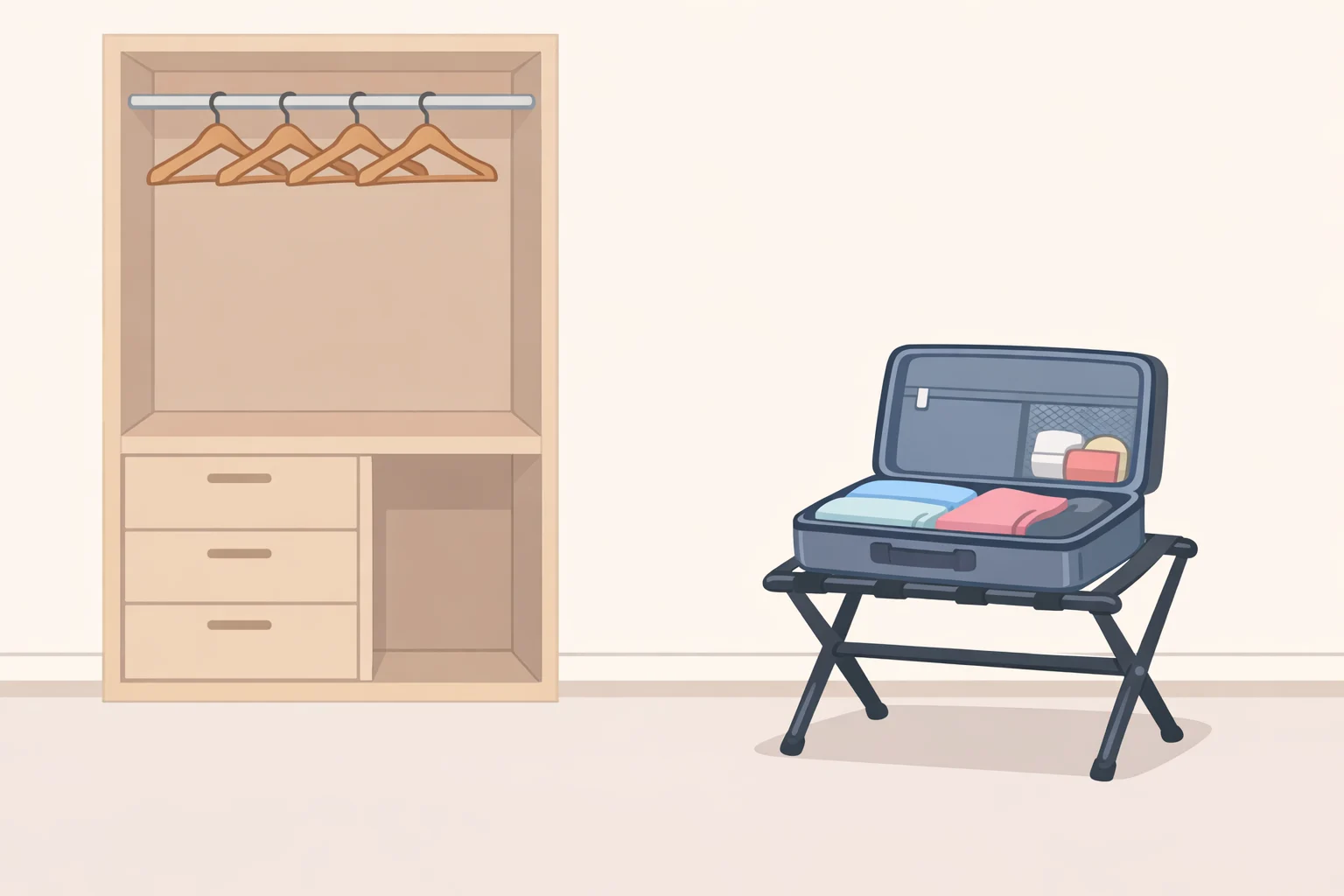
A folding luggage rack gives the room an unmistakably hotel-specific quality it folds flat when not in use and tells guests immediately where their bag goes (Good Housekeeping UK earlier this year). A low bench, ottoman, or cleared section of dresser top works as an alternative. The point is a designated surface at suitcase height, not floor level.
Drawer and closet access
Clear one full drawer not a half-drawer with things pushed to the back, a genuinely empty one (The Cozy Canvas this past June). Hanging space is one of the biggest priorities for a guest bedroom; leave several empty hangers on an accessible section of rail, because guests with anything that wrinkles will use them and their absence is noticed (The Cozy Canvas this past June). No closet? A hook rail on the back of the door and a small basket for folded items is imperfect but functional.
Full-length mirror and towels
A full-length mirror belongs in every guest room (The Cozy Canvas this past June). A leaning mirror requires no wall work. Place fresh towels in the room itself on the bed, dresser, or a visible hook rather than leaving guests to hunt for them elsewhere (The Cozy Canvas this past June). Seeing them in the room confirms they're for the guest's use. Having to ask is the thing that makes someone feel like an imposition.
Step 4: Presentation the final layer, not the foundation
What you'll accomplish: The visual finish that turns a well-equipped room into one that feels intentional without drifting into over-decoration.
Presentation does the most for a room that's already working underneath. Applied on top of a poorly set-up room, it's just staging. Get the sleep environment, bedside, and storage right first, then spend twenty minutes on the below.
Bed-making
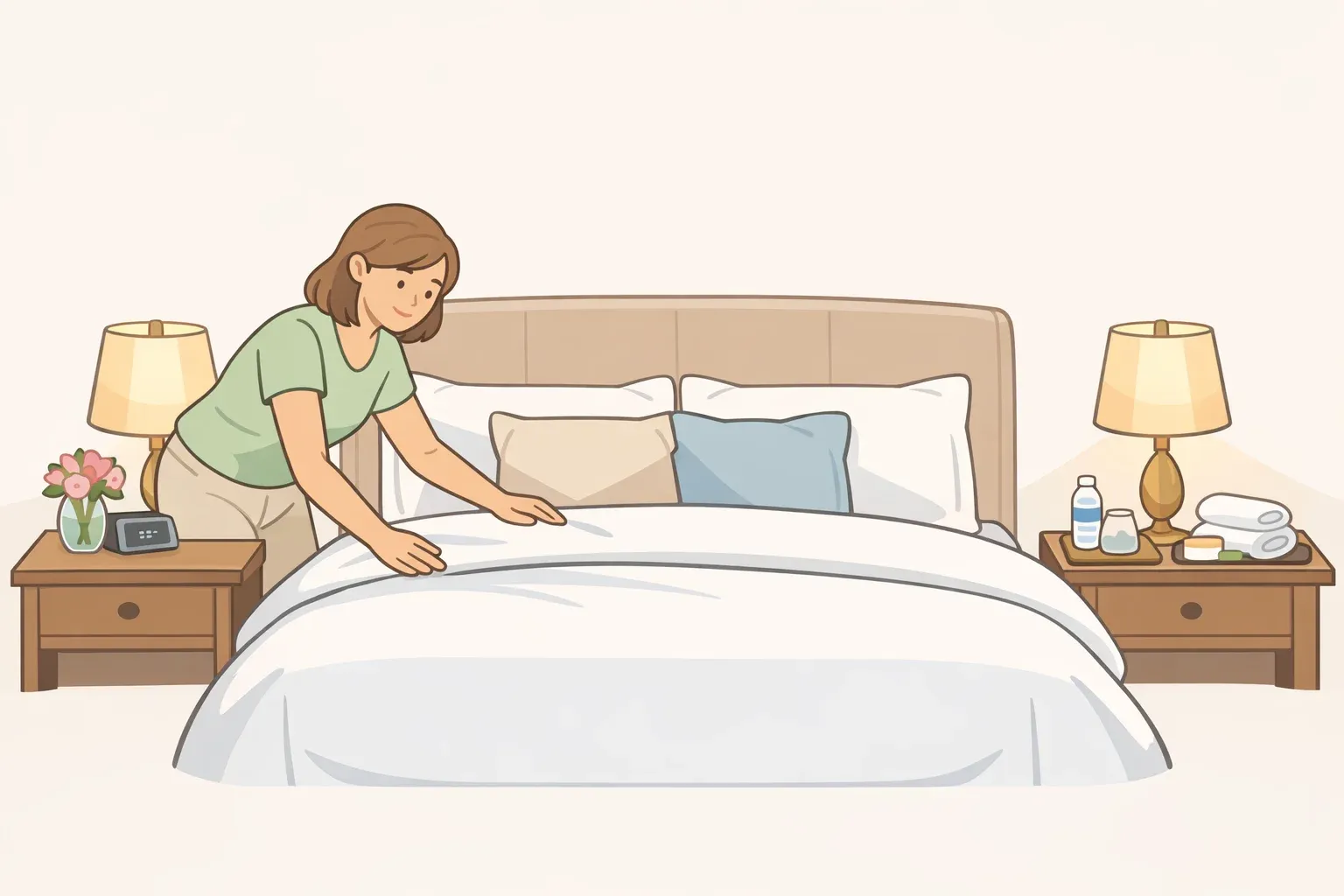
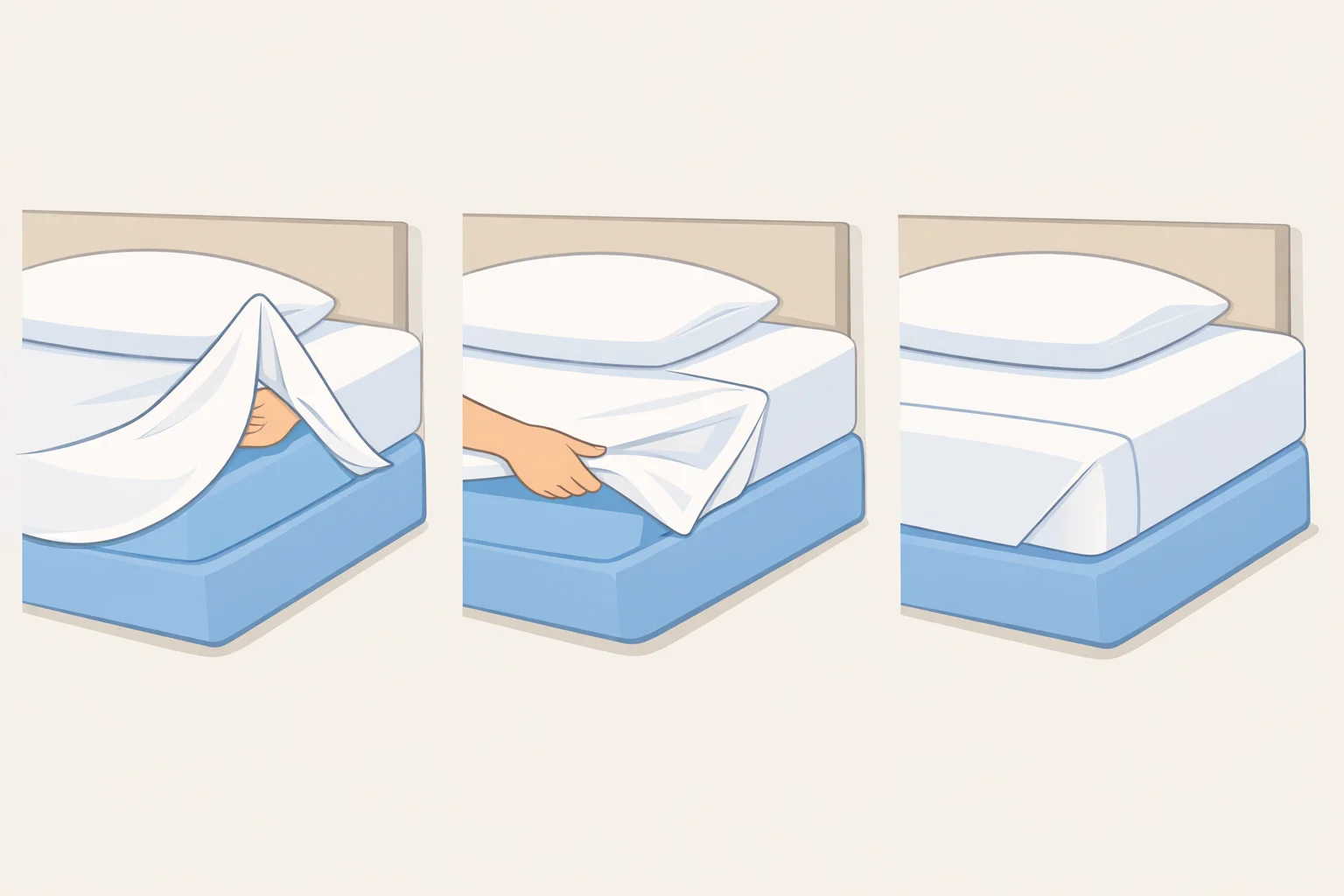
Hospital corners the 45-degree fold used in hotel and military bed-making since the 19th century are the fastest way to make a made bed look professionally finished (Good Housekeeping UK earlier this year). The method: tuck the bottom end of the sheet firmly under the mattress, lift the side section about 30–40cm from the corner onto the bed to form a diagonal, tuck the hanging portion under, then fold the diagonal back down flat. Clean corners that actually stay put (Good Housekeeping UK earlier this year).
Iron only what's visible: pillowcases lightly dampened for a crisp finish, and the top third of the duvet cover that folds back over the bed. Use a steam iron on a medium-high cotton setting, around 180–200°C (Good Housekeeping UK earlier this year). The rest of the bedding doesn't matter guests will never see it.
Scent and freshness
Do this before any bed-making. Bicarbonate of soda neutralizes odors absorbed by mattresses and upholstery: sprinkle across the surface, leave for at least 30 minutes (overnight if possible), then vacuum thoroughly (Good Housekeeping UK earlier this year). A room that smells clean registers as well-maintained in a way that no amount of decoration replicates.
Aesthetic restraint
Traditional minimalism often feels cold; warm minimalist interiors natural textures, calm materials, less visual noise create spaces that read as inviting rather than sparse (Design for Travel earlier this year). In practice for a home guest room: a woven throw at the foot of the bed, a wooden tray to organize nightstand items, one small object that isn't functional clutter. Restraint is the move, not addition. Remove decorative items that belong to the host, not the guest books, photos, keepsakes. That stuff reads as storage, not hospitality.
The pre-arrival reset checklist
A room where guests can sleep well, charge their phones, and unpack without asking permission already feels more generous than most spare bedrooms. The hospital corners are appreciated, but they're not what anyone remembers (The Cozy Canvas this past June).
These are the guest bedroom essentials for guests arriving tonight:
- [ ] Blackout liners on windows, LEDs covered or removed
- [ ] Warm-toned bulb in the bedside lamp
- [ ] Phone charger plugged in at the nightstand
- [ ] One firm pillow and one soft pillow, both visible
- [ ] Lightweight throw at the foot of the bed
- [ ] Sealed water bottle and fresh tissues on the nightstand
- [ ] Small waste basket within reach
- [ ] Luggage rack or cleared surface for a bag
- [ ] One empty drawer, several empty hangers
- [ ] Fresh towels placed in the room
Upgrades once the essentials are covered:
- Hotel-quality cotton sheets, benchmarked against tested options like the Brooklinen Luxe Core Sheet Set (Good Housekeeping this month)
- Full-length mirror, leaning against the wall, no installation required
- Bicarbonate of soda treatment before making the bed
- Hospital corners and ironed pillowcases for presentation
- A hairbrush or a few hair ties on the dresser small, occasionally essential (Good Housekeeping UK earlier this year)
For anyone who wants to extend the same approach to adjacent spaces, the natural next steps are bathroom hospitality basics and bedding care both of which follow the same logic: friction first, aesthetics second.




Comments
Be the first, drop a comment!