



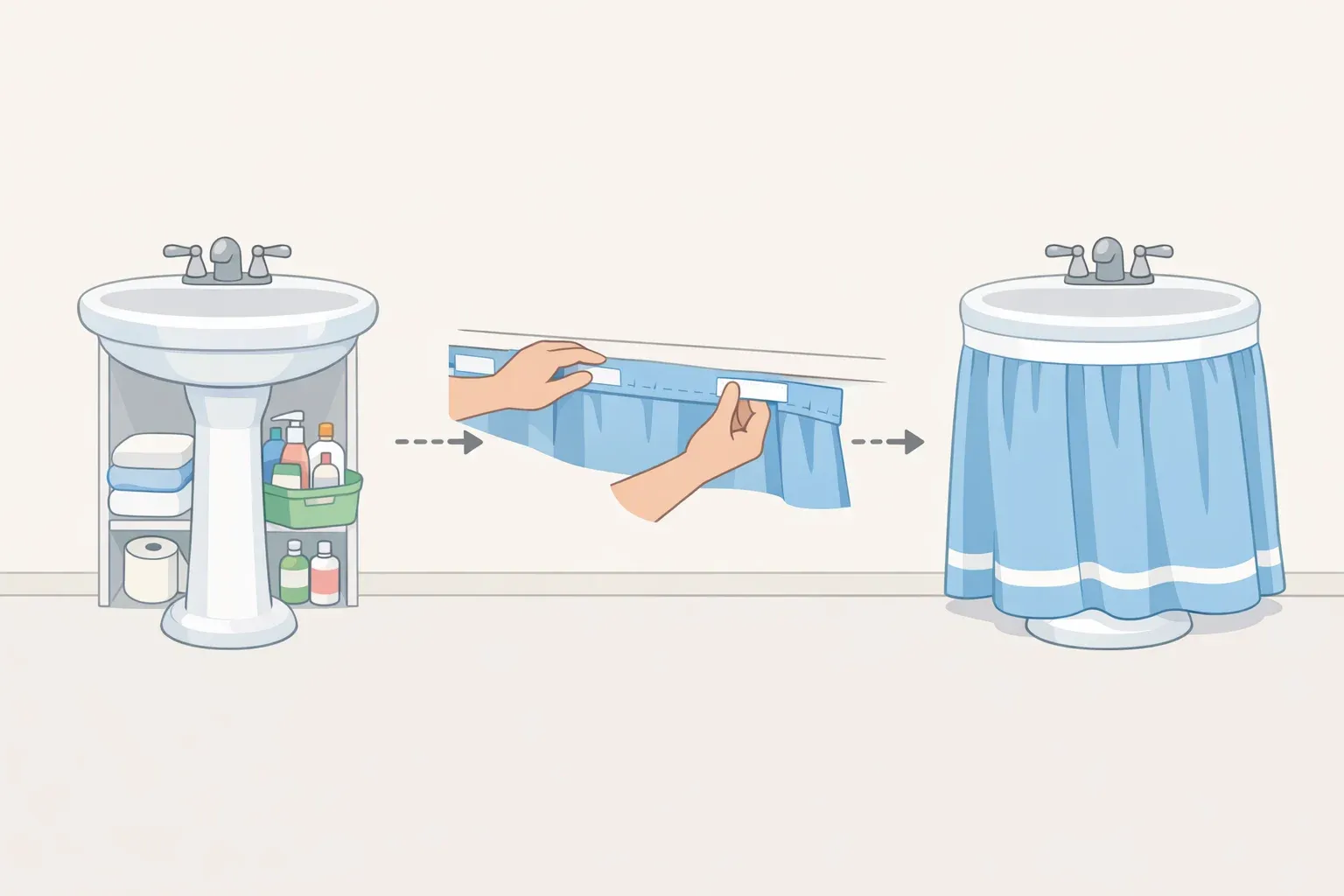
A pedestal sink or open vanity leaves everything underneath fully visible: the cleaning spray, the spare toilet paper rolls, the hair dryer cord that never made it back to a drawer. A bathroom sink skirt doesn't create new square footage. It makes that awkward open cavity usable rather than ignored.
In an account in The Spruce, Elena Navarro, a cleaning professional at Sparkly Maid Austin, puts sink skirts in the same category as hand towels and shower curtains: bathroom textiles that need occasional washing, not constant management. The biggest hesitation most people have about fabric near a bathroom sink is sanitation. Navarro's answer is short: treat it like the other textiles already in the room.
The fastest path here is a shower curtain. Cut off the top header, attach with Velcro, no sewing required.
That Velcro detail matters more than it sounds. The skirt only works long-term if it's washable. Washable means detachable. Detachable means choosing an attachment system that allows clean removal from the start. That chain of decisions shapes everything below: which fabric to buy, how to cut it, what to store underneath, and how to keep it clean without it turning into a project every few months.
Pedestal sink skirt fit check: is this project right for your setup?
Before buying anything, think through whether your sink is a practical candidate. The attachment surface determines whether this works at all.
Where this tends to work well:
Pedestal sinks with a smooth porcelain surface just below the basin rim, where adhesive-backed Velcro can make flat, consistent contact
Open vanities or frameless sink cabinets without doors
Renters who can't drill hardware or install cabinetry, since adhesive Velcro pulls cleanly from smooth porcelain
Where it gets more complicated:
Textured, painted, or porous surfaces below the rim. Adhesive tape may not grip reliably over time, and it's worth running a short test strip on an inconspicuous spot before committing to the full installation.
Limited vertical clearance between rim and floor. Less room means less usable storage underneath and a skirt that can look squeezed rather than intentional. Think through whether the space is actually worth concealing before buying anything.
Sinks with persistent condensation or moisture on the outer basin. The skirt will need washing more often, which is manageable once the system is set up, but worth knowing before choosing a fabric that requires more careful laundering.
Both interior designer Ali Bryde, founder of Mustard Seed Beginning and MSB Interior Design LLC, and Navarro identify double-sided Velcro as the right attachment hardware because it allows full removal without damage. Whatever attachment method you consider, clean detachability is the one thing it can't compromise on.
What you'll need before starting:
Washable fabric or a shower curtain
Double-sided heavy-duty adhesive Velcro tape
Scissors or fabric shears
A tape measure
A clean dry cloth for surface prep
An iron and flat drying surface if using linen
Step 1: Choose your fabric first, then measure and cut
Fabric selection comes before measuring because it determines how the skirt hangs, how it gets cut, and what the maintenance routine looks like. Make this call before picking up a tape measure.
Fabric options, in order of ease:
Shower curtain (easiest path). Already close to the right width for most sinks, already hemmed on three sides, and built for wet environments. DIY blogger Suzannah Stanley, founder of Create/Enjoy, uses sink skirts across two bathrooms and a laundry room and recommends shower curtains specifically for readers who want a washable, low-prep option. "You just need to cut off the top, and it already is hemmed and has the sewing on the edges." Cut the header, and the bulk of the work is done.
Medium-weight cotton or linen. The materials Bryde and Stanley use in their own setups. Stanley has tested a range across her three installations: semi-thick cotton shower curtains, polyester curtain fabric, two layers of fine cotton voile. Her conclusion is specific: "I found a medium-weight fabric is best, because you need the gathers to stay gathered and pressed against the adhesive tape." Lighter materials sag away from the tape over time. Bryde's preference is linen: "Linen will drape beautifully while giving off that relaxed aesthetic," she told The Spruce.
Color and pattern. Navarro recommends patterned or darker fabrics over solid light tones. "They will help conceal minor stains that occur between washings," she told The Spruce. A pattern earns its keep between wash cycles in a way solid white linen won't.
Measuring and cutting:
Measure the sink's front face width from edge to edge at the point where the skirt will attach, just below the basin rim.
Measure the vertical drop from that attachment point down to the floor.
Cut fabric wider than the sink measurement to allow for gathers. A flat panel without gathers tends to pull away at the corners and looks stiff rather than draping naturally. Roughly 1.5 to 2 times the sink width gives a full gather; adjust down if you want something more tailored.
Cut the length slightly longer than the measured drop, then plan to fold or hem the bottom edge so it clears the floor by about an inch. Fabric that drags picks up moisture and soils faster.
One linen-specific warning: Bryde air-dries her skirt flat and skips fabric softener. "Mine is linen, and I was afraid of shrinking and the tassels getting gross." If linen is the choice, decide on the care routine before the first wash, not after discovering the skirt no longer reaches the floor.
How to add a sink skirt to a bathroom sink with Velcro so it comes off clean
Removability is the design priority. These steps assume a smooth porcelain surface; give the adhesive time to set before putting any stress on it.
Wipe down the attachment surface on the underside of the sink rim with a dry cloth, clearing away soap film, moisture, and dust. Adhesive bonds poorly to a contaminated surface, and it's a common reason installations don't hold.
Run a strip of double-sided Velcro tape along the rim where the skirt will hang. Press firmly along the full length. Check the tape packaging for set time before attaching fabric.
Attach the opposing Velcro strip to the top edge of the fabric. Distribute gathers evenly before pressing the strip flat; thin spots where fabric bunches can leave gaps where the tape won't make full contact.
Press the fabric firmly against the mounted tape along the full length. Give extra pressure at the corners, where edges most commonly lift.
Check that the skirt hangs level. If an edge doesn't lie flat, a short additional Velcro section at that point usually fixes it.
Bryde's double-sided Velcro setup has held up for years and needed replacing only once. Navarro endorses the same approach for the same reason: it comes off without tools when you need plumbing access or want to reach what's stored underneath. "The detaching hardware is important when needing to access the plumbing or under-sink storage areas." A skirt you can't pull off cleanly defeats the point.
When things don't hold:
Corners lifting shortly after installation: The surface likely had residue or moisture before taping, or the tape grade is too light for the fabric weight. Strip it back, clean the surface, let it dry fully, then try again with heavier-duty adhesive Velcro.
Fabric sagging in the middle: Either too little tape contact or the fabric is too lightweight. A second tape run parallel to the first can help, as can switching to a medium-weight material.
Skirt dragging on the floor after washing: The fabric shrank. Air-dry going forward and re-hem the bottom edge if needed.
Adhesive residue on porcelain after removal: Rubbing alcohol on a cloth lifts it cleanly from smooth porcelain.
Under-sink skirt storage: what actually fits and how to keep it accessible
The space under a pedestal sink is the same dimensions it was before. What changes is that you can now use it for things that would look like clutter in the open, without having to see them every day.
For pedestal sinks specifically, the pedestal base occupies the center, so usable storage sits on either side of it rather than directly in front. That's the zone to organize. Keep whatever you reach for most often toward the front of those flanking areas, in containers you can pull out without disturbing everything else.
Spare toilet paper rolls in an open-top bin, cleaning sprays in a low caddy, a backup bar of hand soap. Low-profile containers matter more here than in a full cabinet, since vertical clearance under a pedestal is often limited.
Skip anything with a lid. The skirt is already handling concealment; a lid just adds a step when you need something quickly. One or two containers you can slide out as a unit also make washing the skirt easier, since loose items scattered across the floor each wash cycle become a recurring chore.
The area around the pedestal base and drain pipe is not usable storage regardless, so leave it clear; it's also the first thing you need to reach if something goes wrong with the plumbing.
The actual payoff is realistic. A pedestal sink with nothing underneath becomes one with toilet paper, cleaning supplies, and a spare soap quietly out of sight. Not doubled capacity, but space that was functionally wasted becoming space that works.
How to keep it clean without overthinking it
Navarro's benchmark is plain and useful: "If you would not feel comfortable wiping your hands upon it, it has gone too long without being put through the wash cycle," she told The Spruce. Same bar as a hand towel.
Bryde washes hers every few months, alone in the machine, without fabric softener, then lays it flat to dry. Stanley spot-cleans between full washes, targeting toothpaste stains at the base of the sink. Both approaches work; the right one depends on the fabric and how much the sink sees daily use.
Care by fabric type:
Linen: Machine wash cold, no softener, air-dry flat. Iron while slightly damp if needed.
Medium-weight cotton: Machine wash; check the care label before putting it in the dryer, especially if the fabric has any decorative trim.
Shower curtain fabric: Machine wash per the care label on the original curtain.
Bryde has kept the same setup running for years; Stanley runs it across three rooms, per The Spruce. Neither describes it as a burden. A sink skirt asks roughly the same attention as any other textile in the bathroom.
What to do next
Three decisions settle this project. Fabric first: a shower curtain if speed matters, since it's already close to the right width and needs minimal prep. Linen or medium-weight cotton if the look calls for something softer, with air-drying built into the plan from the start. Whatever the fabric, medium weight is what keeps gathers pressed against the tape rather than slumping away from it over time.
Attachment second: Velcro, with real track records behind it from both Bryde and Stanley. If the aesthetic calls for a different fabric down the line, swap it in using the same method. The system stays the same; only the fabric changes.













Comments
Be the first, drop a comment!