



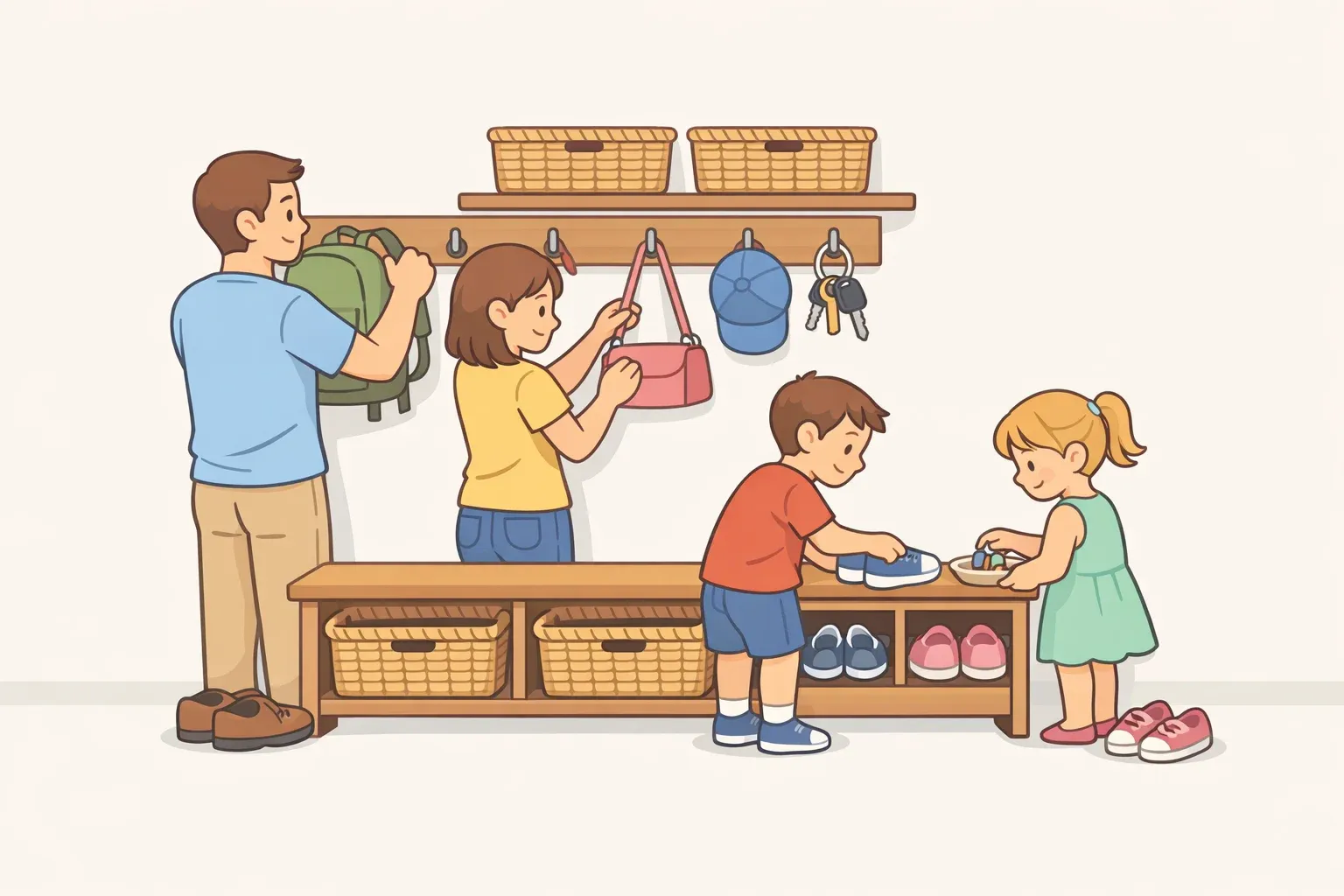
Functional Entryway Ideas: 5 Pieces That Control Daily Clutter
Here's what this guide delivers: five specific items that belong in a working entryway, how to choose the right version of each for the household that actually lives there, and one planning step that determines whether any of it holds. Skip the planning step and the five items will likely become clutter within weeks. Start there, and the rest follows.
The premise isn't "buy better organizers." Functional entryway ideas work when they match how a household moves through the door not how it intends to move through the door. Designer Sasha Basso of Capiz Studio put it plainly in Good Housekeeping earlier this year: it's infinitely easier to change a piece of furniture than to upend years of personal habits, and nothing kills good design faster than clutter. The corollary is uncomfortable but useful. Design around the habits you have, not the ones you plan to develop.
Designer Christopher Boutlier adds the other half of the equation. An entryway that's beautiful but doesn't function will always feel slightly chaotic; one that functions but has no charm is a missed opportunity, according to Good Housekeeping. Both conditions have to be true at once. A studio apartment entry nook and a four-person house with a mudroom won't implement these five items identically, but the logic applies to both.
Before the list: one planning step that determines whether any of this works
This isn't a design project. It's three honest questions that take about five minutes. The key word is honest Good Housekeeping reporting on this specifically flags that answers need to be honest, not aspirational. Aspirational answers produce storage that looks right on paper and gets ignored in practice.
Question 1: Who comes through the door, and how often? David Quarles IV, principal designer of Studio 417, notes that if a household has multiple people coming and going, any open console surface will likely become a drop zone for clutter rather than a useful landing spot, as Good Housekeeping reported earlier this year. A solo commuter needs a different setup than two adults, two kids, and a dog.
Question 2: What physically comes in with you? Coats, bags, shoes, sports equipment, mail, groceries. Write it down. The list determines the storage categories and surfaces where things will drop whether there's a designated spot or not.
Question 3: What do you grab on the way out? Keys, wallet, sunglasses, a child's bag. These items need to live somewhere visible and within arm's reach, not tucked in a cabinet.
Finish these three questions with a rough mental map: what needs to be hidden, what needs to be grabbed daily, and where coats and shoes will realistically land. That map not a shopping list is what makes the five items below fit. As Good Housekeeping put it: settle on what should go where and how it will be used, before committing to any specific piece.
One furniture note before continuing. Open consoles are popular entryway choices, but Quarles IV's point applies here: in any household where multiple people move through daily, a flat open surface tends to collect clutter rather than control it. If that's the situation, let the five items below carry the work instead.
Functional entryway ideas: the 5 pieces that do the work
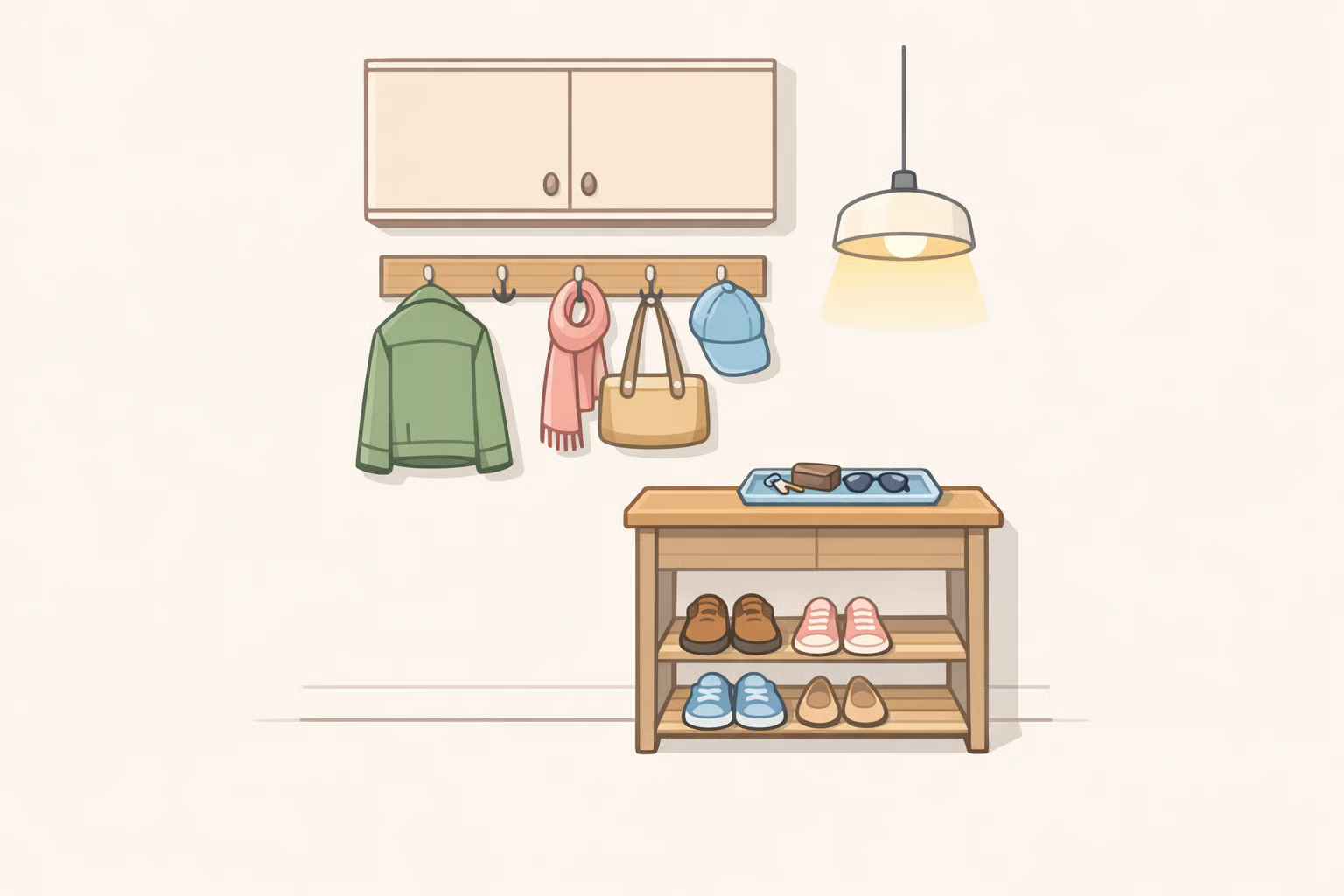
Each item on this list earns its place by solving one specific problem. Erica Leader, owner and principal designer of The Northwest Home, lays out the core framework in Good Housekeeping: closed storage for overflow, open hooks for daily use, and shelves for shoes. The tray and lighting complete the system. This is the entryway storage ideas framework that holds across entry types and household sizes.
1. Closed storage for everything that shouldn't be visible
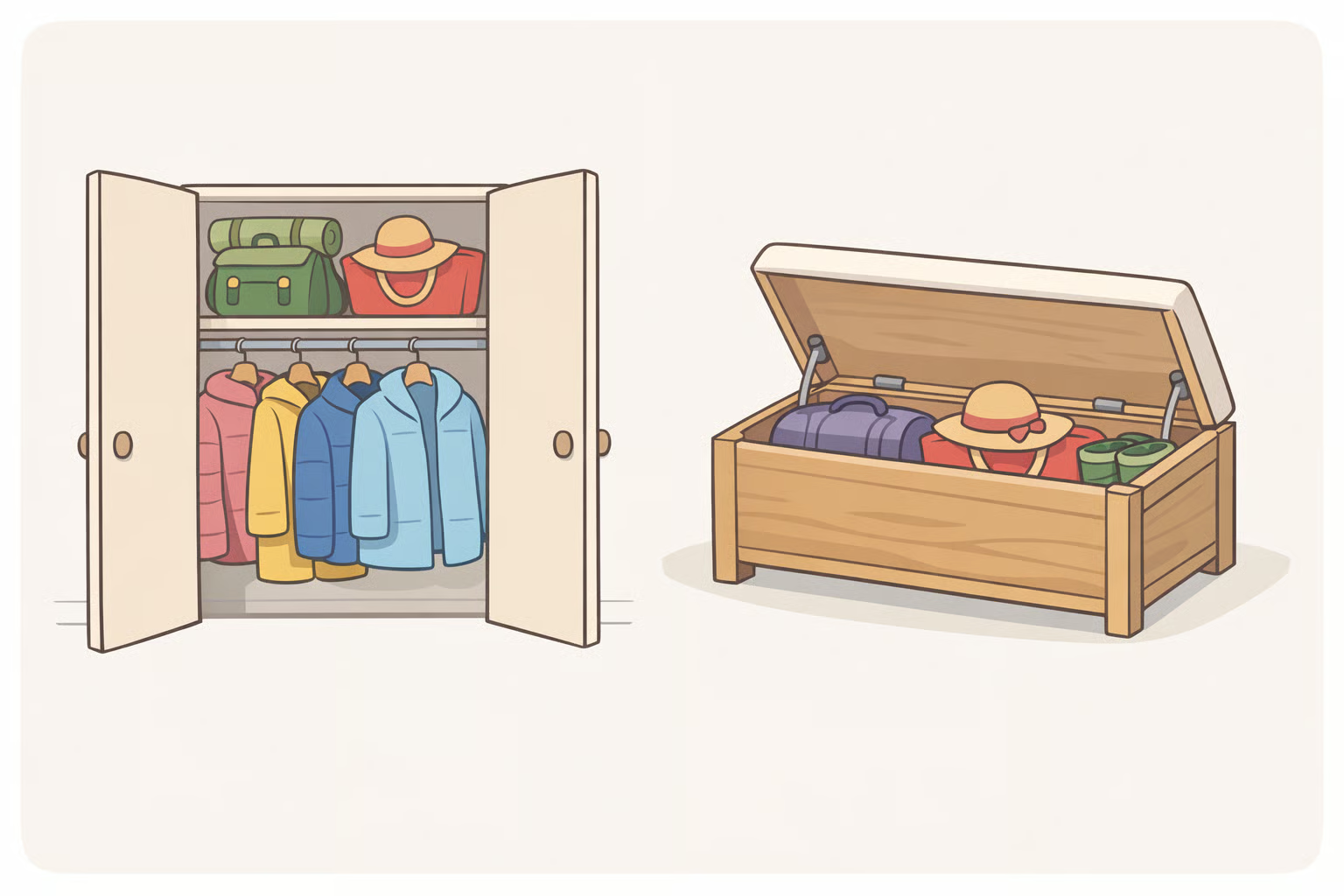
Out-of-season coats, extra bags, umbrellas, the things that accumulate but don't need daily access these are what make an entryway look cluttered even when it's technically organized. Without somewhere to put them out of sight, they'll land on whatever surface is nearby.
Leader recommends closed storage specifically for overflow and out-of-season coats, things that need a home but not a prominent one, per Good Housekeeping. A cabinet with doors, a storage bench with a hinged lid, or a wardrobe-style unit all work depending on available wall space.
The gotcha: assign the closed storage one category and hold to it. A cabinet designated for off-season coats stays functional. A cabinet that absorbs everything nobody wanted to deal with hides chaos temporarily it doesn't resolve it. Pick the category before you buy the piece.
2. Dedicated hooks, with a clear division between residents and guests
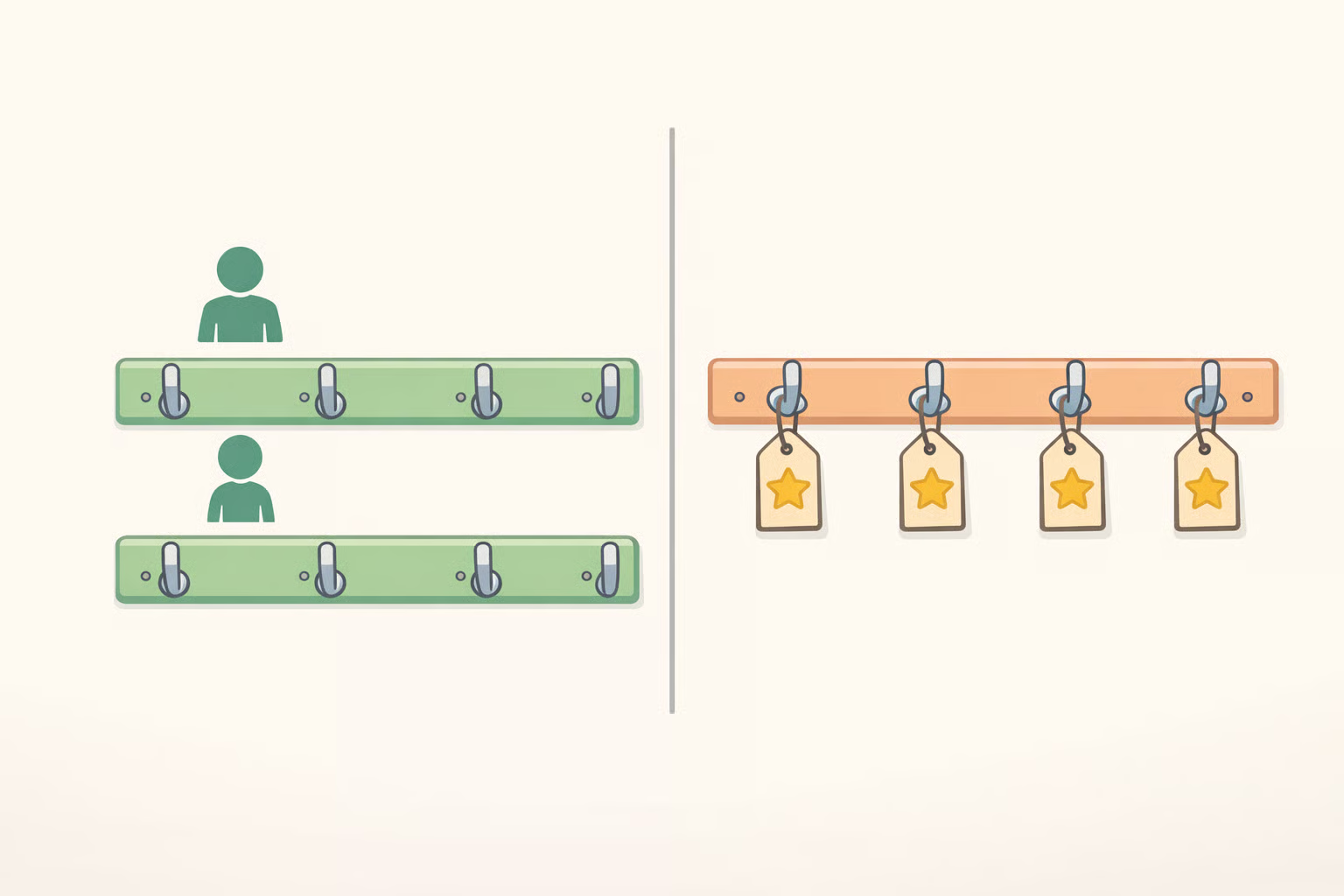
Coats and bags that land on the floor, the nearest chair, or a single overloaded hook are a storage problem, not a discipline problem. There's nowhere with less friction than the floor, so that's where things go.
Leader draws a specific distinction between hooks for the people who live there and hooks for guests, noting they serve different functions and shouldn't compete for the same hardware, as reported in Good Housekeeping. A wall-mounted rail or individual hooks at two heights adult level and a lower row for children or bags handles both. The pairing with closed storage is deliberate: hooks for what's used every day, concealment for everything else.
Don't install more hooks than the household realistically uses. Extra hooks attract extra items, and a rail with unclaimed hooks becomes a secondary clutter zone. One hook per regular user plus a couple for guests is a reasonable starting point.
3. A dedicated shoe zone which often doubles as a landing surface
Shoes scattered across the floor are the most reliable source of visual chaos in any entryway. They're also a tripping hazard, which matters more at 7 a.m. than it seems when shopping for furniture.
Leader names shoe shelves as one of three non-negotiable storage categories, alongside closed storage and hooks, per Good Housekeeping. A low open shelf, a tiered rack, or a storage bench with cubbies underneath all work. For tight spaces, Leader specifically notes that a slim bench with drawers or baskets can transform the function of a small space, according to Good Housekeeping. That slim bench also handles the next item on this list.
Limit the zone to currently worn shoes. Seasonal footwear goes into the closed storage from item 1. If the shoe zone overflows, it stops working the floor fills up anyway and the shelf becomes invisible to household members within a week.
4. A small tray for keys, wallet, and daily essentials
The frantic search for keys on the way out the door is a location problem. Small items that travel daily need one fixed spot not a general surface, a specific object with defined borders.
Leader recommends a small decorative box or tray on top of the bench specifically so keys and wallets are always in the same place, as reported in Good Housekeeping. In most setups, the surface is the top of the shoe bench from item 3, which means items 3 and 4 share one piece of furniture. If space is limited, choose a bench with storage and treat it as the anchor for both.
Keep the tray small on purpose. A large tray becomes a large drop zone. The size constraint is part of what makes it work. If multiple household members have daily essentials, each person gets a separate small tray rather than one shared surface that gradually expands.
5. A light source
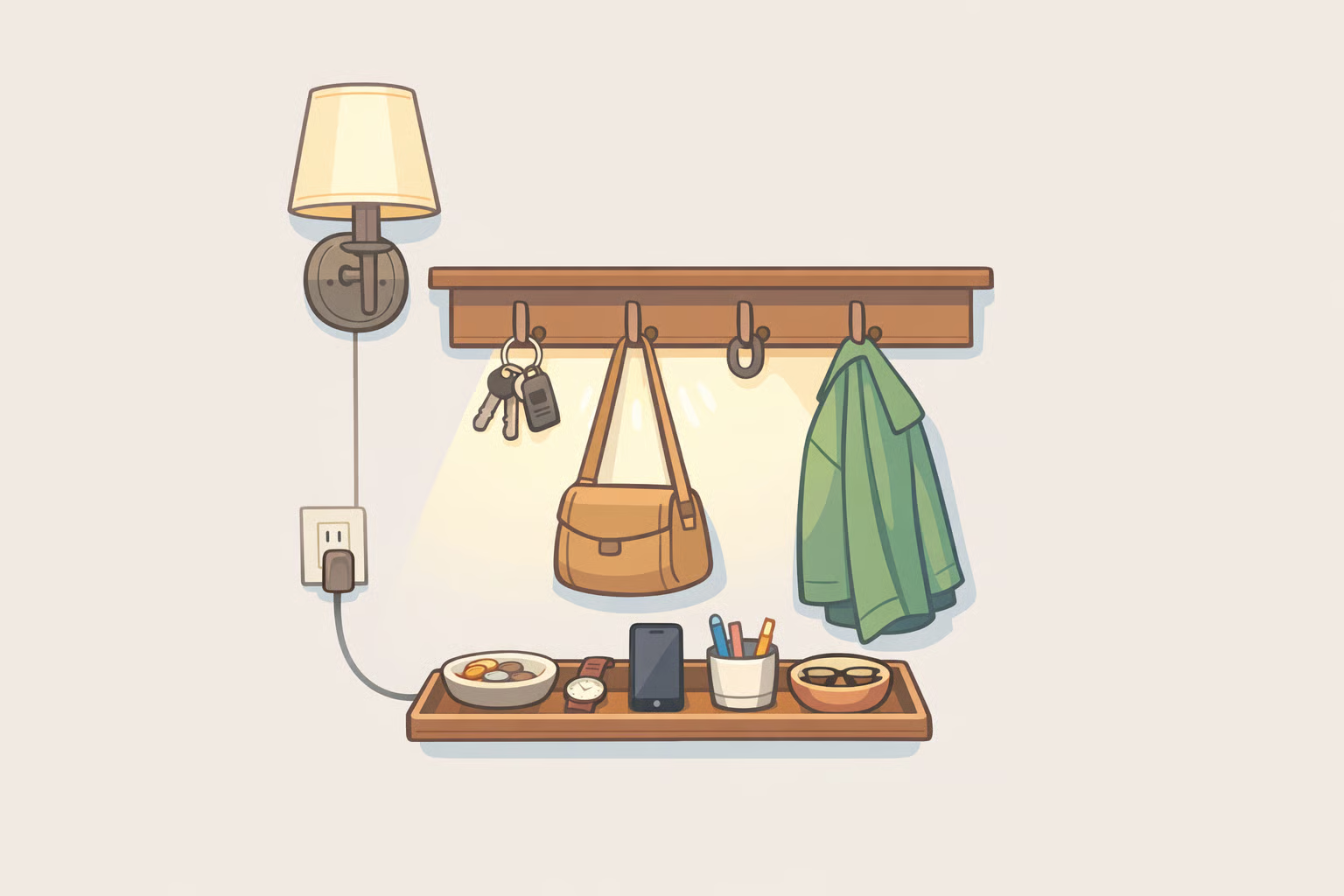
Most entryways are under-lit. That's not a finishing-touches problem it's structural. Boutlier notes that dim entryways consistently feel cramped and unwelcoming, per Good Housekeeping. And practically, a space that's hard to see clearly is harder to keep organized; the hooks and tray that work well in daylight become less legible at 6 a.m. or when coming in after dark.
Designer Erin Tripodi's recommendation from Good Housekeeping is direct: add accent lighting, and if there's no convenient outlet, add a cordless lamp. No rewiring required. A plug-in wall sconce, a battery-operated accent light, or a rechargeable cordless lamp all accomplish the same thing. Treat it as a baseline element, not an optional upgrade.
The effect is more than ambiance. A well-lit entry reads as intentional. A dim one reads as a corridor with furniture in it, and household members will treat it accordingly.
Adapting these ideas to your entry type
These five elements work differently depending on the physical space. Small entryway organization ideas, in particular, tend to require trading individual pieces for multi-function ones.
| Entry type | What to prioritize | What to skip or swap |
|---|---|---|
| No wall space (apartment nook) | Slim bench with integrated storage + tray on top; over-door hooks | Freestanding cabinet, console |
| No formal foyer (open-plan) | Use a rug or bench to define the zone visually; prioritize closed storage | Open shelving that bleeds into the living area |
| No outlet for lighting | Cordless rechargeable lamp or battery-operated sconce | Hard-wired fixture |
| High-traffic family or pet household | Maximize hooks per person + closed storage for overflow; mudroom-style entryway ideas apply here think durability and containment over aesthetics | Console, oversized open trays |
| Narrow hallway only | Vertical storage (tall cabinet), wall-mounted hooks | Bench (blocks flow), wide furniture |
Renters where wall hooks aren't an option: adhesive mounting strips rated for the weight, or furniture-mounted hook rails that require no wall damage, both work as substitutes.
How to know if the system is working
The test isn't whether the entryway looks organized on move-in day. It's whether it holds on a Tuesday after a rainy school morning.
If the entryway resets itself naturally after a busy week, the system fits the household. If it requires constant correction, one of the storage assignments is wrong not the person using the space. Find the item that keeps getting ignored and reassign or replace it. A coat that never makes it onto a hook probably needs a hook in a different location, or the hook category needs to change.
Leader's logic from Good Housekeeping applies here: the goal is for everything to have a place and a purpose. Systems without those defined assignments drift. And Basso's point about style and utility holds at the maintenance stage too an entryway that tips too far toward purely utilitarian tends to get treated as a utility space, per Good Housekeeping, which is when clutter quietly returns.
Households that consistently have organized entryways aren't more disciplined. They have systems where putting something away is the path of least resistance. That's the entire logic of this list.
Start here
The five entryway essentials for organization are: closed storage for overflow, hooks with a resident/guest division, a dedicated shoe zone, a small tray for daily items, and a light source. Each solves one specific problem. Together, they cover everything that enters and exits a front door on a normal day.
The planning audit comes first knowing who uses the space, what they bring in, and what they grab on the way out is what determines which version of each item actually fits. Skip it and the storage will look right but function poorly.
For constrained spaces, the slim bench with integrated storage is the highest-use single piece. It covers shoe storage, seating, and the surface for the tray three of the five items in one footprint, which is what Leader was describing when she flagged how much a well-chosen bench can change a small space.
Once the system is working, the entryway can carry more: a mirror, a plant, a piece of art. But those are finishing moves. The next step is simpler. Stand at the front door, list what comes in with the household daily, and assign each item to one of four homes: hook, tray, shelf, or closed storage. That's the whole job.

Comments
Be the first, drop a comment!