



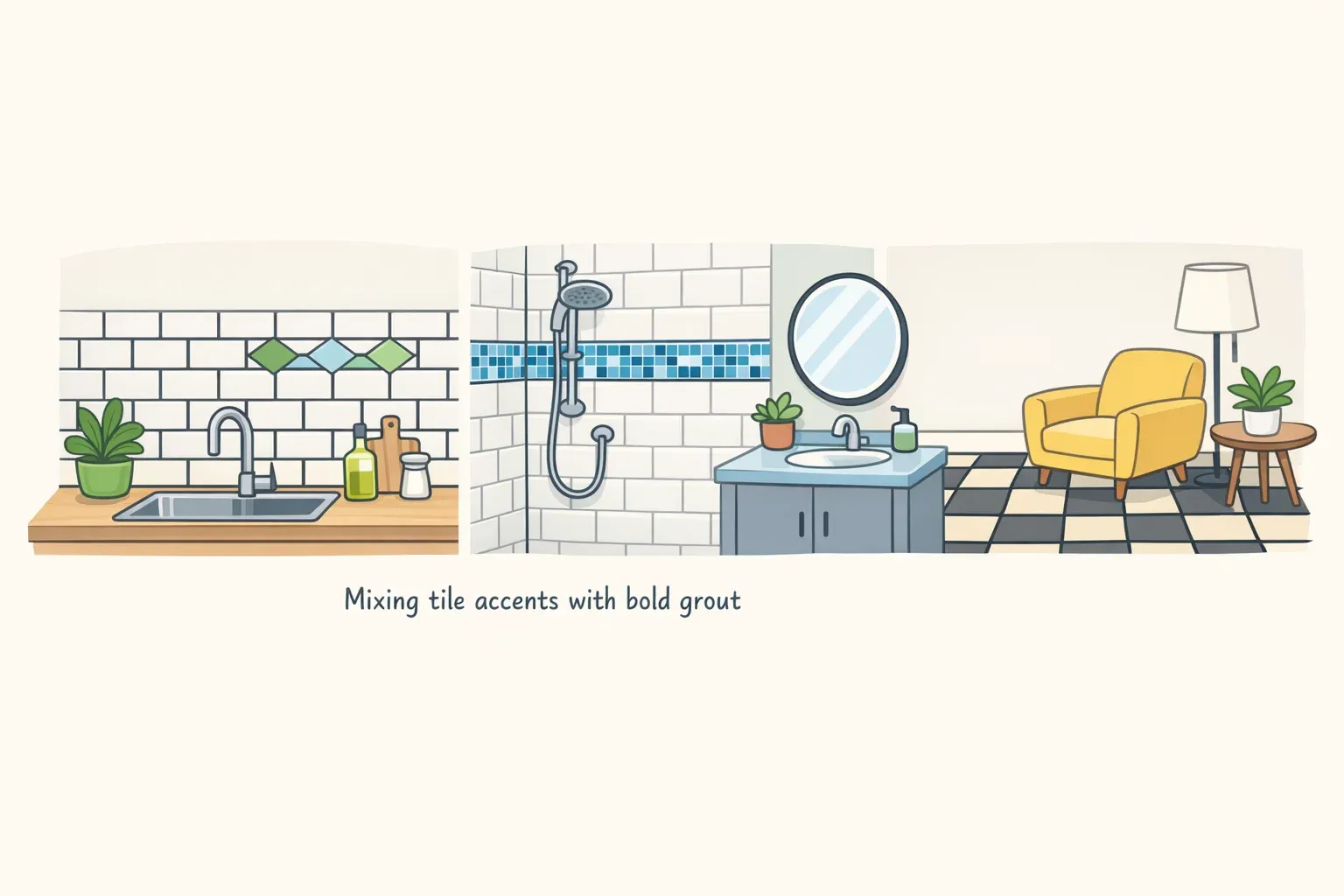
This guide covers seven specific approaches to tile as a design element, organized by cost and complexity. The goal is to help you identify which ideas fit your actual project, not just inspire you to want all of them.
Read Tier 1 regardless of budget. Then move to the section that matches your scope.
Three tiers before you start
Low tier: Statement grout color
Approx. entry cost: Minimal above standard grout
DIY-feasible? Yes, with care
Mid-tier: Architectural surfaces, such as fireplaces, wainscoting, and baseboards
Approx. entry cost: Moderate; standard tile plus installation
DIY-feasible? Partially. Substrate prep often requires a pro.
High tier: Custom hand-painted tile, such as murals, motifs, and door insets
Approx. entry cost: Significant; custom fabrication plus millwork
DIY-feasible? No. This typically requires an artisan and a carpenter.
The floor of what's possible: a 355-square-foot Taipei apartment gut-renovated for $35,000 produced a visually coherent space through contrasting grout alone, per Dwell. The ceiling: Brooklyn bar Deux Chats, where designer Xavier Donnelly commissioned 3,000 individually hand-painted tiles from decorative painter Violet Oliphant, a project that required months of fabrication and a committed artist-designer relationship, Architectural Digest reported.
Neither is right for every project. The framework above helps you enter at the correct level rather than designing for the wrong budget.
Cost ranges for each tier should be confirmed with a tile supplier or professional installer before acting on this guide. The tiers are directionally accurate but not sourced to specific figures.
Tier 1: make grout the design decision
Grout is the most overlooked tool in residential tile work. Choosing a different color costs almost nothing extra, and the visual effect can be as significant as switching tiles entirely. For many projects, this tier is enough.
Idea 1: contrasting grout to define the tile's shape
Use this when: tile is already planned, and you want low-risk visual impact without custom sourcing.
Pick a grout that sits opposite your tile on the value scale. A kitchen backsplash of pink square Domus tiles framed by turquoise blue Mapei grout reads as graphic and intentional rather than standard. The blue was chosen specifically to echo the pale blue pantry and teal cabinetry nearby, so the grout line ties the room's material palette together rather than simply contrasting for contrast's sake, Dwell noted. Yellow grout outlining white floor and wall tiles does the same work at a different temperature: the grid becomes the pattern, the tile shape becomes legible, and no unusual tile is required.
Contrasting grout makes the grid itself the design move. No specialty tile needed.
What to know before committing: Grout color selection happens before installation, not during. Order physical samples and test them in the actual room — grout reads differently wet versus dry, and the shift varies by product. For questions about stain resistance, sealing schedule, and grout type for your specific room conditions, ask your installer before choosing a color.
Idea 2: tonal grout to connect rooms and materials
Use this when: you need tile to feel integrated with adjacent cabinetry, metalwork, or flooring rather than standing apart from it.
Where contrasting grout draws attention, matching grout to adjacent materials does something quieter. One project embedded brass inlays into the grout line where the kitchen flooring met an island's brass backsplash. Principal Jessica Weigley described the intent: "We wanted the color to spill into the grout line and weave its way from the threshold to the kitchen. The evening light catches this and illuminates the line for a moment." The joint becomes deliberate rather than incidental.
A simpler version of the same logic: white tile across multiple rooms with consistent pink grout — RAK Ceramics tile with Grout360 product tying spaces together with one unbroken color relationship. Or terra-cotta grout with terra-cotta tile so the field reads as continuous rather than gridded.
Step 1: Identify the one fixed material in the room — a cabinet color, metal finish, or adjacent floor — that the grout should respond to. That anchor prevents arbitrary decisions.
Step 2: Get physical samples and test them in the room. Custom mixing with a contractor is possible for precise tones. One designer mixed grout on-site with Cava Tile to hit a custom salmon pink for a fireplace surround, noting: "But you have to be flexible because it's an imperfect process," per Dwell. That's not a warning against custom mixing; it's the reality of working outside of the off-the-shelf colors.
What to know before committing: Decide on grout before tile is ordered, not after the two choices inform each other. If the adjacent material changes later, the grout becomes a fixed reference point that's expensive to revisit.
Tier 2: statement tile design ideas for architectural surfaces
These moves take tile off the backsplash and onto surfaces the eye doesn't expect. The cost driver here is installation complexity and surface preparation, not custom fabrication.
Idea 3: tile the fireplace surround as the room's focal point
Use this when: the fireplace is already the room's structural anchor, and you want to formalize that role rather than work against it.
Most contemporary surround tile is an afterthought, generic subway or stone in a color that doesn't commit to anything. The stronger approach is to let the surroundings carry the room. Salmon-pink grout custom-mixed on-site with Cava Tile makes a straightforward surround feel tailored, Dwell noted.
A more ambitious version: in a Wisconsin lakeside home, hand-painted Portuguese tile ran continuously from the bathrooms to the hearth, making the fireplace one node in a house-wide decorative system rather than a standalone feature, Architectural Digest documented.
Step: Treat the surroundings as a picture frame. Map the full dimensions and confirm motif centering before any cuts are made with patterned or hand-painted work; an off-center field reads as a mistake, not a choice.
What to know before committing: Confirm tile suitability for heat exposure with your supplier or installer before ordering, particularly for surfaces adjacent to the firebox opening. That's a question for your installer, not something to resolve from a product description alone. Tile on a surround is also difficult to remove without damaging the underlying structure, so treat this as a long-term decision.
Idea 4: tile entry wainscoting instead of wood paneling
Use this when: the entry hall needs an architectural line and a durable surface, not more pattern or color on an already-busy wall.
Wood wainscoting protects high-traffic walls and adds architectural presence. Tile does the same job with more durability. In a historic Connecticut home designed by Virginia Tupker, Regts Delft tiles lined the entry as wainscoting — the room established its character before a visitor had fully stepped inside, Architectural Digest reported. The same logic holds in modern homes with large-format geometric tile in place of traditional blue-and-white patterns.
What to know before committing: Set the dado height first, then plan the tile layout from that dimension. The top edge needs a finished detail, a cap rail tile, or bullnose resolved before the field tile is ordered. Ask your installer about the appropriate substrate for your specific wall conditions. In rental properties, confirm adhesive removability before committing.
Idea 5: run tile along baseboards as a decorative trim detail
Use this when: a room already uses tile in another application, and you want the baseboard to extend that decision rather than introduce a new one.
This is the subtlest move in the architectural tier and the most transferable. In the Wisconsin project, hand-painted tile ran along baseboards across multiple rooms, not as a gesture in itself, but as a connective thread that made the house feel unified throughout, Architectural Digest noted. The baseboard wasn't the statement; it was the signal that a statement had been made everywhere.
In rooms with no other tile, a tile baseboard can feel stranded. This detail earns its place as an extension, not an introduction.
What to know before committing: The tile needs a factory-finished top edge so the transition from tile to wall terminates cleanly, and an unfinished cut edge will look unresolved regardless of how good the tile itself is. Check with your plumber or contractor whether pipe runs sit behind the relevant walls; if they do, tile baseboards complicate future access in ways that wood would not.
Tier 3: hand-painted tile ideas and commissioned work
The ideas in this tier require a tile artist, a fabricator, or a custom millworker before they involve a tile supplier. These are design briefs, not showroom decisions.
Idea 6: tile murals as a wall art substitute
Use this when: one room can carry a single dominant gesture, and everything else in it is willing to support rather than compete.
A vintage blue-and-white tile mural on a kitchen wall in a Palm Beach home by designer Frank de Biasi functions exactly like a framed work; it doesn't protect anything, it simply exists as the room's focal point, Architectural Digest reported.
Scaled further: in a Punta Mita estate designed by RP Miller and Studio Antoine, tile murals by artist Ángel Santos cover the entire bathroom walls, turning the room into an environment. At Deux Chats, Donnelly's 3,000-tile commission from Violet Oliphant required months of fabrication and a committed artist-designer relationship, not a procurement process, Architectural Digest reported.
A mural will overwhelm a room that can't hold it. The installations that work succeed because the tile carries and everything else steps back.
What to know before committing: Start with an artist, not a supplier. Bring a brief: subject matter, scale, color palette, and room context. Hand-painted tile "defies perfection" by design variation between individual tiles is inherent to the process, Architectural Digest noted. If absolute uniformity is the goal, digitally printed tile is a different product category with a different visual outcome. Be explicit about acceptable variation before fabrication begins, not after.
Idea 7: site-specific motifs that anchor tile to place
Use this when: a room has a strong existing anchor, a significant landscape, a defined architectural period, or a collection with a clear visual identity that can supply the brief.
The strongest custom tile installations are the ones that couldn't be lifted and reinstalled somewhere else. In a San Francisco kitchen, the Archers specified hand-painted botanical tiles by artist Bruno Grizzo, chosen for that house, not pulled from a catalog, Architectural Digest reported.
In the Wisconsin boathouse, closet-door panels were painted with native flowers drawn from the Piet Oudolf-designed gardens visible just outside. The motif is a literal reference to its own site. A Connecticut kitchen used a William Morris-inspired motif on Portuguese tile to connect the backsplash to the house's architectural period, Architectural Digest reported.
Each brief started with something concrete: a view, a garden, a historical reference. Generic briefs produce generic tile.
The door inset application adds a coordination step: cabinet or closet doors need a routed panel opening sized to the tile before either the millworker or the tile artist begins work. Those two need to align on dimensions before anything is fabricated, and confirm that handoff is planned before signing off on either scope.
What to know before committing: A highly specific tile story can feel stranded if the room's context changes significantly, such as new owners, a major renovation, or a shift in the surrounding character. That's a resale consideration more than a design flaw, but worth weighing if the house is approaching sale.
Where to stop, and when to go further
Three rules that hold across all seven ideas:
Stop at grout if you want reversibility or are working within an existing installation. The Taipei apartment's $35,000 renovation used contrasting grout as its primary move and produced a coherent, intentional space, Dwell reported. That principle scales to any budget.
Move to architectural surfaces when walls, surrounds, or floor lines are already open. Renovation is when substrate questions get resolved; adding tile at that point costs less in coordination than it would mid-occupancy.
Commission custom work only when a room can support one dominant gesture, and you have something specific to give an artist. Designer Jessica Jubelirer put the disposition plainly: she'll tile just about anything, Architectural Digest reported. The point isn't ambition, it's that the decision has to be deliberate. Projects that fail in this tier are usually the ones where the tile was the first decision made rather than the last one confirmed.
Before acting on Tier 3: confirm cost ranges for custom hand-painted tile and millwork integration with a fabricator or professional installer, and ask about maintenance requirements for colored or custom-mixed grout.



Comments
Be the first, drop a comment!