



IKEA BILLY fireplace built-in hack: the finishing details that actually fool people
When Selma got a carpenter's estimate for fireplace built-ins, she went ahead anyway, just not with a carpenter. Using IKEA BILLYs, she built a full bookcase wall flanking her fireplace for £585 (roughly $650), which she says came in at less than half the professional quote, Apartment Therapy reported three days ago. Erica and Chris did the same math differently: their finished BILLY built-in cost $800 total, which Erica described as having "knocked a whole zero off" a contractor estimate, putting their DIY version at roughly 10% of the quote, Apartment Therapy reported two months ago. A Brighton homeowner named Mel put her total savings at around £11,000.
The cost gap is the easy part to understand. What's less obvious is why these projects work visually, and why so many similar attempts don't. The BILLY bookcase itself is not the hack. It's a $90 flat-pack with a laminate finish and a cardboard back. What makes it read as custom millwork is a short list of finish carpentry moves: trim, baseboard, caulk, proper primer, and unified paint. Get those right and the IKEA origins become genuinely hard to detect. Skip them and you have a wall of expensive-looking furniture.
This guide walks through the complete process: assessing whether your fireplace wall suits the project, translating your wall dimensions into a unit layout that works, and executing the finishing sequence that creates the built-in illusion. Realistic cost for a typical fireplace wall installation runs $420 to $800, depending on unit count, door fronts, and hardware, before tools.
What you'll need before starting: A stud finder, a level, a miter saw or hand saw, a brad nailer, and a caulk gun. Intermediate comfort with basic carpentry: measuring, cutting trim, shimming, nailing. Budget a full weekend for assembly and trim work, plus several additional days for primer and paint to cure. Paint curing is not a step you can compress.
Before you build: is this project right for your fireplace?
Not every fireplace wall is a straightforward candidate. Work through these questions before ordering anything.
Fireplace type: The documented projects in this guide each use a decorative surround or a biofuel burner without a flue. If your fireplace burns solid fuel or gas, consult a certified installer or your local building code before placing any wood-framed structure nearby. This guide doesn't address clearance requirements for live fireplaces, and neither do the source projects. That's a gating question, not a footnote.
Wall width: A standard BILLY is 31.5 inches wide; the narrow variant runs 15.75 inches. Most fireplace walls don't divide evenly into 31.5-inch increments, and running only standard-width units can leave awkward gaps or force an asymmetrical layout. Mel used six narrow 15.75-inch units specifically to get finer layout control around the fireplace opening, Livingetc documented in early 2023. If your wall doesn't accommodate clean runs of standard units on both sides of the surround, narrow units are a layout tool, not a fallback.
Ceiling height: Standard BILLYs reach 79 inches. Height extenders ($45 each) close the gap to 8-foot ceilings. Units that stop visibly short of the ceiling will always read as furniture.
Things to check before buying:
- Floors that slope significantly (shimming handles minor variance; major slope compounds across a multi-unit run)
- A fireplace surround that projects deeper than the BILLY's 11-inch depth, creating an awkward step between units and surround
- Electrical panels, outlets, or HVAC vents on the target wall that can't be relocated
- Walls with no accessible studs at the anchor points you'll need
Step 1: plan the layout your wall width determines everything
The BILLY's dimensions happen to align closely with a lot of custom millwork: 79 inches tall, 31.5 inches wide, 11 inches deep, at $90 per unit, DIY Queen noted earlier this year. That dimensional overlap is one reason these installations read as more custom than their price suggests, even before any trim goes on.
How to translate your wall into a unit count:
- Measure each side of your fireplace wall in inches. Divide by 31.5 to see how many standard units fit. Use the examples below to cross-check your layout before ordering.
- Common wall width examples: A 95-inch run fits three standard BILLYs almost exactly (3 × 31.5 = 94.5 inches, hairline seam). A 110-inch run fits three standard units plus one narrow (94.5 + 15.75 = 110.25 inches). For fireplace flanking where each side is independent, a 63-inch side takes two standard units exactly; a 47-inch side takes one standard plus one narrow (31.5 + 15.75 = 47.25 inches). Map both sides of your fireplace separately before ordering.
- Plan for continuous runs. A visible gap between units, or between a unit and the wall, is extremely difficult to disguise once trim is on. Units should touch or leave only a hairline seam.
- Decide on ceiling coverage. For 8-foot ceilings, one height extender per unit closes the gap. Come Stay Awhile confirmed this for their fireplace installation: their 8-foot ceilings required exactly one extender per unit. Erica and Chris used four standard BILLYs with four height extenders across their project, Apartment Therapy reported.
- Decide on base storage. BILLY units with OXBERG door fronts on the lower section, open shelving above, is the most common fireplace-wall configuration. It provides closed storage and creates a proportional break that mirrors traditional built-in design.
Rough materials cost for a 3-unit wall (DIY Queen, earlier this year):
- 3 BILLY bookcases at $90 each: ~$270
- 1×2 or 1×3 primed pine for face trim: ~$40
- Crown or cove molding: ~$28
- Baseboard molding: ~$20
- Construction adhesive, nails, wood filler, caulk: ~$20
- Bonding primer and paint: ~$45
- Total: approximately $420 before optional extenders, door units, or hardware upgrades
Step 2: assemble and anchor build it to last, not just to look good
Work through these steps in order. The sequence matters: assemble flat, upgrade backs, dry-fit and level, then anchor before any trim touches the units.
- Assemble each BILLY unit flat on the floor before standing it up. Follow IKEA's instructions and don't rush. Misaligned shelves become permanent once the trim goes on.
- Upgrade the back panels before positioning. BILLY's factory backs are thin cardboard, per DIY Queen. They flex and show through paint as an uneven surface. Replace them with 1/4-inch beadboard panels or plywood cut to fit, or adhere rigid backing over the originals. This also gives you a finish-ready surface.
- Stand the units and dry-fit them on either side of the fireplace, flush against the wall. Units should touch or leave only a hairline gap.
- Check level and shim. Most floors aren't flat and most walls aren't plumb. Use shims under each unit's base until it sits level and plumb. DIY Queen needed three different shim depths across a single three-unit installation. That's normal.
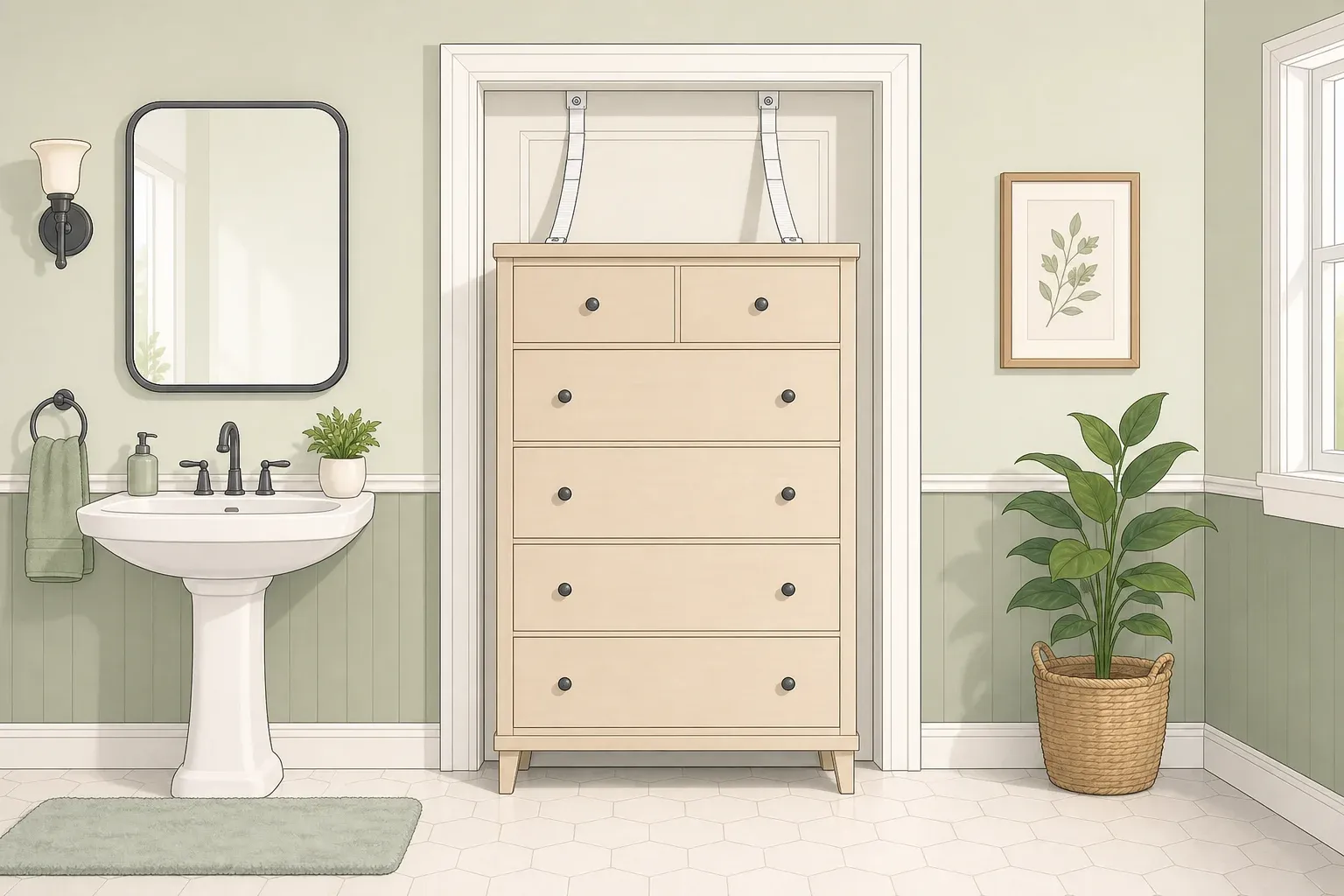
- Anchor every unit to the wall. Use IKEA's included anti-tip hardware and drive at least one heavy screw through the back of each unit into a wall stud, per DIY Queen. Locate studs before positioning the units so your anchor points line up.
- Bolt adjacent units together through their side panels. Selma bolted her entire run together before adding any trim, which kept the structure aligned through the rest of the build, Apartment Therapy reported.
Step 3: trim work is the IKEA BILLY built-ins-around-fireplace transformation
Every project in the research arrives at the same conclusion independently: the BILLY units are the substrate, and the trim work does the persuading. This is the most skill-sensitive phase and the one most likely to be underestimated.
Work through the trim in this sequence:
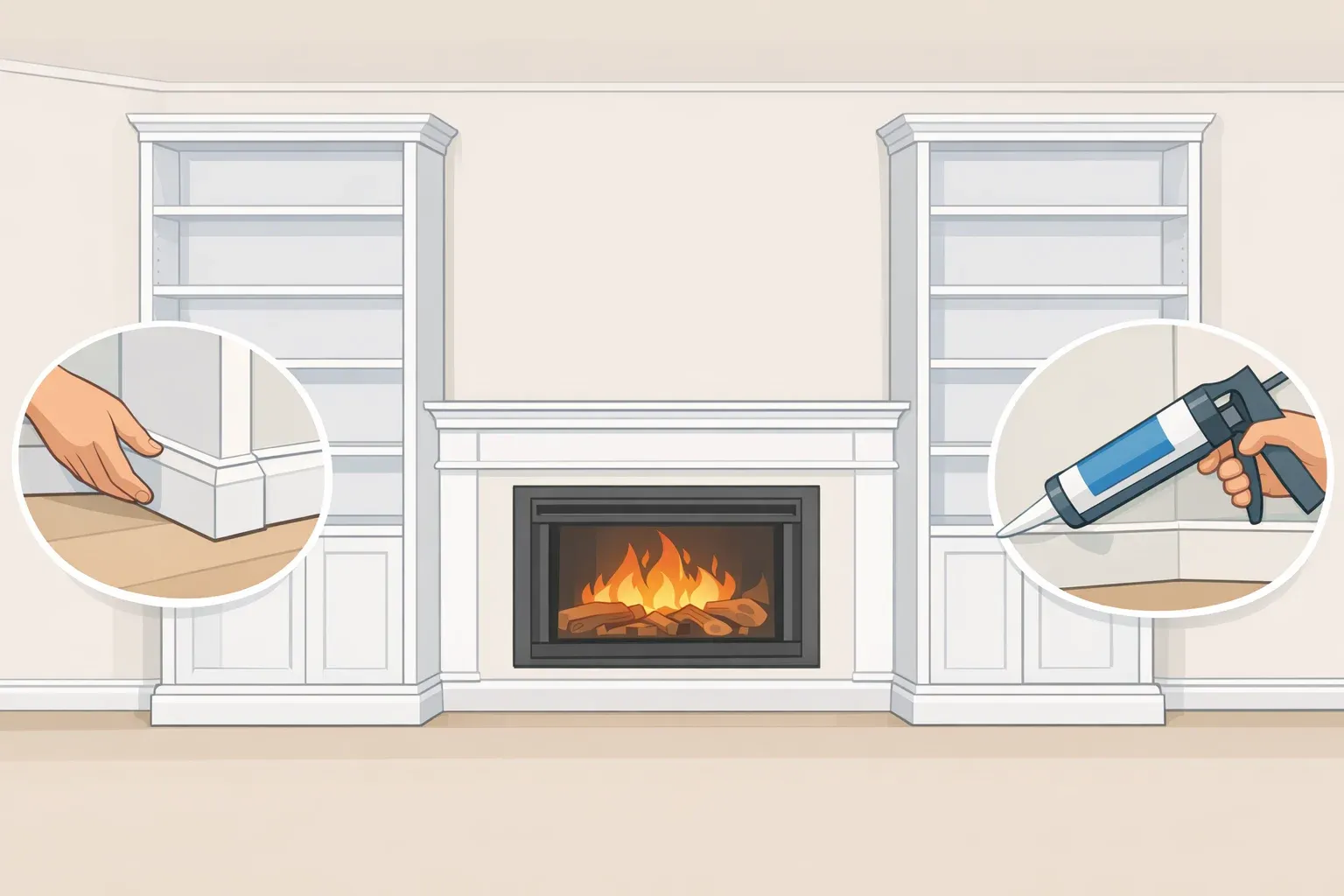
Face trim between units: Cut 1×2 or 1×3 pine strips to the full height of the bookcases. Nail them vertically at the seams between units and at the outer edges where units meet the wall. The result is added visual thickness, covered raw laminate edges, and shadow lines that register as architectural detail, per DIY Queen.
Crown molding at the top: Run crown or simple cove molding across the full installation width, matched to whatever profile is used elsewhere in the room. This seals the gap between units and ceiling. It's also the element that most visitors' eyes register first as "built-in rather than freestanding."
Baseboard at the bottom: Extend your existing baseboard profile across the front face of the BILLY bases, matching height and profile exactly to the baseboards on the rest of the wall. Come Stay Awhile calls this step "where the magic happens." The gap between the unit base and the floor is what makes furniture look like furniture. This closes it.
Caulk every seam, gap, and joint trim-to-unit transitions, unit-to-wall gaps, molding corners, baseboard joints with paintable caulk before any primer goes on. DIY Queen calls caulk "the single biggest quality-of-work tell" in faux built-ins. A visible seam catches shadow and immediately undermines the finished look.
Optional decorative elements: Selma added a scallop-profile trim panel across the top of her units to extend height and add a distinctive silhouette, Apartment Therapy reported. Mel cut MDF into arch shapes with a jigsaw for an Art Deco facing, then adhered strip wood to OXBERG door fronts for a ribbed panel effect, Livingetc documented in early 2023. Both require jigsaw competence and careful pattern work. The base formula face trim, crown, baseboard, caulk is more approachable than either of those.
Step 4: prime and paint patience is the skill here
BILLY's laminate surface requires bonding primer; standard latex won't hold reliably without it. Three independent sources recommend the same product, which is about as close to a consensus as DIY guides get.
- Prime with Zinsser BIN or Zinsser shellac-based primer, two full coats. DIY Queen, Come Stay Awhile, and Livingetc all arrived at this recommendation independently. Standard latex primer is not an adequate substitute on laminate.
- Allow each coat to dry fully before the next. Light scuffing between coats only; anything more aggressive will compromise the surface.
- Apply two to three coats of finish paint, with full cure time between coats. Mel's project required three color coats on top of primer and took four weeks total, most of it waiting rather than working, Livingetc reported. Come Stay Awhile used Sherwin-Williams Emerald Urethane Trim Enamel in Pure White, a cabinet-grade paint that cures harder than standard wall paint. On surfaces that get touched regularly, the price premium is worth it.
- Paint everything the same color units, face trim, crown, baseboard, and door fronts in a single unified finish. This is what visually merges the separate components into one structure.
On color: The illusion holds across a wide range of shades. Documented choices include Benjamin Moore Hale Navy, Sherwin-Williams Urbane Bronze, Farrow & Ball Down Pipe and Studio Green, and Valspar Thames Fog, per DIY Queen and Livingetc. White works just as well: Erica and Chris painted both the units and the adjacent wall Behr Falling Snow, making the shelving appear to grow from the wall, Apartment Therapy reported. Color choice matters less than consistent application across every surface.
Replace the hardware after painting. New pulls and knobs, particularly in brass or matte black, complete the shift from flat-pack to custom. Selma credited new brass hardware alongside the trim as the two details that most changed the look of her installation, Apartment Therapy reported.
The finishing layer: how to make IKEA BILLY look built in, not just assembled
Assembly, trim, and paint get the structure in place. These details are what separate a completed project from a designed room.
Shelf styling: Leave roughly 30 to 40 percent of each shelf empty, per DIY Queen. Fully loaded shelves read as storage. Vary object height and mix books, objects, and plants rather than running uniform rows across each level.
Add lighting if the budget allows. Battery-operated puck lights installed under each shelf a six-pack runs around $20 introduce layered illumination that flat overhead light can't replicate. Picture lights mounted above the top cornice work equally well. Neither requires an electrician.
Treat the fireplace surround as part of the same composition. Selma painted her existing surround in deep charcoal, Frenchic Al Fresco "Smudge," which grounded the lilac bookcases and pulled the whole wall together as a single intentional focal point, Apartment Therapy reported. Even a coordinating tone rather than a matching one does the job.
Where the custom look usually fails the four most common mistakes:
- Skipping the baseboard extension. The gap between the unit base and the floor is the clearest flat-pack tell. Nothing else gives it away as quickly.
- Using standard latex primer on laminate. The laminate surface needs bonding primer. Shellac-based primer is not optional.
- Uncaulked seams. Shadow lines at trim joints are the most visible sign of rushed execution. Caulk before you prime, not after.
- Rushing paint cure time. Three coats of color on top of two coats of primer means five separate drying intervals. Compress them and the finish will be soft, prone to scuffs, and likely to show brush marks permanently.
Realistic expectations
Cost: $420 for a well-documented three-unit installation is the floor, per DIY Queen. For a useful upper-end reference: Erica and Chris's four-unit installation with extenders and door fronts came in at $800, per Apartment Therapy, though their project was a media-room accent wall rather than a fireplace flanking. Neither figure includes tools.
Timeline: Plan on a full weekend for assembly, positioning, and trim. Then add time for primer and paint curing Mel's Art Deco version took four weeks, most of it waiting for paint, Livingetc reported in early 2023. Simpler builds with no decorative MDF work will finish faster, but the curing intervals don't change.
Who this suits: Someone comfortable with basic measuring, cutting, and nailing. Assembly and trim are methodical rather than technically demanding. Decorative extras jigsaw MDF work, scallop trim profiles, ribbed door panels require more patience and a higher tolerance for precise measurement. The paint phase is almost entirely about waiting.
Get the non-negotiables right bolted and wall-anchored units, upgraded back panels, face trim at the seams, baseboard extended to the floor, caulked joints, shellac-based primer, and unified paint across every surface and the result is, as the DIY Queen author put it, something where "every single person who walks into my living room asks who built them."





Comments
Be the first, drop a comment!