



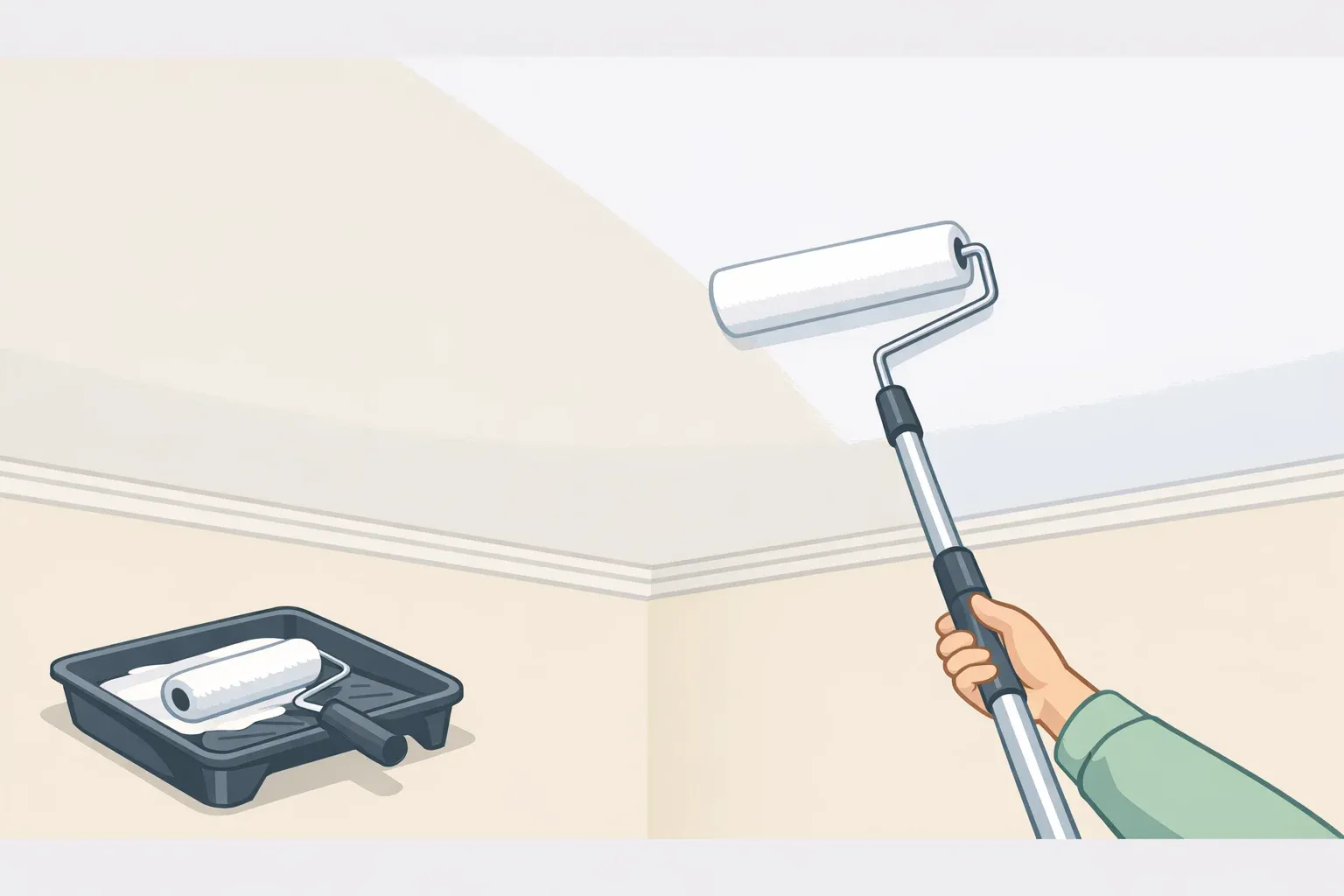
This guide covers how to paint a ceiling well, from choosing the right color and finish to prepping the surface and rolling without lap marks. By the end, you'll know how to read the room, test color before committing, and work through the job in the right sequence so the result looks deliberate rather than improvised.
Choose the right ceiling paint and color
For most ceilings, choose a high-quality flat or matte interior ceiling paint (per Benjamin Moore), often sold as acrylic latex, waterborne ceiling paint, or simply ceiling paint. A flat finish reflects very little light, which keeps color reading consistently across the surface and helps conceal minor imperfections. That matters overhead, where raking light from recessed fixtures can expose surface flaws that walls hide more easily. Gloss on a ceiling amplifies brush strokes and bumps in the plaster. Unless the goal is a deliberately lacquered effect, skip it. In bathrooms, laundry rooms, and kitchens, choose a ceiling paint rated for moisture-prone spaces or mildew resistance rather than relying only on the flattest finish.
On color: the same chip that looks right in the store can look completely different overhead. Two things are responsible. First, ceilings are viewed from farther away and at a different angle than walls, which means subtle colors read differently and intricate patterns largely disappear. Broader, bolder choices hold up from below; fine detail gets lost, as Better Homes & Gardens puts it, ceilings carry prints differently than walls precisely because of that viewing distance and angle. Second, light changes what you picked.
Natural light shifts throughout the day in ways that affect how paint reads. Morning light runs warm and yellow; midday direct sunlight makes colors appear cooler and more washed out; late afternoon adds a reddish cast, per Sherwin-Williams. Artificial light matters too: warm bulbs can make reds, yellows, and creams feel richer, while cooler bulbs can make blues, grays, and whites read sharper or more sterile. A dining room or bedroom used primarily at night should be evaluated under the artificial light it actually runs on, not by holding a chip to a window at noon.
How to test before committing: Paint a sample patch directly on the ceiling surface, not on paper taped to it. Colors read differently overhead than vertically. Check it at multiple times of day and with the room's artificial lights on. If the room has recessed lights, check the sample with those lights on, since shadows between fixtures can make the ceiling color look different from the area directly under the beam.
Decide whether the ceiling should blend in or stand out
Answer this before picking a color: should this ceiling disappear into the room, or define it? Everything else follows.
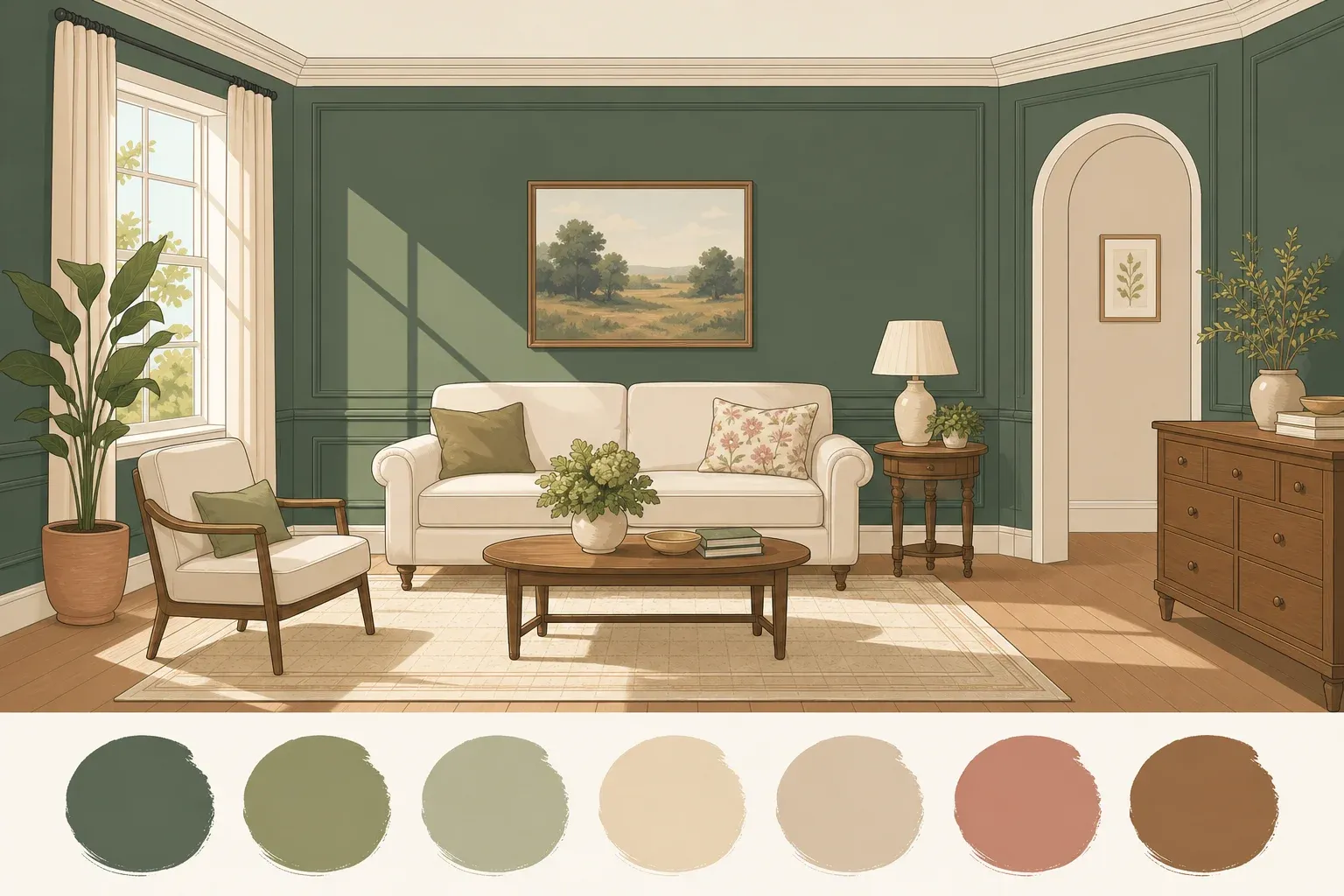
Rooms that are small, low, or used for focus and rest benefit from a ceiling that recedes lighter than the walls, matte finish, same color family. Rooms that are large, tall, or used for gathering can support more visual weight overhead. A contrasting ceiling color pulls the eye upward and gives the room a visual boundary. A ceiling one shade lighter than the walls in the same color family produces something subtler: the room feels cohesive rather than decorated, which is often exactly right.
A non-white ceiling does not automatically make a room feel heavy or closed-in. Lighter shades and tone-on-tone approaches can keep the room open while still making the ceiling feel intentional. Ceiling height, lighting, wall color, trim, and furniture scale all affect the result, so treat color as one part of the room rather than a formula.
Five room scenarios:
Small bedroom: Tone-on-tone, ceiling one shade lighter than the wall. Keeps the room cohesive without amplifying any sense of compression.
Formal dining room: A deeper or contrasting color creates intimacy. Dining rooms are typically used at night under warm artificial light, which makes a richer ceiling read as warmth rather than weight.
Low hallway: Go lighter than the walls — a pale tint that bounces light and pushes the ceiling plane up visually. Dark hallway ceilings have nowhere good to take the eye.
Large living room: A mid-tone or contrasting color gives the room a visual boundary overhead and makes furniture arrangements feel more intentional.
Room with recessed downlights: Those fixtures direct light straight down, which makes the ceiling surface and the top edges of walls appear noticeably darker than they actually are. Choose a shade lighter than instinct suggests and always evaluate the sample with those lights switched on.
Prep the ceiling before painting
Ceiling paint failures trace back to prep more often than application. Three things matter most.
1. Wash the ceiling first. Dust, cooking residue, and airborne grease reduce paint adhesion. A pass with a damp cloth or mild detergent solution, followed by a full dry, directly affects how long the finish holds. Don't skip this in kitchens or older rooms.
2. Use stain-blocking primer where needed. Water stains, nicotine marks, and heavy discoloration can bleed back through the finish coat if they are not sealed first. Apply a shellac-based or oil-based stain-blocking primer to affected areas, let it cure completely, then proceed with ceiling paint. For a significant color shift — dark to white, or white to a saturated color — a full-coat tinted primer can reduce the number of finish coats needed and produce more even coverage.
3. Match roller nap to texture. A standard 3/8-inch nap works on smooth ceilings. Textured surfaces like skip trowel or orange peel need a 3/4-inch nap to work paint into the recesses. A short-nap roller on texture leaves a patchy result that a second coat won't fix cleanly.
If you have an older popcorn or heavily textured ceiling, do not scrape, sand, or disturb it until you know whether it contains asbestos. The EPA says asbestos cannot be identified by sight alone, and suspect materials that may be disturbed during renovation should be tested by a trained and accredited professional.
Patch before priming: Fill small cracks and nail pops with joint compound, sand smooth, and spot-prime before the full coat. The texture difference reads through finished paint under raking light if this step is skipped.
How to paint a ceiling without lap marks
What you'll need before starting: Drop cloths covering the full floor and all furniture. Low-tack painter's tape. Eye protection and a hat or head covering for overhead drips. A stable step ladder, extension ladder, or scaffold board. A 2.5-inch angled brush for cut-in work. A roller frame with extension pole. Roller nap matched to your ceiling texture. Flat or matte ceiling paint, combined into one bucket if using multiple cans. Per OSHA, if you remove light covers, ceiling-fan parts, or vents, turn off power to the fixture first and let bulbs cool before working around them.
1. Tape the wall-ceiling edge. Press tape firmly along the top edge of every wall, sealing the edge with a putty knife or credit card to prevent bleed-under. The critical rule: remove the tape while the paint is still slightly wet, not after it has cured. Tape left on dried paint can bond to the surface; pulling it may tear the ceiling paint and create a repair job before you can move on. Worth noting: many experienced painters skip tape entirely and cut in freehand. For less confident DIYers, tape gives a margin for error that's genuinely worth having.
2. Paint the ceiling before the walls. In any full room repaint, ceiling goes first. Drips and roller spatter onto bare walls are easy to cover when walls are painted afterward. Doing walls first guarantees ceiling paint lands on a finished surface.
3. Box the paint. Pour all cans into one bucket and stir before starting. Even same-batch paint can vary slightly between cans, and boxing eliminates any risk of a visible seam where one can ended.
4. Cut in first, roll while the edge is still wet. Work a 2- to 3-inch border along all ceiling edges with the angled brush, in manageable 4- to 5-foot sections. Roll each section immediately after cutting in. Wet paint blends into rolled paint seamlessly; a dried cut-in edge creates a visible line that touching up won't remove cleanly.
5. Roll in parallel strips and maintain a wet edge. Work across the room in overlapping passes, roughly one-third overlap per strip. Letting one section dry before starting the adjacent pass causes streaking. The roller should feel well-loaded but not dripping if paint is flinging off the nap, it's carrying too much. Finish each pass with light, consistent pressure rather than bearing down at the end of the stroke, where excess paint deposits and dries as a visible ridge.
Ventilation and recoat timing: Insufficient airflow slows dry time and causes paint to drag when the second coat goes on too soon. Open windows, run a fan, and follow the manufacturer's recoat window on the can; dry time varies by product, humidity, temperature, and ventilation. Two thin coats produce a cleaner result than one heavy application.
6. Evaluate under the room's actual lighting before calling it done. Once the first coat dries, switch on the room's normal lights. Recessed downlights will expose uneven coverage and missed patches that are invisible under diffuse light. A second coat is standard practice for any color other than white-over-white.
Troubleshooting common ceiling paint problems
A few problems appear often enough to be worth knowing before they show up.
Lap marks and flashing. These appear when a section dries before the adjacent pass is applied. Work continuously — don't stop mid-ceiling. If flashing shows after the first coat, rolling a full second coat in the opposite direction may resolve it.
Roller stipple. A bumpy, textured look from the roller nap, usually a sign of paint applied too thickly or a nap that's too coarse for a smooth surface. Thin coats and correct nap selection prevent it; once dry, light sanding followed by a thin finish coat can correct it.
Paint bleed under tape. Happens when the tape edge isn't fully sealed before painting. The putty-knife press along the tape edge at application is what prevents it. If bleed occurs, let the paint dry fully, then scrape gently with a razor before touching up rather than trying to wipe it wet.
Flaking or poor adhesion. Almost always a prep failure: unwashed surface, undertreated stain, or paint applied over an incompatible existing finish. If a section peels within days, that section needs to come off, the surface needs cleaning and priming, and the area repainted.
Room-by-room ceiling paint tips
The same ceiling color can read differently from room to room, so make the final call under the light you actually use most. Test the sample in daylight and at night, then choose the finish and color that match the room's purpose.
The ceiling is already doing something in every space. Choosing a color and finish intentionally even just the right white in the right finish is what separates a room that feels resolved from one that was simply covered.















Comments
Be the first, drop a comment!