



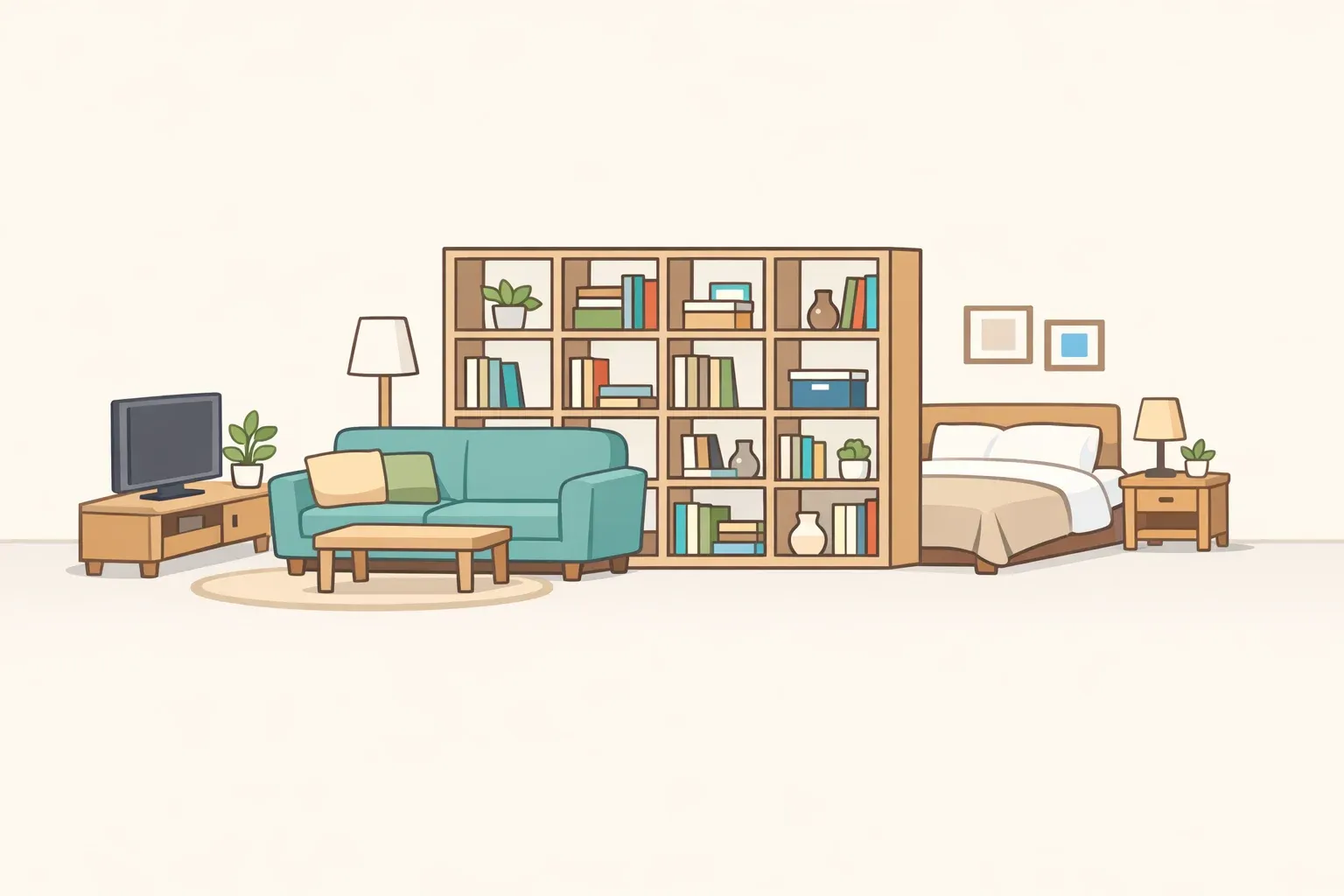
Bookcase room divider for studio apartment: planning your layout
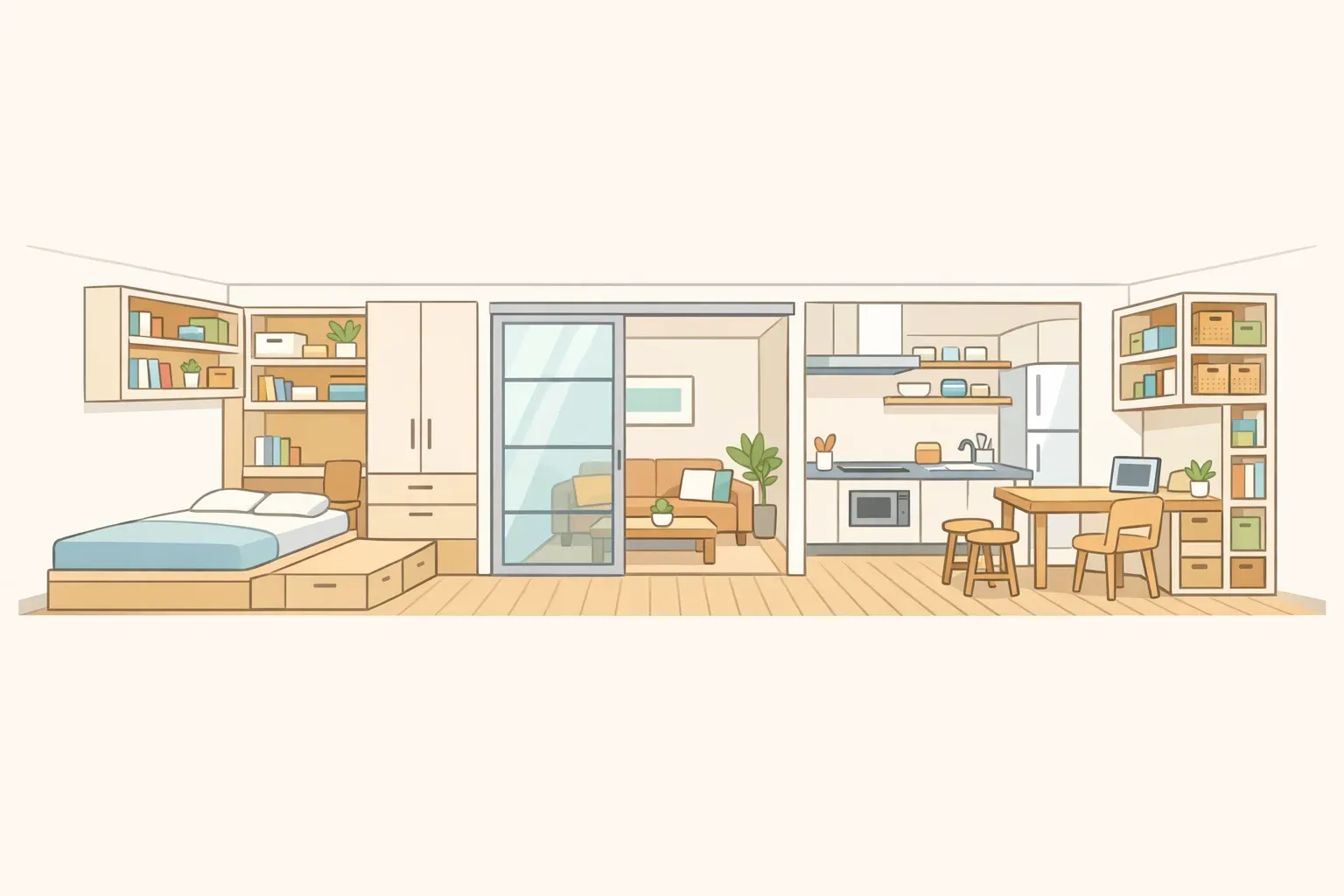
This guide walks through how to use freestanding bookcases to create a visually and functionally separate sleeping zone in a studio apartment, without permanent construction and often without permits, though your lease and building rules still apply.
Be clear about the outcome before reading further. A well-executed bookcase room divider for a studio apartment gives you genuine visual separation, a defined sleeping zone, and added storage, all while preserving natural light. It does not give you a legal bedroom, meaningful sound isolation, or a solution for every floor plan. The pitch is specific: if your studio has the right geometry, this approach delivers privacy and comfort that multiple renters describe as transformative. If it doesn't fit your layout, this guide will tell you that too.
Prerequisites: A tape measure, a rough floor plan sketch (hand-drawn is fine), and access to your lease terms. No tools, construction experience, or contractor required.
Three real builds illustrate the range. One renter arranged six IKEA BILLY bookcases into a box configuration around a back corner of his studio, a "room within a room" completed for $1,100 with no permanent fixtures (Apartment Therapy, last December). A D.C. renter used an IKEA Elvarli shelving system she already owned to carve a distinct sleeping zone from a 480-square-foot studio, fitting a queen bed with comfortable walking room on both sides and significant extra storage (Apartment Therapy, last December). In a compact European flat, a single tall open-backed bookcase positioned between the bed and living area accomplished clean zone separation while keeping both sides bathed in natural light from the apartment's large windows (COCO LAPINE DESIGN, last month).
The throughline across all three: the approach works when it's chosen for the right layout and executed with care. Layout assessment comes first.
Step 1: Decide whether your floor plan can actually support this
Don't buy anything yet. Run through these four questions first.
Does your floor plan have a usable corner near the bed? A corner placement gives you two existing walls as the sleeping zone's boundary, which means fewer shelving units and a more structurally stable setup. A divider positioned against open floor with no adjacent wall still works, but requires more units to achieve the same enclosure.
Can the sleeping zone maintain clearance on both sides of the bed? You need enough space to walk on both sides of the bed without squeezing past furniture. One D.C. renter spent deliberate time on space planning to confirm she could fit a queen bed with walking room on both sides before committing to the layout, and only then purchased her shelving (Apartment Therapy, last December). Map this on paper with your bed's actual dimensions before proceeding.
Where are your windows, and which zone gets the light? Open-backed shelving allows light to pass through rather than block it, which is the key advantage over solid partitions (Interiorholic, earlier this year). In a fully enclosed box configuration, though, the sleeping zone will receive significantly less ambient light. Plan for supplemental lighting, a plug-in wall sconce or a floor lamp, before setup rather than after.
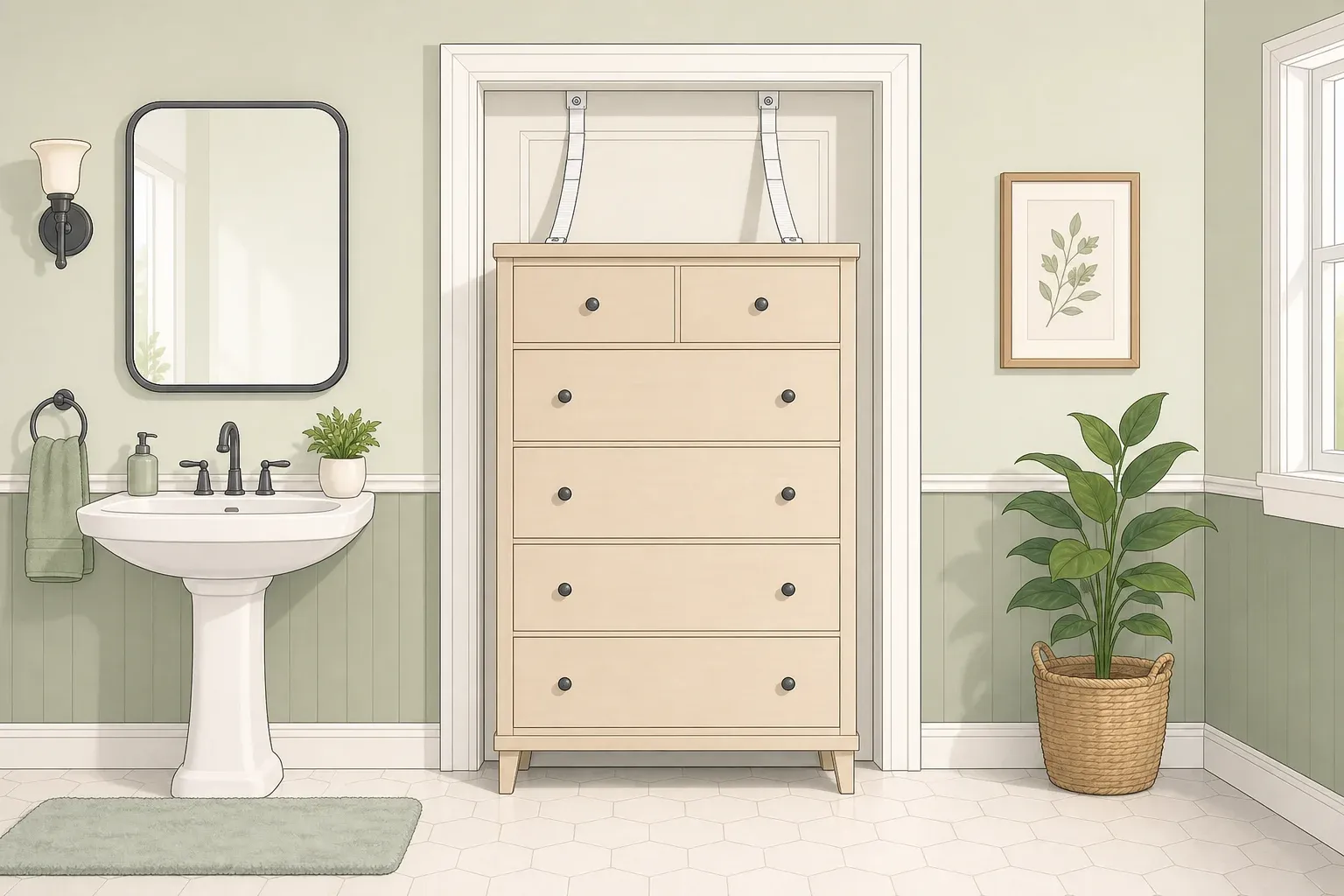
Does your lease allow small wall anchors? Tall units should be anchored with an anti-tip bracket wherever the lease permits. Most leases restricting "alterations" target structural changes, not small fasteners. Check your lease language, and get written landlord approval for anything uncertain before installation begins. Written confirmation is the only real protection for a security deposit, and most temporary partition approaches don't require city permits, though buildings, particularly co-ops and condos, often have their own rules about wall types and placement (Temporary Walls NYC, earlier this year).
Don't proceed if any of these apply:
- The only viable bed placement blocks a window, fire exit, or emergency egress. A bookcase arrangement that compounds that problem creates a building compliance issue.
- Your studio is narrow enough that a perpendicular divider would leave one zone too tight for comfortable use.
- Ceiling height or lease restrictions make wall anchoring impossible and freestanding stability unreliable for the unit height you're planning.
Quick layout assessment: match your situation to a starting point
| Layout type | Privacy need | Light tolerance | Recommended starting config |
|---|---|---|---|
| Corner near bed | Low to medium | Preserve most | Single unit or L-shape |
| Corner near bed | High | Willing to darken | Box configuration |
| Open wall, no corner | Low | Preserve most | Single unit |
| Open wall, no corner | Medium to high | Either | L-shaped pair |
| Already own modular shelving | Any | Any | Extend existing system first |
This is a starting point, not a prescription. Measure your actual space against any configuration before committing.
Step 2: Choose the right rental-friendly room divider configuration
The divider configuration determines cost, enclosure level, and how much floor plan the sleeping zone consumes. Three practical options, from simplest to most enclosed:
Single unit, perpendicular to a wall
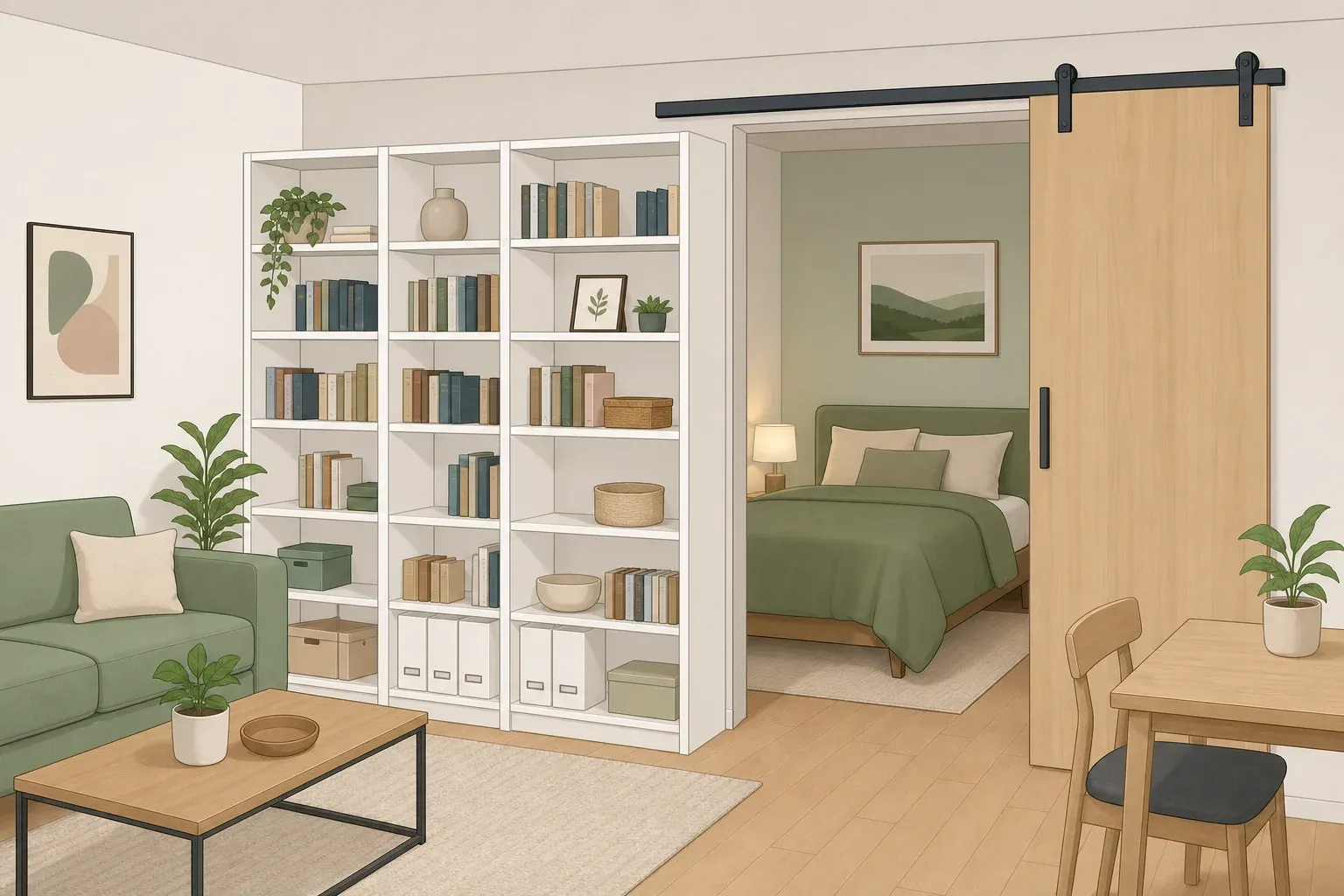
One tall open-backed bookcase placed at a right angle to the wall creates a visual and physical boundary, living room on one side, sleeping zone on the other (Interiorholic, earlier this year). The compact European flat uses exactly this approach: a sleek open-backed unit that holds books and objects while cleanly splitting the apartment's open plan, with both zones still connected by natural light from the flat's large windows (COCO LAPINE DESIGN, last month). Lowest cost, lowest enclosure. Best for studios where the layout creates natural separation and full privacy isn't the priority.
L-shaped or offset pair
Two units placed in an L-shape or staggered configuration increase enclosure on a second side without fully boxing in the bed. Works well when a corner placement provides a third wall for free. Moderate cost, meaningfully more enclosure than a single unit.
Box configuration with a door (3 to 6 units)
The most enclosed option: multiple units arranged to surround three sides of the sleeping zone, with two existing apartment walls completing the fourth. This is what the $1,100 BILLY build achieves, six bookcases in a box around a back corner, creating what the builder described as "a room within a room" (Apartment Therapy, last December).
A box configuration requires a door. Without one, the enclosed space becomes awkward to enter and exit. One renter fitted an IKEA SKYTTA sliding door between two BILLY units specifically to solve this; a sliding door avoids the swing radius a hinged door would require in a tight space. A custom millwork version of the same build, by that renter's estimate, would have cost at least three times as much.
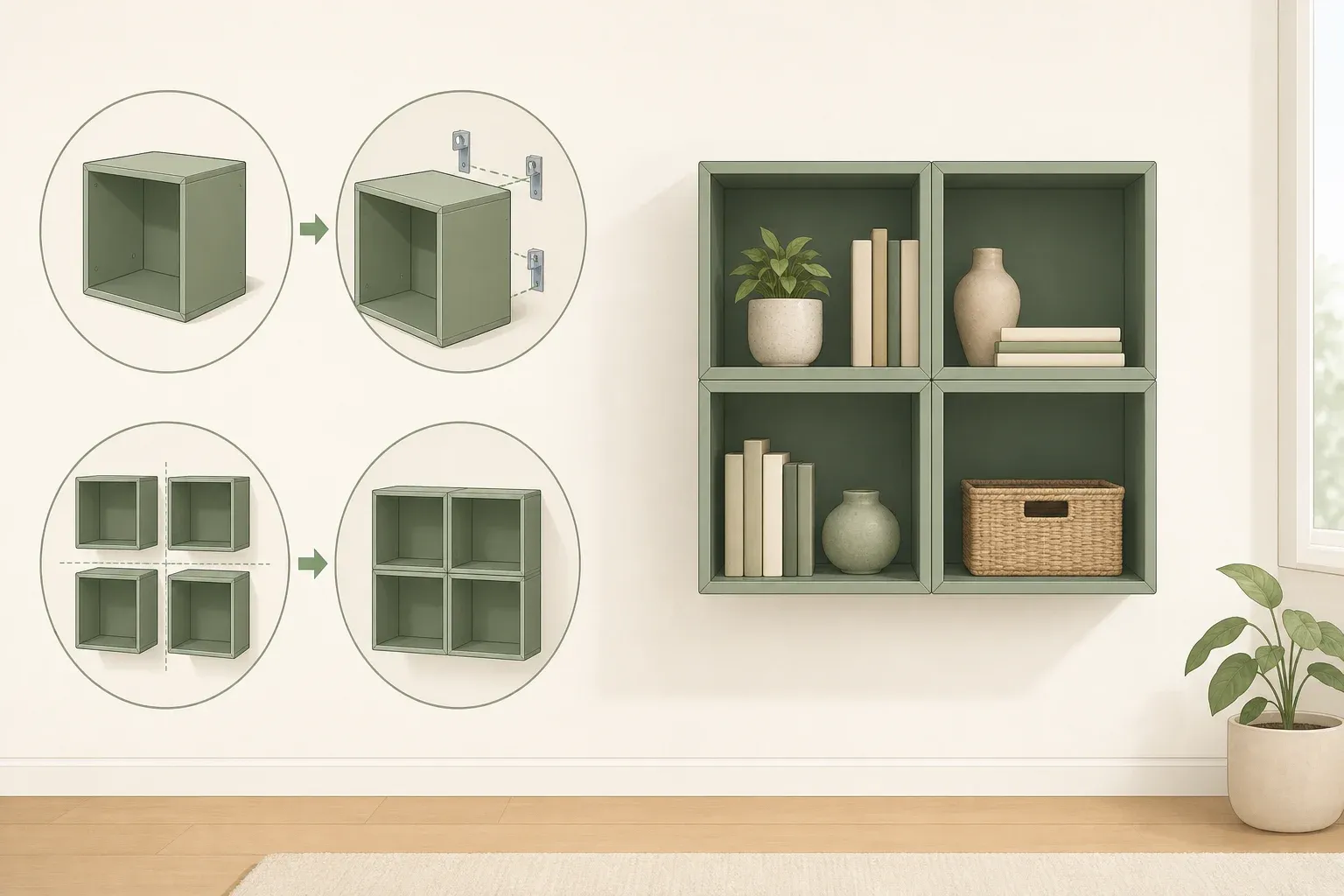
A note on existing systems: If you already own a modular shelving system, extending it is significantly cheaper than buying new units. One renter achieved a full sleeping zone by adding only a few shelves to an Elvarli system she already had (Apartment Therapy, last December). Work with what you have before specifying new purchases.
Compared with the alternatives: ceiling-mounted curtain tracks can fully enclose a zone and close for maximum privacy, but block all light when drawn; folding screens are repositionable but offer no storage and minimal visual authority; half-walls offer privacy when seated but require construction. The bookshelf divider's edge over all of them is that it handles division and storage in one piece while keeping light largely intact (Interiorholic, earlier this year).
Step 3: Measure, check your floors, and plan for what goes wrong
Measure precisely, then measure again.
Prefabricated shelving units have fixed widths. Small measurement errors compound across multiple units, turning a gap that should be flush into one that's several centimeters off. The builder behind the six-BILLY project named precise measurement as his single most important piece of advice: get it right upfront and assembly is straightforward; get it wrong and you're returning units (Apartment Therapy, last December).
On your floor plan sketch, mark windows, doors, outlets, radiators, and any fixed built-ins. The bookshelf divider cannot obstruct fire exits, emergency egress windows, or HVAC access. This applies to furniture-based partitions just as it does to built walls.
Check your floors before assembly, not after.
Older apartments frequently have sloped floors or walls that aren't plumb. Check with a level in the exact location where units will stand, not the center of the room. One renter discovered a notably sloped floor and resolved it by shimming individual BILLY units with cut plywood pieces to keep the tops level and the assembled structure sound (Apartment Therapy, last December). Correct uneven floors before joining units together; fixing it afterward is significantly harder.
Gotcha: Face the open back of the shelving toward the apartment's primary light source. Light passes through the open back; it terminates against a solid side panel. This orientation is easy to overlook in planning and difficult to fix once the units are loaded.
Load the shelves with stability in mind.
Heavy items like books, boxes, and folded linens go on lower shelves. Light or decorative items go higher. A top-heavy unit raises its center of gravity and increases tip risk, which reinforces the case for wall anchoring wherever the lease allows. The outward-facing side, visible from the living area, benefits from intentional styling. A few books, a plant, and some objects make the divider read as a considered design choice rather than a workaround.
Step 4: Address sound, light, and the feeling of separation
A bookcase divider creates visual separation and psychological privacy. It does not meaningfully reduce sound transmission. That's the honest version of what it delivers.
If noise bleed between zones matters, add a curtain track along the bedroom side of the divider. Heavy velvet provides modest acoustic dampening that linen or cotton doesn't (Interiorholic, earlier this year). This combination captures the practical best of both approaches: the storage utility and spatial definition of shelving, with the option to fully close off the sleeping zone when needed. A small white noise machine handles residual sound without any installation at all.
For light in a box configuration, a plug-in wall sconce above the headboard is the rental-safe solution. No rewiring, no landlord conversation. The compact European flat featured exactly this: a wall sconce mounted just above the bed to supplement the natural light the open-backed bookcase allows to pass through (COCO LAPINE DESIGN, last month). Install it before the units go up if the bed placement makes access difficult afterward.
Two renters described the outcome in nearly identical terms: a sleeping space that feels distinct from the rest of the apartment, cozy, private, less exposed, without making the studio feel smaller or sacrificing the storage they needed. One said the new setup made the whole studio feel "more like a home" (Apartment Therapy, last December). The other said her sleeping zone makes "the space look twice the size" (Apartment Therapy, last December). Neither was describing a legal bedroom. Both were describing a real change in how the apartment felt to live in.
Which setup is right for your situation
The right choice comes down to three things: how much enclosure you actually need, what your floor plan allows, and whether you're starting from scratch or extending something you already own.
Choose the single-unit approach if your layout creates natural zone separation, light preservation matters more than privacy, or your budget is limited. It's the lowest-commitment version, establishes a clear boundary without enclosing the bed, and costs a fraction of the box build. It also suits studios where full enclosure simply isn't possible given the floor plan.
Choose the box configuration if privacy is the priority and your floor plan has a usable corner. At the $1,100 price point, it delivers near-complete enclosure, significant storage, and the privacy outcome renters consistently describe as the most meaningful improvement to how their studio feels day-to-day (Apartment Therapy, last December). For context, professionally installed bookcase walls in one New York market run $1,200 to $2,500; the DIY approach, built carefully, sits at the lower end of that range without the installer fee (Temporary Walls NYC, earlier this year).
Skip the bookcase approach entirely if your studio is too narrow for a perpendicular divider, or if the light loss of a box configuration would make the sleeping zone genuinely uncomfortable. In those cases, a ceiling-mounted curtain track gives you full closable privacy without consuming floor space or blocking light when open.
Freestanding shelving is generally easier to remove than anything built into the apartment. Anti-tip hardware may leave small holes, but that's the extent of the footprint. When the lease ends, the whole setup comes with you.
Once the divider is in and the sleeping zone is defined, the next decisions are lighting and window coverage on the bedroom side. Neither requires a landlord's involvement.








Comments
Be the first, drop a comment!