



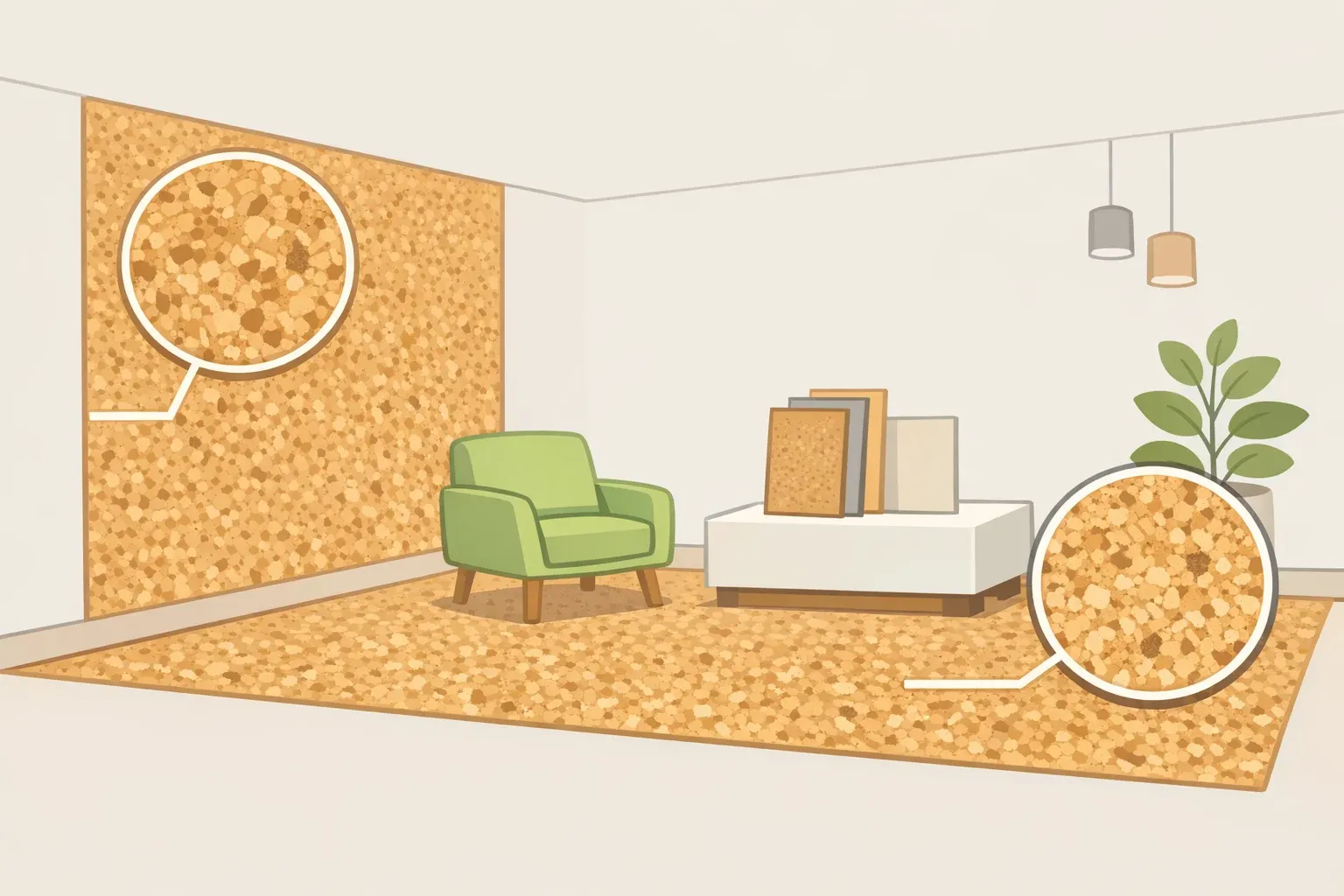
Cork has spent most of its interior life out of sight. It absorbs sound beneath timber floors, insulates behind drywall, and cushions under vinyl tiles. The cork interior design trend is now pulling it into visible applications on wall surfaces, flooring you can see and feel, the deliberate exterior face of a published architectural project is specific, and worth understanding on its own terms. Not a rebranding exercise. Two signals from the past few weeks suggest this uptick has more substance than a passing novelty, and examining why is more useful than simply noting that it's happening.
Portuguese manufacturer Granorte brought cork floors, walls, and furniture to Clerkenwell Design Week in May. Sophie Brady of Granorte said the designer's response "highlighted the relevancy of the material for today's commercial interiors." Clerkenwell is where specifiers and architects assess materials for actual projects, not just gather inspiration, which makes that reaction a credible signal rather than a trade show formality, as detailed in the Interior Designer Magazine.
Recently, Studio Bauform's 377-square-foot home extension in Herzogenaurach, Germany, also appeared in print with brownish-red cork as the deliberate exterior face of the building. The cork was chosen to echo and soften the Cor-Ten steel cladding of the adjacent main house. Dwell described it as "a tactile and calm presence that emphasizes material authenticity and craft."
Cork is not a fringe material seeking an audience. The global industry processes more than 280,000 tons annually, with wall, floor, and ceiling coverings consuming roughly 18,000 tons per year and insulation applications adding another 18,000 tons on top. What 2026 shows is an acceleration, not an origin story.
This analysis is not arguing that cork is replacing wood. The evidence does not support that claim. What it does support is that cork is establishing a distinct and defensible role in interior finishes, particularly for floors and acoustic wall surfaces, where its combination of tactile warmth, sound absorption, and genuinely renewable sourcing is difficult to match with conventional alternatives. The question is where that case is strong, where it frays, and what to verify before specifying or buying.
Why the cork interior design trend is showing up visibly now
The shift in 2026 is not that cork became available. Hotel Ecork in Évora, Portugal, purportedly the world's first cork-clad hotel, covered its entire façade in cork well before this decade, according to the same 2024 construction review. What changed is that two forces in the design market converged at the same moment.
The first is sustained appetite among specifiers for natural, tactile surfaces with legible material character. Cork's muted warmth and texture read as honest rather than processed. Many commercial interiors now favor natural-looking materials as a baseline expectation, and cork fits that vocabulary without requiring any surface fabrication to get there.
The second force is sustainability pressure with actual teeth. Specifiers and procurement teams are increasingly required to justify material choices with more than visual appeal. Cork's sourcing model offers something most "natural" materials cannot: a harvest cycle that does not destroy the source.
Cork oak bark is stripped from living trees on a nine-to-twelve-year cycle. The trees live more than 200 years and regenerate their bark fully after each harvest. Regularly harvested cork oaks also produce between 250% and 400% more cork than unharvested trees, meaning commercial demand actively sustains the ecological productivity of the forests that supply it, rather than depleting them.
Granorte manufactures its interior products from waste generated by wine stopper production granules and offcuts that would otherwise be discarded, which gives the circular-economy framing substantive grounding rather than marketing language.
The harvest story is genuinely strong. What happens downstream is more complicated. Around 20-30% of raw cork arriving at processing facilities is discarded as dust, a significant waste fraction even within a renewable system. Composite cork products, which include most finished flooring and decorative panels, also incorporate adhesives, coatings, and surface layers that complicate biodegradability claims.
There is also a structural supply-chain constraint that gets less attention than it deserves. A Frontiers study mapping Portugal's cork value chain found that poor raw material quality was the single most commonly cited challenge across producers, processors, and buyers alike. Portugal accounts for approximately 55% of global cork production, which makes this a structural issue for the entire market, not a problem confined to a single region or supplier. For buyers, product-to-product variation is a realistic consideration, not a worst-case scenario.
What cork actually does inside a home: performance by product type
The single most common source of misleading cork claims is treating two meaningfully different categories of product as interchangeable. Getting this distinction right is probably the most useful thing anyone can do before specifying or purchasing.
Natural versus composite: why the distinction matters
Expanded or natural cork, sometimes called insulation corkboard, contains no synthetic binders. It is compressed under heat and bonded by cork's own natural resins, making it a genuinely binder-free product.
The Studio Bauform extension uses this type: open, breathable cork insulation between exposed timber studs in a diffusion-open wall assembly that allows moisture vapor to pass through rather than accumulate, as Dwell reported this week. That is a specific and meaningful performance advantage in timber-frame construction, not a general property of all cork products.
Composite cork products, which include most finished flooring and decorative wall panels, combine cork granules with adhesives and surface coatings. Granorte's commercial flooring lines contain up to 89% natural cork by composition, but their surface is finished with a proprietary wear-resistant coating. The cork core delivers acoustic and thermal comfort; the coating delivers durability. These are different products serving different jobs, and their environmental profiles differ accordingly.
Where the performance case is strongest
Cork's cellular microstructure, a honeycomb arrangement of air-filled cells, confers "lightweightness, insulation, thermal regulation, and remarkable mechanical performance," according to a Green Chemistry review published in 2024. That structure makes cork genuinely well-suited to acoustic applications. Sound is absorbed rather than reflected. For home offices, bedrooms above active living spaces, and open-plan areas where hard surfaces amplify noise, that is a real and testable advantage.
Lab testing of composite cork panels found low water absorption, strong acoustic insulation, hardness comparable to established building materials, and notable fire resistance, a combination that supports practical use well beyond decorative application.
Where to be careful
The same review notes that decay rates for cork products in everyday residential use are "not grounded in empirical data but rather assumed based on typical product usage." Independent long-term durability data for finished cork flooring under realistic residential traffic does not yet exist at the level it does for hardwood or luxury vinyl. Manufacturer-cited durability figures should be verified against independent testing where available.
The "all-natural" framing common in cork marketing also sits uneasily with composite products that include epoxy adhesives or synthetic wear layers. Those additions frequently improve performance, and they are not inherently problems, but they affect biodegradability claims and end-of-life handling in ways that a simple "natural material" label does not acknowledge.
Cork wall and flooring design: where it works and where it doesn't
Knowing where cork performs well is useful. Knowing where it fails and what questions to ask before that happens is more useful.
Best-fit applications
Cork flooring works best in rooms where acoustic comfort and thermal warmth underfoot are priorities over heavy scratch resistance: home offices, bedrooms, children's rooms, living areas with open-plan layouts. The softness underfoot and sound absorption justify the specification in those contexts. Cork wall panels as functional acoustic treatment or decorative surface work well in home offices, media rooms, and bedroom accent walls anywhere texture and sound absorption justify the cost without requiring the surface to take physical punishment. Ceiling panels in open-plan spaces where hard finishes are amplifying noise round out the clearest applications.
High-moisture rooms and heavy-traffic corridors require closer scrutiny. Not all cork flooring carries the same moisture tolerance. Wear-layer ratings vary significantly between products. The room label matters less than the stress profile: how much standing moisture, how much foot traffic, and how long the installation is expected to last.
Six checks before purchasing
The questions most likely to be skipped in a purchase decision are also the ones most likely to matter later.
Product type: Is this natural/expanded cork or a composite? The answer determines moisture behavior, breathability, and what end-of-life handling looks like.
Wear layer and coating: What is the surface made of, and what is its rated thickness? A proprietary wear layer affects both durability and biodegradability claims.
Moisture rating: Does the product's rated tolerance match the intended space? This is not the same question for a bedroom and a kitchen.
Acoustic data: Published NRC figures are more reliable than general claims about sound absorption. If a manufacturer cannot provide them, that is worth noting before committing.
Adhesive disclosure: What binds the cork granules in composite products? Epoxy-based binders affect end-of-life handling in ways the sustainability narrative will not flag.
Installation context: Does the intended wall assembly or subfloor match the product's requirements? The Studio Bauform exterior example involves a specific breathable-wall system within a timber-frame envelope. It is architecturally compelling as evidence that designers are choosing to expose cork with deliberate intent, but it is not a direct reference point for standard interior renovation decisions.
Cork flooring's upfront cost runs higher than most conventional alternatives, and the 2024 review acknowledges this is the primary adoption barrier. The same review argues that thermal performance savings can offset the premium over time, though that calculation depends on what is being replaced and how long the installation will be in place. The Frontiers value-chain study finding on raw material quality is worth keeping in mind throughout: variation in finished product quality is a structural supply issue, not a random occurrence, and no marketing material is going to flag it.
What 2026 confirms and what remains open
Cork's move into visible finish applications is real and supported by credible sources from the past several weeks. A major industry festival where specifiers reported genuine interest in cork surfaces, and a published architectural project where cork was the deliberate aesthetic and performance choice rather than a concealed utility layer. That is a thin evidentiary base for sweeping claims, but it is a coherent one.
The case for cork in interior finishes rests on three properties working together: acoustic absorption built into the material's cellular makeup, tactile warmth that is genuinely difficult to replicate with conventional alternatives, and a harvest model where commercial use actively sustains the ecosystem that produces the raw material. The 2024 construction review supports this with material science evidence, not just environmental advocacy.
The real constraints are less glamorous. Upfront cost sits higher than most alternatives. Long-term residential durability data is incomplete. Raw material quality inconsistency across Portugal's supply chain is documented and ongoing. The sustainability story for composite products with synthetic binders and coatings is more complicated than the harvest narrative alone suggests. None of these is disqualifying; all of them are things a buyer should know going in.
Cork is not taking over from wood. It is earning a specific role in spaces where acoustic comfort matters, tactile material quality is a priority, and the sustainability argument needs to hold up past a surface glance. What would actually confirm the shift: independent wear data from real residential installations, broader published acoustic specs across product lines, and more consistent commercial-grade offerings from multiple manufacturers. The evidence from 2026 shows genuine traction. Whether that traction outlasts the moment depends on parts of the picture that are still genuinely unresolved.











Comments
Be the first, drop a comment!