



Flat Pouf Repair: How to Diagnose, Refill, and Restore It
How to tell if a pouf is actually refillable
This guide walks through how to identify whether a flat pouf can be refilled, choose the right fill material, buy the right amount, and restore it to firm in one focused workflow. If your pouf is refillable, This can restore firmness in most refillable poufs. If it isn't, you'll know that in the first five minutes instead of after a wasted trip to the craft store.
Not all flat poufs are fill problems. Structured ottomans with rigid frames or plywood bases, and soft-sided poufs with stretched, torn, or seam-separated covers, cannot be fixed by adding more material. Knowing which category you're dealing with is the real first step.
Run this check before doing anything else:
The base has a zipper, or a seam you can carefully open and hand-stitch back
Pressing down on it, you feel shifting loose material, not a solid frame underneath
The outer cover is intact: no major seam separation, no visible fabric thinning, no structural stretch that causes it to sag unevenly when empty
The flattening was gradual, meaning it got softer over months, not suddenly
If all four are true, you have a refillable pouf and the rest of this guide applies directly.
If the cover is compromised, stretched out of shape, torn, or pulling away at the seams, adding more fill won't help. The cover does structural work too, and a tight refill inside a weakened shell still looks flat and feels uneven. That's a cover-replacement or full-unit-replacement situation.
When to call it done and replace the whole piece: If the outer fabric has visibly thinned, if seams are separating along more than one edge, or if the cover no longer holds a round or square profile when partially filled, the pouf has reached end of life. A new mid-range pouf runs $60–$150 at major home retailers, based on commonly observed retail pricing; weigh that against refill materials before proceeding.
Step 1: identify your fill type and decide: top-off or full replacement
Open the zipper fully and pull out a small handful of material. What you find determines everything: what to buy, how much, and whether you're topping off or starting over.
EPS beads look like small white pellets, similar to packing material in a shipping box. This is the most common fill in knit and woven-fabric poufs. Compressed beads feel dense and slightly gritty, like coarse sand, but the beads themselves are structurally intact. EPS bead poufs are almost always good top-off candidates unless they've picked up moisture or odor, since beads compress but don't break down quickly under normal use.
Polyester fiberfill comes out in soft, cottony clumps. Healthy fiberfill is light and lofty; matted fiberfill feels dense and won't spring back when squeezed. If the clumps pull apart easily with your hands, a top-off works. If they've compacted into a dense mass that doesn't separate, full replacement gives better results. Topping off matted fill just adds a lofty layer over a dead core.
Shredded foam feels spongy and irregular. If it's leaving residue or crumbling between your fingers, it's degrading. Foam breaks down over time rather than simply compressing, and once it starts shedding, a top-off won't restore the pouf. Replace the fill entirely with fresh shredded foam or switch to EPS beads.
The working rule: if the fill is structurally intact and just compressed, top it off. If it's degraded, musty-smelling, or mostly gone, do a full replacement. Fresh fill on top of dead fill underperforms. When in doubt, replace everything.
Don't mix fill types. EPS beads added to a fiberfill pouf shift to the bottom and create uneven pockets. Match the original material, or do a full replacement with one consistent type.
How much fill to buy for a pouf
Use pouf diameter as your guide. The amounts below are practical estimates based on common pouf proportions; your specific pouf may vary depending on how it was originally filled and how much the cover stretches.
These estimates apply to standard round poufs; oval and square poufs of similar footprint are roughly comparable:
| Pouf diameter | EPS beads (top-off) | EPS beads (full refill) | Fiberfill (full refill) | |---|---|---|---| | 14–16 inches | 0.25–0.5 cu ft | 0.5–1 cu ft | 0.5 lb | | 18–20 inches | 0.5–0.75 cu ft | 1–1.5 cu ft | 1 lb | | 22–26 inches | 0.75–1 cu ft | 1.5–2 cu ft | 1.5–2 lbs |
For a top-off, buy roughly half the full-refill amount. Buy slightly more than the table suggests; leftover EPS beads store easily in a sealed bag for the next round.
A full EPS bead or polyester fiberfill refill typically runs $10–$25 in materials depending on pouf size, based on commonly observed craft retail pricing. Both materials are widely available in bags labeled "bean bag refill" or "pillow stuffing." JOANN and Amazon both carry multiple sizes. Polyester fiberfill runs approximately $8–$12 per pound at most craft retailers. At those prices, a refill costs a fraction of what a comparable new pouf would run, as long as the cover is in solid shape.
Step 2: prepare the fill and the pouf
Before starting, gather what you'll need: a large plastic bin or bucket, a large contractor bag, a measuring cup for EPS beads, and a funnel if you have one. The funnel isn't strictly necessary but makes transferring EPS beads into the pouf significantly less chaotic.
For a top-off: Before adding anything new, pour the existing EPS beads into the bin and stir for a minute. This redistributes compressed material so new beads don't sit in a lofty layer on top of a dense mass. For matted fiberfill, pull each clump apart by hand until it's loose and airy. Five minutes of this meaningfully improves the final result.
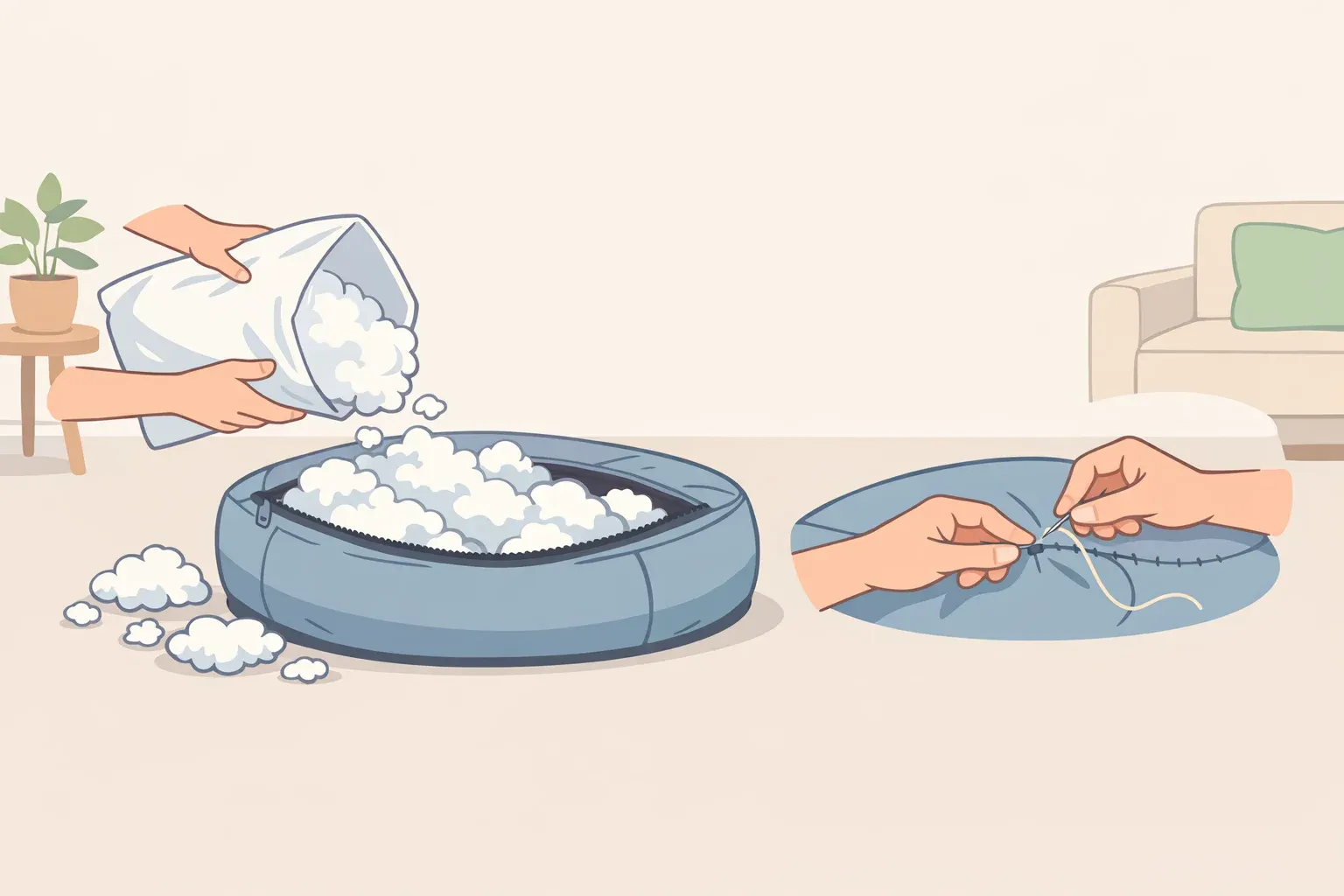
For a full replacement: Place the pouf inside a large contractor bag before unzipping. This contains the beads as you scoop them out. Do not vacuum EPS beads with a standard household vacuum. The beads can overwhelm the filter and damage the motor. Use a shop vac, or scoop by hand into the bag. Fiberfill and foam can go into a standard trash bag.
EPS beads carry significant static cling and will migrate to every surface in the room. Work in a contained space, a bathroom, laundry room, or garage, and keep pets and small children out until cleanup is done. This is the step most people skip and most regret.
For full replacements, consider an inner liner. Fill a piece of muslin or an old pillowcase with your new material, tie or hand-stitch it closed, then place the filled liner inside the outer cover before zipping. This keeps fill evenly distributed, slows re-compression, and makes every future top-off a five-minute job instead of a 30-minute one. Do this as part of the replacement step, not as an afterthought.
Step 3: fill incrementally, test firmness, and seal
Add fill in stages. Overfilling stresses the seams and creates a pouf that's too rigid to sit comfortably.
Add roughly half your new material, zip partially closed
Press down firmly with both hands. A well-filled pouf should compress noticeably under moderate pressure and spring back within a few seconds
Add fill in small increments, a cup or two of EPS beads or a loose handful of fiberfill, until you reach that resistance
Zip fully closed, set on the floor, and sit with your full weight for 30 seconds
Stand up and check the profile from the side. It should hold shape and recover within a few seconds
If it flattens significantly after one sit, open and add more fill in small amounts. Repeat until firmness holds.
If your pouf sits on hardwood or tile rather than carpet, fill it a little firmer than feels right at first. Hard floors accelerate compression, and the fill will settle noticeably within the first week. The practical test: it should still hold shape after a few days of normal use.
Once firmness holds, check that the zipper pull is fully seated and the teeth are aligned. If you notice gapping along the seam, remove a small amount of fill before the stitching takes stress.
Troubleshooting: when the refill doesn't hold
Still flat after refilling. The most common cause is not enough fill. Go back and add more in small increments, testing firmness after each addition. If you've clearly exceeded the table estimates and the pouf still bottoms out under your weight, the cover has stretched beyond its original dimensions. More fill won't fix that; the cover is the problem.
Zipper won't close. The pouf is overfilled. Remove fill until the zipper closes without resistance, then check firmness. A zipper under strain will fail at the seam over time, so don't force it.
Fill keeps migrating to one side. This usually happens when EPS beads are added to an existing fiberfill base, or when a pouf without an inner liner gets used heavily from one direction. If it's a fill-mixing issue, do a full replacement with one consistent type. If it's a use-pattern issue, an inner liner solves it permanently by containing the fill as a single unit.
Pouf feels lumpy after fiberfill replacement. The fill wasn't broken up enough before going in. Open the pouf, pull the fill out in sections, tear each piece apart until it's fully airy and separated, then repack. Dense clumps that go in as clumps stay as clumps.
New fill compressing too fast. Low-density EPS beads compress more quickly than standard-density beads. If you bought a bulk bag labeled only "bean bag refill" without a density specification, the beads may simply be lighter grade material. Next time, look for bags that specify bead weight; denser beads hold firmness longer. For now, a more generous fill volume compensates partially.
How to keep it firm longer
A refill done right should hold for a year or more before needing another top-off, based on typical household use, though heavier use or humid conditions shorten that window. Three simple habits extend the interval.
Rotate the pouf every few weeks. If it sits in one spot and gets used from one direction, fill compresses unevenly and creates a permanent lean. A quarter-turn redistributes wear across the whole structure.
Knead fiberfill poufs weekly. Pick up the pouf and work it briefly with your hands to break up early clumping before it sets. It takes 30 seconds.
Keep moisture away from the fill. Humidity accelerates fiberfill matting and EPS bead degradation. In humid rooms, a waterproof liner between the fill and the outer cover extends fill life noticeably.
Keep leftover fill in a sealed bag. The next top-off, with maintenance habits in place, takes 10 minutes.




Comments
Be the first, drop a comment!