



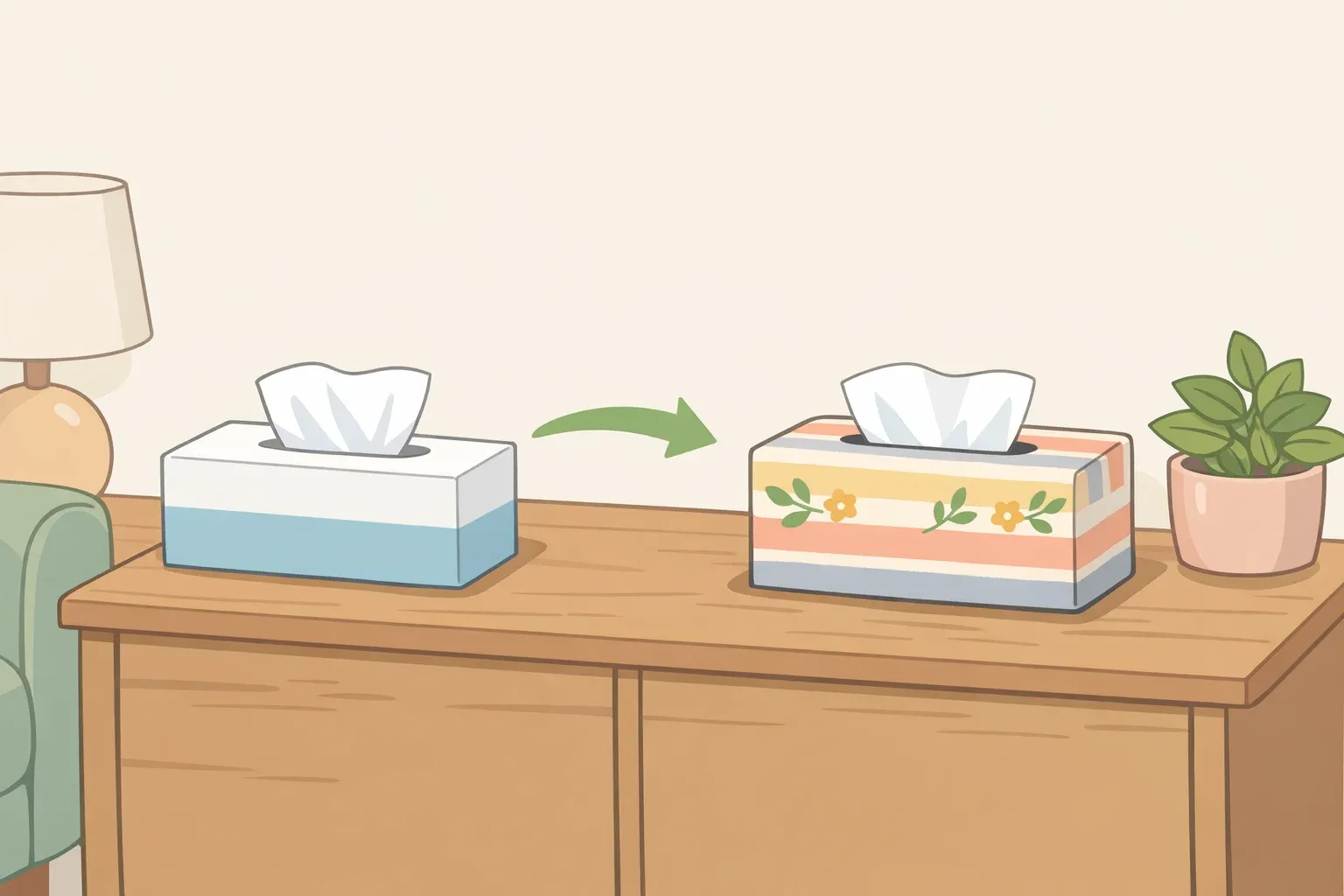
A tissue box is functional packaging. It was designed to move off a store shelf, not to sit on a styled nightstand, and it looks exactly like that. Swapping it for a decorative tissue box cover is one of the cheaper finishing moves in home decor. Entry-level options start under $10; examples run up to $75. The visual payoff is immediate on the right surface.
The risk isn't the price. It's choosing a cover that competes with what's already in the room. A cover that clashes with existing decor or reads as too bold draws attention to exactly the wrong thing. The bare box it was meant to hide would have been less disruptive.
Before you start browsing, check whether your household uses cube-format or standard rectangular tissue boxes. Covers are sized for one or the other, and mixing them up is an easy purchasing mistake to make.
This guide walks through the three decisions that determine whether a tissue box cover works: whether it blends visually, whether the material suits the room's function, and whether it holds up in daily use.
Step 1: Match the cover to the room, not just your personal taste
The selection logic starts with the room, not the product page. A cover that blends with what's already on the surface will feel like the room was always finished. One that competes will make the surface look busier than a bare tissue box ever did.
Choose covers that coordinate with the room's dominant colors and textures, treating the cover as a small extension of the existing textile palette rather than a standalone decorative object. The cover should match other decor elements like pillows and curtains, creating a cohesive look rather than a focal point. Think of it as belonging to the same visual family as your hand towel or pillowcase, not as a feature piece trying to stand out.
From there, the visual strategy splits into two modes:
Blending: If the room already has a lot going on, pattern, layered textiles, strong color, choose a solid cover in a tonal color pulled from something already in the room. Patterned rooms need the cover to disappear.
Accenting: If the room is mostly neutral, a cover with texture or a restrained pattern can do a small amount of styling work. A woven linen or block-print cover in a warm neutral adds dimension without adding noise.
That distinction, blend, or accent is the bridge between reading the room and choosing the right material. It tells you whether you need something quiet or something with a little character, which narrows the material decision considerably.
Place a cover on your nightstand or bathroom counter for a whole new look, and those two surfaces make sense as starting points: visible, relatively uncluttered, and exactly where a well-chosen tissue box cover does the most work. Pick one surface first rather than trying to solve every room at once.
Step 2: Choose the right decorative tissue box cover material for each room
Once you know whether the cover needs to blend or accent, the room itself drives the material decision. The split is primarily functional, not aesthetic.
Fabric covers: bedrooms, living rooms, guest rooms
Linen, cotton, and velvet are the most reliable choices. Natural fibers are recommended since they are soft, durable, and more sustainable than polyester blends, and they look more considered. Fabric covers add warmth and tactile character, which is exactly what bedrooms and living rooms benefit from. They're also reusable and customizable, which matters when something will sit on a nightstand for years.
A burlap cover runs around $17 to $20, woven and block-print styles land at $25 to $29, and a premium linen option sits at $75. Some designs can be monogrammed for an added $15, a practical option for a guest room or a gift.
One consideration for fabric in a bathroom: humidity means regular washing to keep covers fresh. If you want the warmth of fabric in a bathroom, treat it as a laundry item from the start. For most bathrooms, a hard-shell cover is the simpler default.
Hard-shell covers: bathrooms, offices, desks
Porcelain is a long-standing bathroom accessory material. It has elegant appeal built over hundreds of years, which is the relevant selling point in a space where you want something that reads as considered rather than improvised. For a more minimal or work-oriented room, leather is a good choice. It reads as intentional on a desk surface without trying too hard.
Resin covers occupy a useful middle ground. House Beautiful describes one example made from durable resin with a faux wood base, with a printed sandy exterior that evokes the Mojave Desert. That kind of cover functions less like a box wrapper and more like a small sculptural object, useful in earthy or nature-forward rooms where you want something with more visual weight than a fabric option provides.
Fast decision guide
Bedroom: Fabric cover — linen or cotton; match the room's dominant textile.
Living room: Fabric cover — woven or block print; pull in one accent color.
Bathroom: Hard-shell cover — porcelain or resin; match the hardware or tile.
Office / desk: Hard-shell cover — leather or lacquered finish; match the desk surface.
Patterned room: Solid fabric cover — use a tonal shade that pulls one color from the pattern.
Neutral room: Textured fabric cover — choose a warm, natural material with minimal pattern.
The table is a shortcut, not a rule. Fabric where you want warmth and texture; hard-shell where the environment demands something more practical. A bathroom tissue box cover almost always wants to be porcelain or resin. A bedroom cover almost always wants to be linen or cotton. Edge cases exist, but most rooms fit one column cleanly.
How to make a tissue box look better in five minutes
If the three-step framework feels like more than you need right now, this is the short version.
Pick up the tissue box currently on your nightstand or bathroom counter. Note whether it's a cube or a rectangle. That determines sizing before anything else.
Look at one other textile or finish already on that surface. A hand towel, a lamp base, a throw. The cover should belong to the same color family, not match it exactly.
Choose fabric for a dry room, hard-shell for a humid one. Bedroom nightstand: linen or cotton. Bathroom counter: porcelain or resin.
Check the product's interior dimensions against your tissue box before ordering. Tight fits cause friction. A slightly loose fit causes nothing.
Place it. Done. The cover should disappear into the room, not announce itself.
One surface, done right, reads better than five surfaces handled carelessly.
Step 3: Check fit and daily function before you buy
A tissue box cover that makes tissues hard to grab gets removed within a week. This step takes two minutes and prevents a return.
Sizing first. Tissue boxes come in two main formats, cube and rectangular, and covers are built for one or the other. Confirm the product's listed interior dimensions against the tissue brand you actually buy. If a listing's interior dimensions look tight, assume they are. A slightly loose fit is preferable to a cover that grips the box and requires two hands to manage.
Refill access second. Choosing designs that allow easy refilling and that don't make it difficult to grab tissues quickly. Some snug-fitting fabric covers require removing the cover entirely to swap in a new box. Check whether the bottom opening is large enough to access with the box inside before you order. Her benchmark holds: a great balance between style and convenience. A cover you have to think about has already failed its job.
Frequency of use matters more than it seems. Cold and flu season turns this into a high-use item for months at a stretch. Whatever looks good in September needs to function just as easily when you're reaching for it without looking, one-handed, at midnight. The practical test is a better filter than the product photo.
A common sizing mistake: buyers assume standard sizing is universal across brands. It isn't. If you buy tissues in bulk from a single brand, measure that specific box rather than assuming it matches a generic standard. The difference is small but enough to make a cover either snug or unusable.
One surface, three checks
The payoff from a tissue box cover is specific: it removes visually disposable packaging from surfaces you've worked to make feel considered. The cost entry point is under $10, per House Beautiful, which means the barrier to a good result is mostly attention, not money.
The three decisions run in sequence, and each one narrows the next:
Visual role first. Blend or accent. That single call shapes everything downstream, as Apartment Therapy reports.
Material to match function. Fabric for bedrooms and living rooms; hard-shell for bathrooms and offices. Linen, cotton, or velvet over polyester when choosing fabric.
Fit and refill access before checkout. Cube vs. rectangular sizing confirmed; bottom opening large enough to use without removing the cover entirely.
Start with one surface, a nightstand or bathroom counter, and get it right. A single well-chosen cover on the right surface is more noticeable than matching covers scattered across a home without a plan. Restraint, here, is the actual finishing move.








Comments
Be the first, drop a comment!