



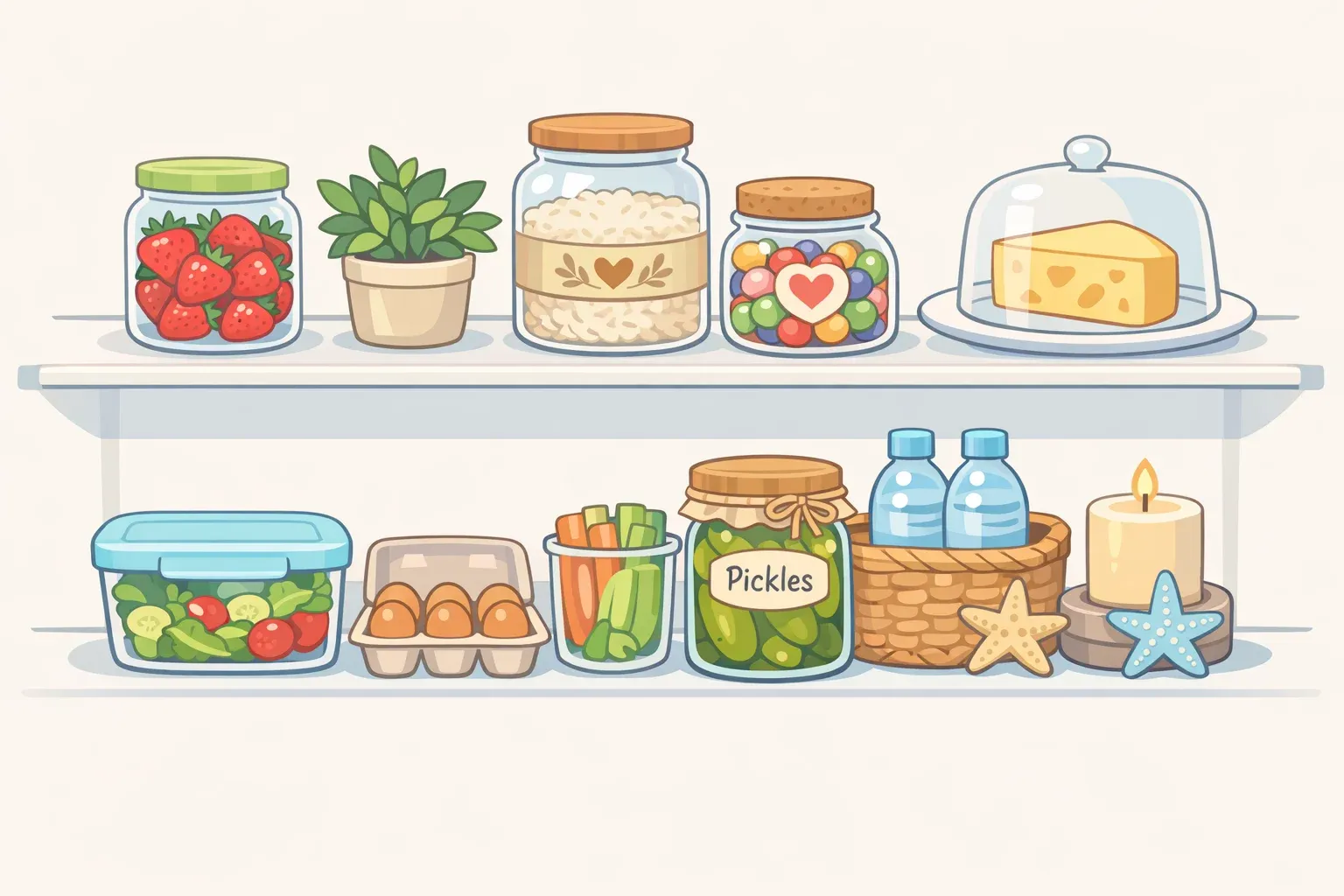
Content creator Lynzi Judish turned her refrigerator into a Hobbit hole, complete with doilies, moss, and mushroom-shaped jars. In 2024, Eater reported that she was already planning her next project: a Charles Dickens-themed Christmas fridge, drawn from her love of classic literature.
This isn't meal-prep organization. It's interior design applied to an appliance most people only think about when something spills, and it's left plenty of people wondering how to decorate the inside of your refrigerator without turning it into a science experiment.
The practice has a name: fridgescaping. Blogger Kathy Perdue coined the term in 2011 to describe food storage that blends the practical with the aesthetic. Stated plainly, this is a harmless creative outlet exactly as long as it stays subordinate to the fridge's actual job: keeping food cold, ventilated, and safe to eat.
That trade-off runs through everything below, from why the trend caught on, to why it draws sharp criticism, to a practical framework for anyone who wants to try it without creating a health risk.
What fridgescaping is, and why it isn't as new as it looks
Judish's own explanation is disarmingly simple. "You decorate your home, why not your fridge?" she says. She's also described refrigerators as stressful before she took up the hobby, which suggests the appeal isn't purely visual. It's about making a repetitive chore feel intentional instead of dreaded.
This impulse didn't start on social media. By the 1950s, nearly every American household owned a refrigerator, and manufacturers marketed them as "beauties" promising "a finer way of living." Food scholar Emily Contois, who studies food culture at the University of Tulsa, notes that fridge advertising has long shown open doors and packed shelves as symbols of American abundance, a promise extended to every consumer citizen.
Fridgescaping, then, is a social-media-native version of a decades-old instinct. The platform changed from print ads to TikTok. The urge to make food storage reflect identity and taste never really went away.
Why the trend divides opinion
Critics frame fridgescaping as a marker of unrealistic free time and privilege. Content creator Shabaz Ali joked that the average viewer could only "strive to be this level of unemployed" to pull off the look.
That critique often carries a gendered undertone. One anonymous Reddit post in the AITA subreddit described a husband telling his wife he hated her fridgescaping, calling it unnecessary since he "doesn't have to use the fridge much anyways." It's a single anecdote, but it shows how quickly domestic-labor debates attach themselves to this particular trend.
Judish pushes back on that framing directly. "I hope people see that this is not another ridiculous standard we should set for women," she says.
Strip away the specifics, and the backlash has little to do with moss or mushroom jars. It's the same friction between aspiration and obligation that ran through midcentury homemaking ideals, replayed now with a phone camera instead of a magazine spread.
How to decorate the inside of your refrigerator safely
This is where the styling impulse and the appliance's actual function meet. A workable framework treats the two as compatible, not competing.
Confirm the baseline before you start
Start with the basics. The FDA recommends keeping refrigerators at 40°F (4°C) or below, and freezers at 0°F (-18°C), and since most built-in dials don't display the actual temperature, an inexpensive appliance thermometer is the most reliable way to verify the temperature.
Treat the makeover itself as a food-handling task, not just a decorating project. The FDA's rule for any food left unrefrigerated applies here, too: perishables pulled out to rearrange shelves shouldn't sit at room temperature for more than 2 hours, or 1 hour if the room is above 90°F.
A shelf-by-shelf approach
Decorating refrigerator shelves works better as a rolling project than a full teardown. Clear and style one shelf at a time instead of emptying the whole appliance at once, so most of the food never leaves the cold for long enough to matter.
Once everything is back in place, check the thermometer again. Décor, jars, and bins can change how air moves through the fridge, so it's worth confirming the temperature still reads 40°F or below rather than assuming it does.
Leave gaps between containers, especially near the back wall, so cold air can keep circulating; that's the same logic behind the FDA's warning against overpacking a refrigerator in the first place.
What can go inside
For anyone wondering how to make your fridge look aesthetic without creating extra work, material choice matters more than people expect. Décor that's easy to remove and wipe down — glass jars, ceramic dishes, acrylic frames — holds up better over time than anything porous. Moss and fabric can't be cleaned the same way, which makes them harder to keep sanitary in a space that's supposed to stay clean.
That's a practical preference rather than an official rule, but it follows directly from the airflow and cleanliness guidance above. If it can't be wiped down or run through a dishwasher, it probably doesn't belong on a shelf next to raw food. Keep raw meat, poultry, and seafood securely wrapped or in sealed containers so their juices cannot drip onto food or decorative items.
How to style with storage
Fridgescaping isn't the first attempt to merge looks and function inside a refrigerator. In the 1950s, Frigidaire sold color-matched refrigerators with interchangeable containers and moveable shelves, and the International Harvester Decorator Refrigerator let owners match their kitchen using "7 minutes and 1¾ yards of fabric."
The modern, food-safe version of that idea is simpler than a fabric swap. Clear, labeled bins grouped by category — dairy, produce, leftovers — satisfy the styling impulse while meeting the FDA's guidance to store food in covered containers or sealed bags. Call it refrigerator organization ideas dressed up, rather than décor bolted onto an otherwise chaotic fridge.
Keeping it that way
Spills need to go the moment they happen, especially drips from thawing meat. The FDA identifies quick cleanup as central to preventing cross-contamination, where bacteria from one food spread to another. A fridge with more surfaces to wipe, jars, trays, and framed photos simply gives spills more places to hide.
Refrigeration slows most bacteria, but it doesn't stop all of them. Listeria monocytogenes can survive and even grow at refrigeration temperatures, and the longer a contaminated ready-to-eat food sits, the more chances it has to multiply. Dated leftovers need checking regardless of how nice the fridge looks around them.
The risk isn't distributed evenly, either. Pregnant people, adults over 65, and people with weakened immune systems face a higher risk of serious complications from listeriosis, which is one more reason to prioritize visibility and rotation over clutter.
A simple weekly reset keeps a decorated fridge from drifting into a hazard. Pull items forward, wipe down shelves and any decorative surfaces, check dates on anything questionable, and only put back what's still genuinely good. It's a small habit, and it's the difference between a fun weekend project and a fridge that only looks fun until something goes wrong.
Conclusion
Décor is a bonus feature, never a replacement for a fridge that keeps food cold, visible, and safe. That single test is what separates safe refrigerator decorating ideas from ones that only look good in a video.
Verify 40°F or below with an appliance thermometer.
Decorate one shelf at a time so food doesn't sit out for long.
Leave room for airflow; don't overpack shelves with décor.
Keep food in covered containers or sealed bags.
Choose washable, non-porous décor that can actually be cleaned.
Wipe spills immediately, especially meat drips.
Recheck the temperature after restocking, and do a weekly reset: wipe down, check dates, discard anything questionable.
Anyone wanting food-specific shelf-life guidance beyond the basics can consult the USDA's FoodKeeper tool.



Comments
Be the first, drop a comment!