




Most furniture shoppers only solve half the fit problem. They check whether a piece will look right in the room, but not whether it can physically get there or be lived with once it's in place. That gap is a frequent cause of avoidable returns and layout problems, and it sits behind most of the furniture shopping mistakes to avoid before you place an order.
Furniture buying really breaks into two separate questions: can the piece get into the room, and does it leave enough space once it's there? Rooms in older homes complicate the first question, since opposite walls can differ by 2 inches or more, which is enough to turn a "close enough" measurement into a return.
The math backs up how often this goes wrong: incorrect measurements account for roughly 45 percent of furniture returns, according to the American Society of Interior Designers. One interior design source describes a client who nearly bought a large sectional before taping out its footprint and discovering it would have blocked the path to her deck. That piece would have passed a square-footage check and still failed daily life.
This guide walks through a five-step workflow that catches those common furniture buying mistakes before they become a delivery-day problem: measure the room against the product's real dimensions, check the delivery route, test daily function, check visual scale, and inspect any secondhand piece by hand. It's beginner-friendly. No special skills required, just a tape measure, some patience, and a willingness to test before you buy.
Before you start: what to gather
Give yourself a relaxed stretch of time to measure the room properly, not five rushed minutes before checkout. Once the room is measured, plan on a 24- to 48-hour "tape test" period before committing to the purchase. This is a beginner project. No power tools, no special skills, just a tape measure, painter's tape, and graph paper or a floor-planning app.
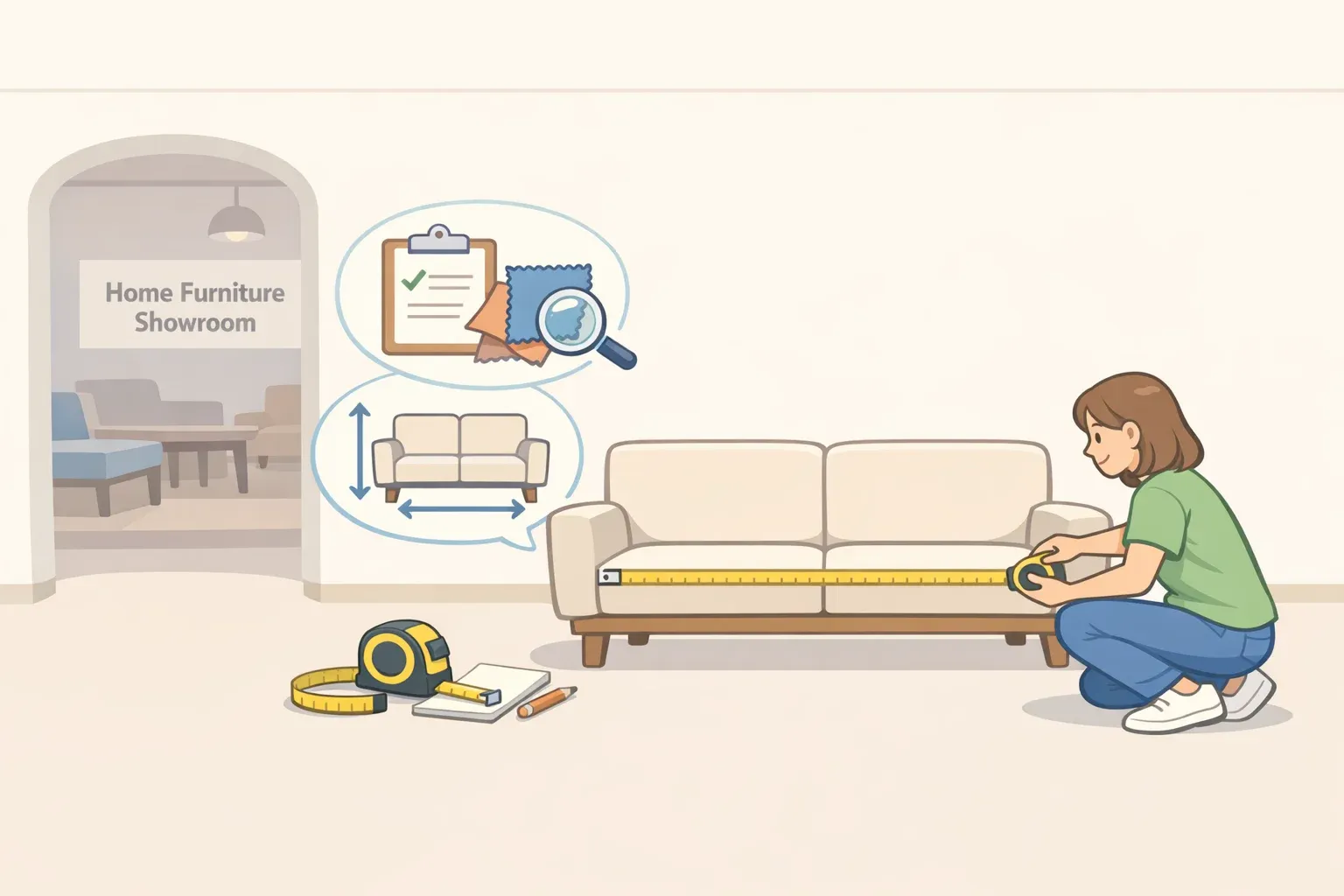
Before you touch a tape measure in your own home, pull these numbers from the product listing:
Assembled width, depth, and height
Diagonal depth, meaning the distance from the front-bottom corner to the back-top corner
For wardrobes and other storage pieces, whether the item disassembles for moving through doorways, since many do
For dining tables with a leaf, the fully extended size, not just the size it ships in
Every mistake below traces back to the same root cause: comparing a room dimension against a product spec you never actually checked.
Measure in this order
Skipping around between the room and the product listing is how shoppers end up remeasuring everything twice. Work through these five checkpoints in sequence:
Pull the product's real dimensions from the listing, including the diagonal depth.
Measure the room's full perimeter and mark fixed features: outlets, vents, radiators, and window sills.
Walk and measure the delivery route from the truck to the room.
Tape out the furniture's footprint plus its required operating space: walkway, chair pull-out, door swing.
Live with the taped footprint for 24 to 48 hours before you order.
Each mistake below maps to one of those five steps.
Mistake 1: How to measure a room for furniture (without just checking the wall)
A complete room measurement covers length, width, ceiling height, doorway locations, outlets, and vents, not just the wall where the piece will sit. Measure every wall at floor level. Older homes frequently aren't square, so trusting one wall's measurement to represent the whole room is how mistakes creep in.
Once you have the room's real shape, compare it against the product's overall width, depth, and height, along with its diagonal depth. For sofas specifically, that diagonal number is what actually determines whether a piece clears a doorway, not the width alone.
Sketch the room to scale on graph paper. A quarter-inch equals one foot is a common scale, and it works fine for this. Draw the furniture's footprint inside that sketch. If the footprint plus clearance space doesn't fit on paper, it won't fit in the room.
Don't trust the room's square footage or a single "fits the wall" measurement. A piece can match the wall length and still be too deep, too tall, or impossible to angle through the door.
Mistake 2: Measuring the room, then ignoring the delivery route
The room and the path to the room are two separate problems. A sofa that fits the living room can still fail at a hallway turn or a stairwell landing.
Route measurements should cover the front-door width and height, staircase width and turning space, hallway pinch points, interior doorways, and elevator dimensions where relevant. Standard interior doors run about 30 inches wide and 6.5 feet tall. With tilting, most sofas up to roughly 8 feet 2 inches long can angle through a standard door, as long as the corridor has enough width to maneuver.
Walk the entire route with a tape measure and write down three numbers as you go: the narrowest width you find, the lowest height, and the location of every turn or landing where the piece has to change direction. Compare those figures against the delivery method the retailer lists for the piece. Some retailers offer white-glove delivery that handles tight spaces; others leave it to you to confirm access before the truck shows up.
The most common furniture layout mistake here is measuring only the width of the tightest doorway. Subtract 3 inches from your narrowest measurement before you commit to a piece; that single habit is credited with preventing roughly 80 percent of delivery-day disasters. A sofa that "just" matches a doorway's width on paper often can't be turned through it in practice.
Mistake 3: Planning for footprint, not for how you'll actually use the room
Getting a piece through the door is only half the job. Once it's inside, the real question is whether it leaves room to live comfortably.
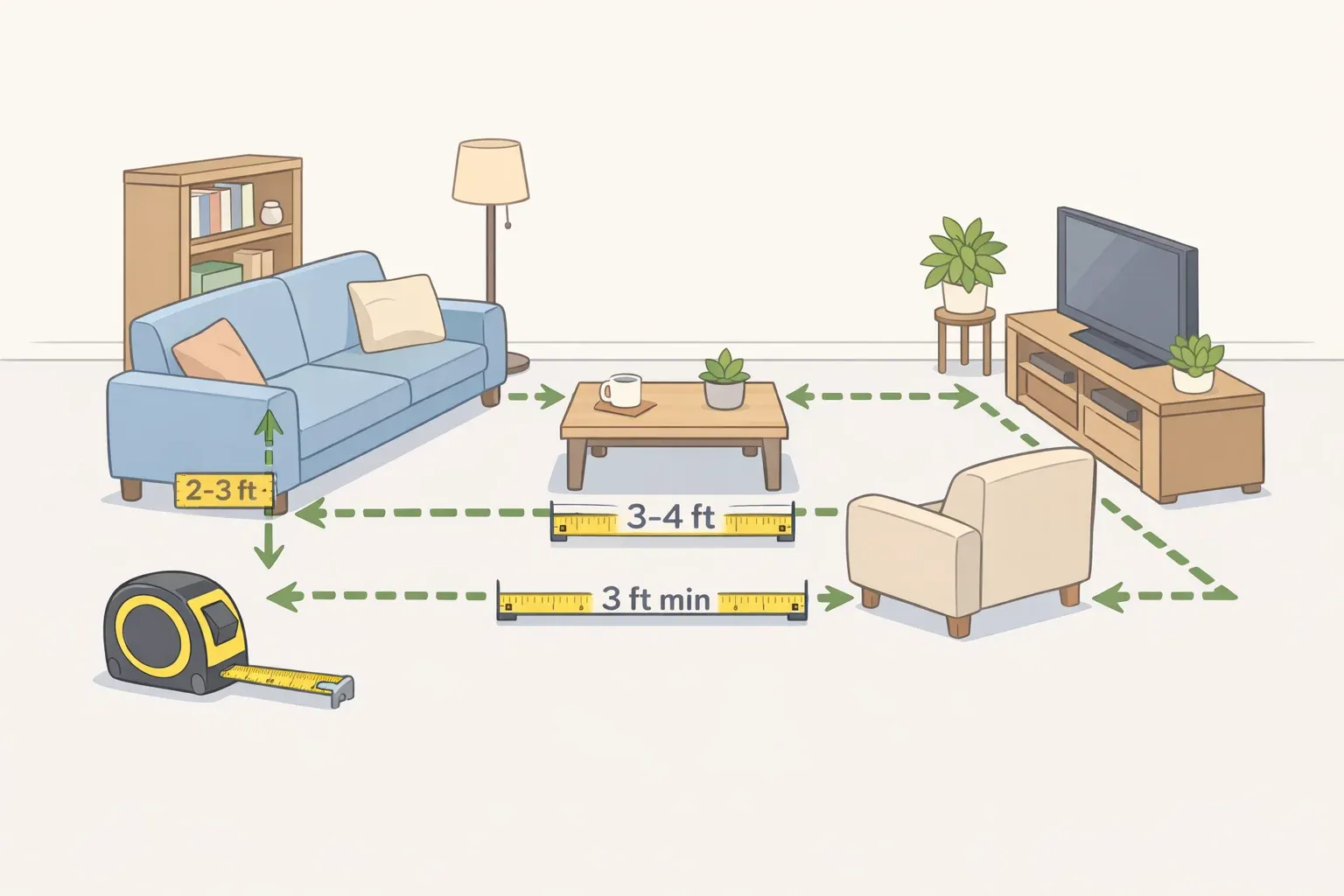
Working clearances to build around:
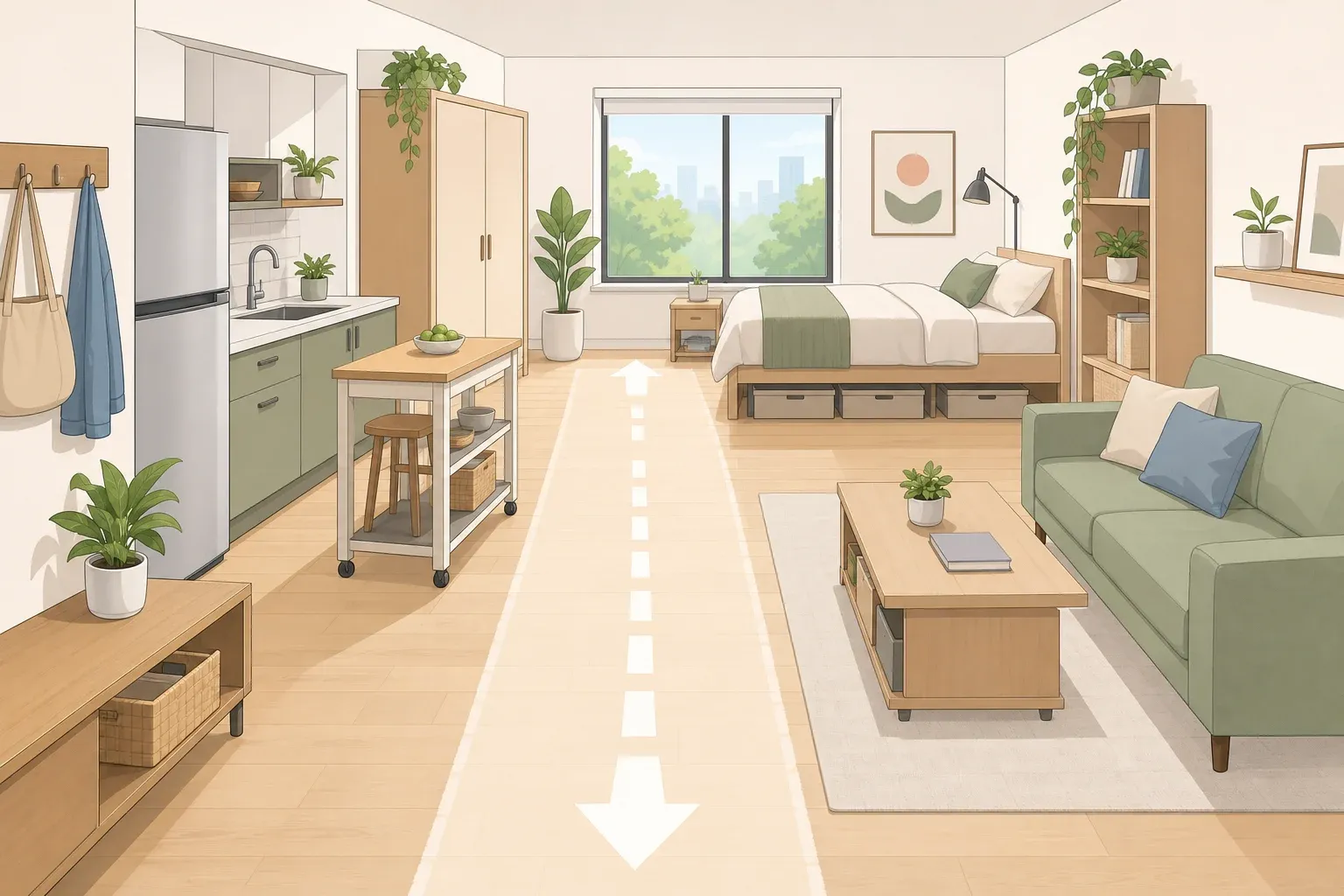
30 to 36 inches for main walkways; below 24 inches starts to feel cramped
14 to 18 inches between a sofa and coffee table
36 to 48 inches from a dining table to the wall so chairs pull out cleanly
Map fixed features before you place anything: outlets, vents, radiators, window sills, and door swings. Skip this step and a piece can end up blocking power access, forcing an extension cord across the room.
Clearance needs also shift by furniture type. A bed needs at least 24 inches of clearance on one side and 18 inches on the other, enough room to walk and make the bed. A wardrobe needs its door-swing space clear, roughly the door's width plus 4 inches. A dining table's clearance should be measured against its fully extended size, not the size it ships in.
Mark the furniture's footprint on the floor with painter's tape and live with it for 24 to 48 hours. Walk the main path, open nearby doors and drawers, and simulate normal daily use before you buy. If the tape test makes you rethink the purchase, that's the test working as intended.
Don't treat any single clearance number as universal, and don't confuse a bare minimum with a comfortable target. One source lists 18 inches as the minimum walkway just past a sofa, while another puts 24 inches as the floor for a secondary traffic path and reserves 30 to 36 inches for a room's main route.
Mistake 4: Confusing "it fits" with "it looks right"
A piece can pass every measurement check and still overwhelm or underwhelm a room. That's a scale problem, and it's a different failure than a measurement error.
Undersized rugs are the classic example. A 5-by-7 rug under a full sectional makes the furniture look like it's floating, while an 8-by-10 rug or larger, with at least the front legs of seating resting on it, grounds the space. Oversized vertical pieces cause the opposite problem: a tall bookcase in a low-ceilinged room crowds the space and shrinks its perceived height.
Judge a piece by how the room will actually use it, not by how well it photographs online. That's one of the more consistent furniture shopping tips from designers, and it holds whether the piece is a modest side table or a big-ticket sectional.
After taping out or placing the piece, stand at the room's main entry point. It should read as proportionate to the ceiling height and floor area, not like it was resized from a showroom photo. Judging scale from a single product photo alone is a common furniture shopping mistake, because even a specific-sounding rule like TV viewing distance is actually a range, not a fixed number. Sources put it at 1.5 to 2.5 times the screen's diagonal, depending on screen size and seating preference.
Mistake 5: Skipping a hands-on inspection when buying secondhand
Bed bugs aren't limited to mattresses and upholstered headboards. They can travel on sofas, chairs, and bedside tables.
Inspect every used piece before you buy it, including non-upholstered furniture, and check small cracks and crevices specifically. Ask the seller what precautions they take against bed bugs before you commit. Secondhand furniture that's free of pests or serious damage is generally safe to buy, though that reassurance doesn't extend to baby furniture like cribs and bassinets.
If your inspection turns up any sign of bed bugs, walk away rather than negotiate a lower price and hope for the best.
If you discover bed bugs after a piece is already in your home, don't assume a can of spray from the hardware store will finish the job on its own. Bed bugs and their eggs need sustained exposure to high heat to die, and the combination that actually works is effective, safe insecticides paired with heat treatment from a professional exterminator equipped to apply high heat to furniture over longer periods.
Where to go from here
The two questions that matter most before ordering are whether a piece can physically get into your home, and whether it leaves enough room to live comfortably once it's there. Clearances like 30 to 36 inches for main walkways, 24 inches beside a bed, and a dining table's fully extended footprint keep a room usable day-to-day, not just accurate on a tape measure.
None of these checks take long, and skipping any one of them is how an otherwise perfect sofa ends up back on a truck. Run through this checklist before you place the order:
The product's assembled dimensions and diagonal match your room sketch.
The delivery route is measured and clear, with margin for maneuvering.
The taped-out footprint has passed a 24- to 48-hour daily-use test.
The piece reads proportionate to the room's ceiling height and floor area.
If secondhand, the piece has passed a hands-on inspection with no signs of pests.
If any one of these fails, treat it as your signal to re-measure, choose a different piece, or, for a used item showing signs of infestation, walk away entirely rather than bring it home and hope for the best.




Comments
Be the first, drop a comment!