



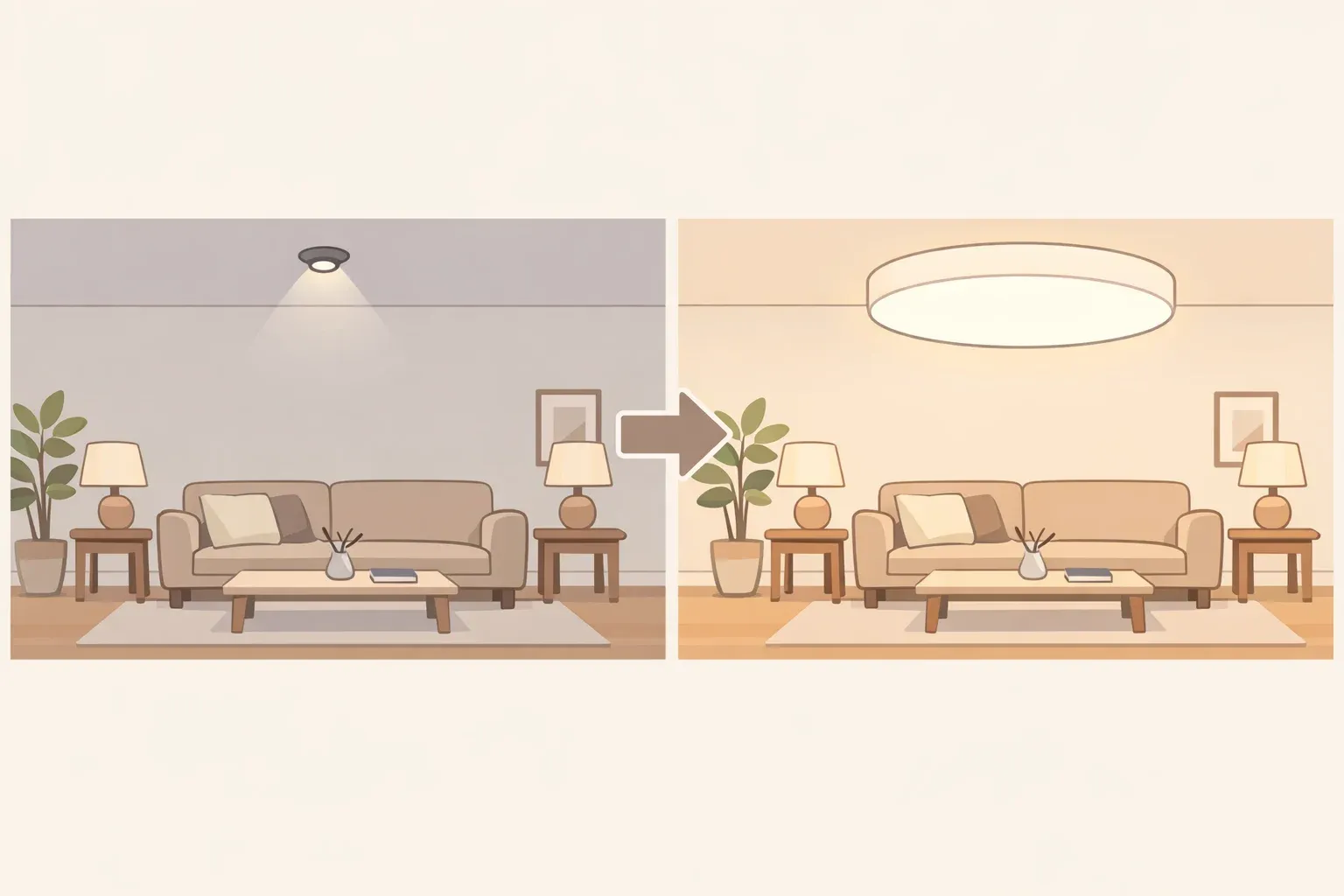
A small light fixture in a large room reads as "apologetic," even when every sofa, rug, and side table in that room was chosen with care, according to Nikki Levy Interiors earlier this year. That mismatch is usually what's behind the nagging sense that a living room looks expensive but doesn't quite feel finished.
Getting quiet luxury living room lighting right isn't about buying pricier lamps; it's about making sure the light in the room has enough visual weight for the space and spreads evenly after dark, instead of one small source straining to cover territory it was never built for.
Buying pieces too small for a room ranks among the most common decorating mistakes homeowners make, according to designers interviewed by House & Garden last year, and that "scale up" logic applies just as much to light fixtures, lamps, and shades as it does to sofas and rugs.
Lighting also happens to be one of the easiest of these scale problems to correct without redoing the whole room. This guide covers why undersized, single-source lighting causes that unfinished feeling, how to run a simple after-dark audit using lamps already on hand, and where the fix stops being a lamp swap and starts requiring an electrician.
The real mistake: living room lighting mistakes to avoid
Relying on one undersized fixture and skipping additional light sources aren't two separate mistakes. They're the same error: lighting that was never measured against the room in the first place.
A cozy living room needs a mix of table and standing lamps, with picture lights and sconces worked in, rather than one ceiling fixture doing all the work, according to designer Banker in an interview with Architectural Digest. The goal is several light sources set at different heights around the room, casting an even, welcoming glow rather than one hot spot and a lot of shadow.
That principle extends to the main fixture itself. Designers generally advise going bigger than expected with pendants and chandeliers rather than defaulting to whatever standard size turns up first in a search, since ceiling height, window size, and wall width are the non-negotiables that should set a fixture's scale.
An undersized or lone fixture creates the same "lost" effect that undersized furniture creates in a tall room: a gap between how the room should feel and how unfinished it actually looks. Closing that gap starts with knowing what to gather before shopping for anything.
Before you start: what you need and where the DIY line is
Most of this fix is beginner-friendly. A few steps cross into household wiring, and that's the part to plan around before spending any money.
The ordinary-reader boundary: swapping bulbs, adding or repositioning freestanding lamps, and using plug-in sconces or picture lights are all safe to do yourself. Anything that involves opening a ceiling box, adding a new switch or dimmer circuit, or hardwiring a fixture in a new location is electrical work that should go to a licensed electrician. Get that assessment before buying a hardwired replacement fixture, not after.
What to gather before starting:
One or two floor lamps
One or two table lamps
Bulbs in a warmth that feels right for the room; if lamps end up with mismatched bulb colors once they're all switched on, standardizing the color temperature across the room will make the layered lighting feel like one intentional scheme instead of a jumble
Optional: plug-in sconces or picture lights, which add to the mix without touching household wiring
Extra cord length or a power strip, so lamps can sit where the room needs them rather than wherever the nearest outlet happens to be, and cords can run along baseboards instead of across walking paths
Room variables to check before buying anything:
High-ceilinged or larger rooms need more visual weight overall, since these spaces tend to swallow small pieces whole.
In a smaller room, one deliberately larger lamp or fixture can trick the eye into reading the space as bigger, according to designer Alidad in comments to House & Garden last year.
Renters, or anyone who can't alter existing fixtures, should treat any hardwired replacement as off the table from the start and plan around plug-in lamps instead.
The after-dark audit: layered lighting for a cozy living room
Run this after the sun is down. Daylight hides exactly the problem being diagnosed.
Step 1: Map the activity zones. Before turning anything on, note what actually happens in each part of the room: a reading chair, a conversation grouping, the spot facing the TV, the paths people walk through. Then turn on only the current main light source and walk through each zone. Note where it goes dark and where the light feels harsh or concentrated in one spot. This step is diagnosis only, not a fix.
Step 2: Move what's already in the room before buying anything. Reposition existing lamps into the zones that went dark in Step 1. For each seat, check three things: is there a light source within reach without getting up, is the bulb shielded from direct eye-level view rather than glaring at anyone nearby, and does the lamp actually serve what happens in that zone, whether that's reading or conversation. If a lamp passes on all three counts in its new spot, leave it there. If a zone still has no usable light after repositioning, that's where a new lamp goes.
Step 3: Vary the heights, not just the count. A tall table lamp or a sculptural floor lamp helps break up the room's "horizon line" and adds visual interest when lamps aren't all sitting at the same height. Success here looks like being able to sit in any chair or sofa cushion and read without leaning toward one lamp.
Step 4: Decide whether the main fixture is undersized. There's no single universal size formula for this, since it depends on the specific ceiling height, wall width, and window scale in the room. But the general rule designers lean on is a useful gut check: if a piece looks slightly too big on paper, it's usually right once installed. If the current fixture looks small even against that generous rule of thumb, it may genuinely be undersized for the room.
Mock up a replacement fixture before you buy
A photo on a retailer's site rarely shows how a fixture will actually read hanging in a specific room. Before ordering anything:
Cut a piece of cardboard to roughly the fixture's stated width and diameter.
With another person, hold or suspend the cardboard at the height and location the fixture would hang.
Walk to the room's main seating spots and look back at it from where people will actually sit, not just from the doorway.
This mock-up only tests visual proportion: whether the fixture will look right against the ceiling and walls. It doesn't confirm whether the existing electrical box can safely support the new fixture's weight or wiring needs. That determination belongs to the fixture's installation instructions and, for anything beyond a simple like-for-like swap, to a licensed electrician.
Step 5: Add one accent source last, only if the room still feels flat. A plug-in picture light or sconce keeps the mix Banker describes without requiring any new wiring. If the idea shifts toward a hardwired sconce, a new switch, or opening a ceiling box, that's a decision for an electrician, not step five of an afternoon project.
Success check: Repeat the after-dark walk-through from Step 1. A room that's working lets anyone sit, read, and hold a conversation in any seat without leaning toward one lamp. The lamps themselves should visually hold their own next to the furniture and architecture, not disappear beside a sofa or console table.
Adjusting for your room: renters, TV nights, reading corners, and high ceilings
The audit above works the same way in every living room, but a few setups change what to prioritize.
Renters: Put the full budget toward floor and table lamps instead of chasing fixture replacements. A larger-than-expected plug-in floor lamp can do the scale-correcting work that a bigger chandelier would in a home someone owns.
Rooms built around a TV: Place lamps beside the seating rather than directly behind the screen, so light supports the room without adding glare to the display itself.
A dedicated reading chair: That seat needs its own lamp positioned close enough to read by, checked in Step 2's within-reach test, rather than relying on whatever ambient light the rest of the room's fixes provide.
High ceilings: These rooms swallow small pieces, so the fix is one larger fixture or lamp, not several modest ones stacked up to compensate. A taller floor lamp or a genuinely bigger main fixture will read better here than three or four small lamps scattered around trying to close the gap.
Troubleshooting and the finish line
Not every lingering issue after the audit means buying more lighting. Work through these before spending anything else:
A dark corner remains: reposition or add a lamp there rather than turning up the brightness on the main fixture.
The main fixture still looks lost against the room: it's likely undersized. Run the cardboard mock-up above before ordering a larger replacement.
Glare feels like the bigger problem than dimness: switch off the overhead source for an evening and rely only on the lamps to see whether that reads calmer in that specific room.
The plan now involves a new switch, a dimmer circuit, or a fixture location without existing wiring: stop and get a licensed electrician's quote before ordering the piece.
Don't overscale everything at once, either. Alidad describes balancing one large element against another rather than making every piece in the room oversized, such as a bookcase that only just fits a room paired with one large mirror on the opposite wall. The same balance applies to lighting: one confidently large fixture plus a few well-placed lamps, not every piece competing for attention.
If lighting is sorted and the room still feels off, look elsewhere before buying more lamps. Seating pushed to the perimeter creates a disconnected, waiting-room feel that no amount of lighting will solve. Treat that as a separate follow-up project; folding it into the same round of changes makes it hard to tell which fix actually solved the problem.
If the room still reads underscaled after all that, rug size and oversized art are two other scale corrections covered in the same design guidance, and neither one involves touching a wire. Anything that does need a new circuit, a new switch, or a change to the ceiling box needs a licensed electrician's quote before it goes on order, not after it's already sitting in a box in the living room.









Comments
Be the first, drop a comment!