



How to Turn a Studio Apartment Into a One-Bedroom: Glass vs. Bookcase Walls
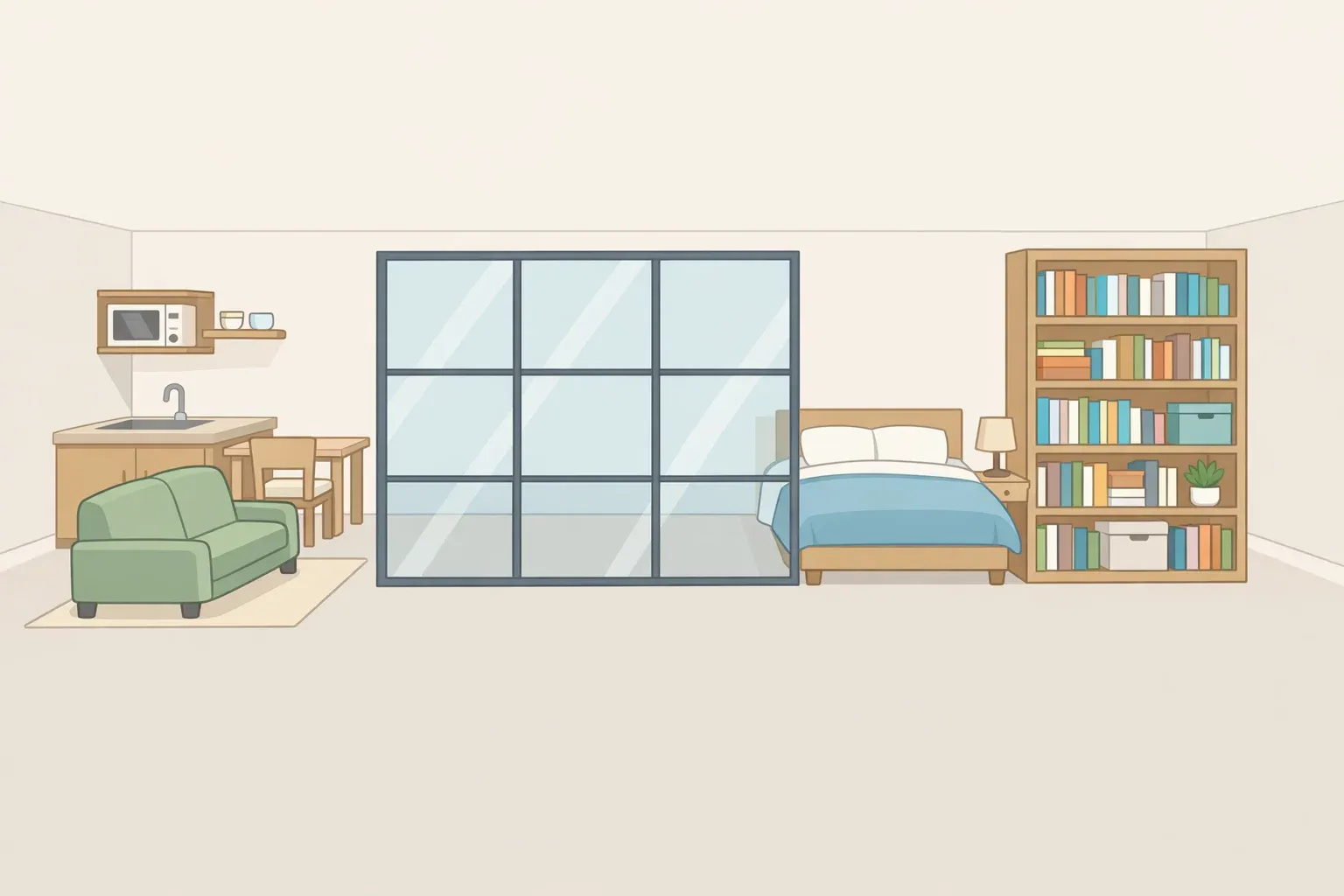
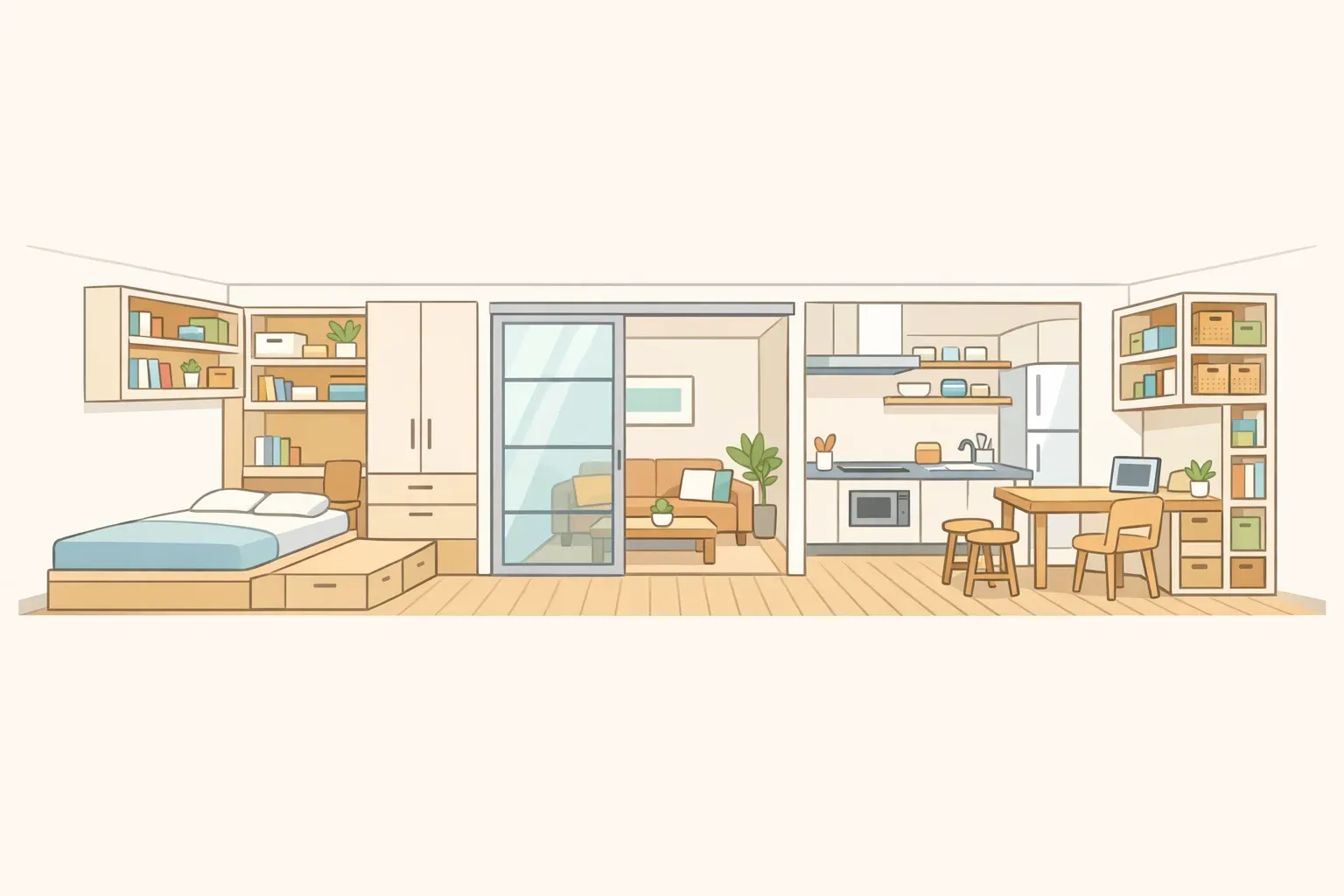
A 270-square-foot studio in Kyiv now has a bedroom. Not a sleeping area cordoned off by a curtain, not a bed wedged into a corner a genuine sleeping zone separated from the living space by a glass partition that preserved the apartment's light while creating a boundary that didn't exist before (Dezeen, July 2024). That project makes the central point as plainly as anything: the difference between a studio and a one-bedroom is often just a well-placed divider.
The right partition creates privacy without surrendering what makes a small space livable. The wrong one trades one problem for another. Studio dwellers are managing a single open room for sleeping, working, eating, and living simultaneously, with no physical signal marking where one activity ends and another begins (Apartment Therapy, December 2025). A divider solves that. The cost range is wide: renter-friendly DIY builds have come in at roughly $200 to $1,100 (Apartment Therapy, July 2024; Apartment Therapy, December 2025), while professional glass-and-metal installations represent a different category of investment entirely, one that implies contractor involvement and permanent installation.
Before you pick a divider: is your layout ready for one?
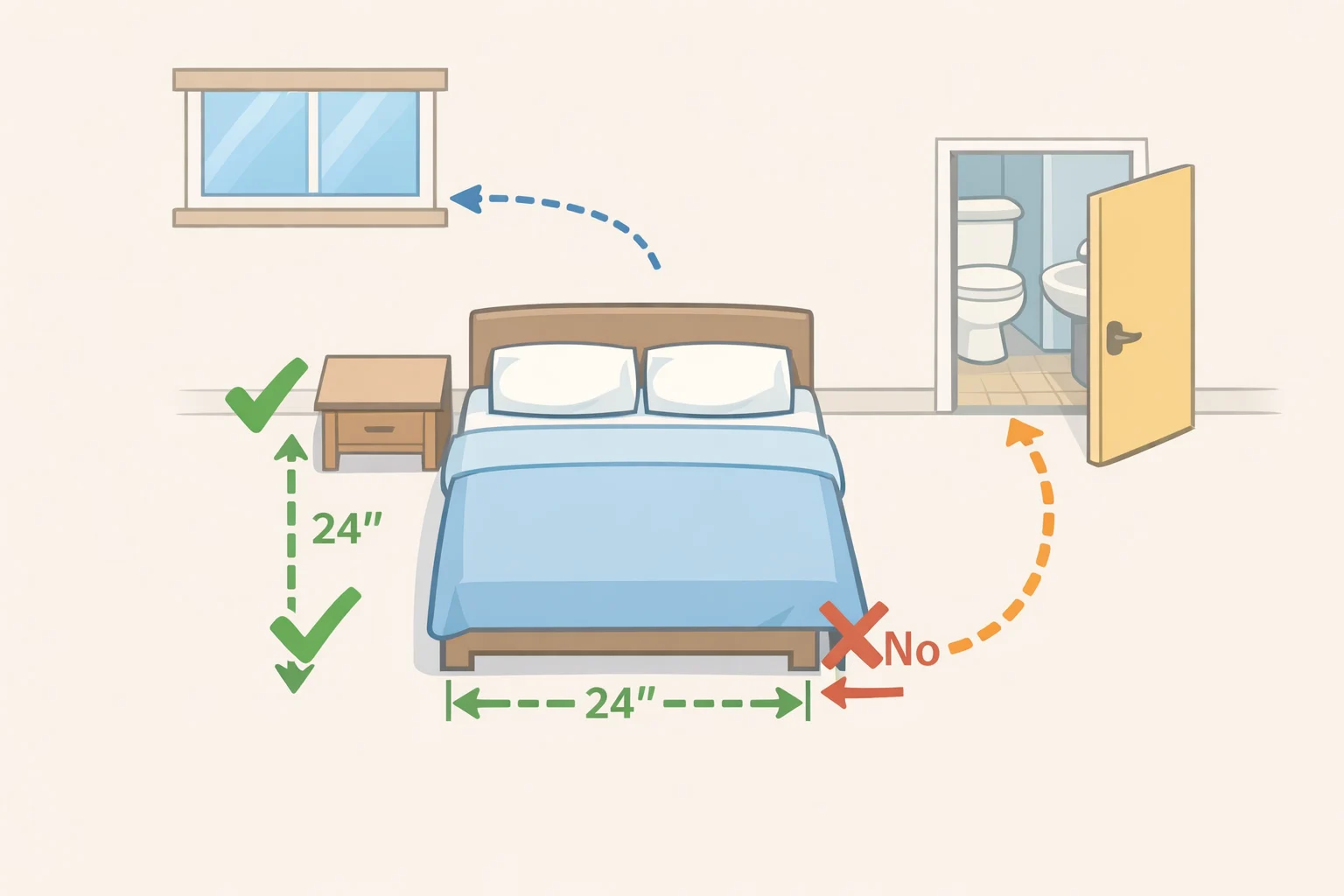
The partition comes second. The sleeping zone has to be physically workable before any divider makes it real.
Start with the bed, not the wall. Identify where the bed goes and whether that position leaves enough clearance to move around it. Then ask whether the zone has access to a window, or whether a divider would wall it off from natural light and air entirely. A sleeping area that blocks the only source of daylight in the apartment creates a new problem while solving the original one. Circulation matters too: can you reach the bathroom, kitchen, and front door without routing through the bedroom? If any of those answers give you pause, the layout needs adjustment before the materials conversation starts.
Open-top dividers, which covers most bookcase walls, let light and air pass over freely. Ceiling-height configurations restrict airflow more significantly, and in a compact footprint, that's a practical issue, not just a comfort preference. Some jurisdictions set minimum ventilation requirements for enclosed sleeping areas. Check local rules and lease terms before building anything enclosed (Apartment Therapy, December 2025). These questions are faster to answer before purchasing than after.
The glass partition: maximum light, honest tradeoffs
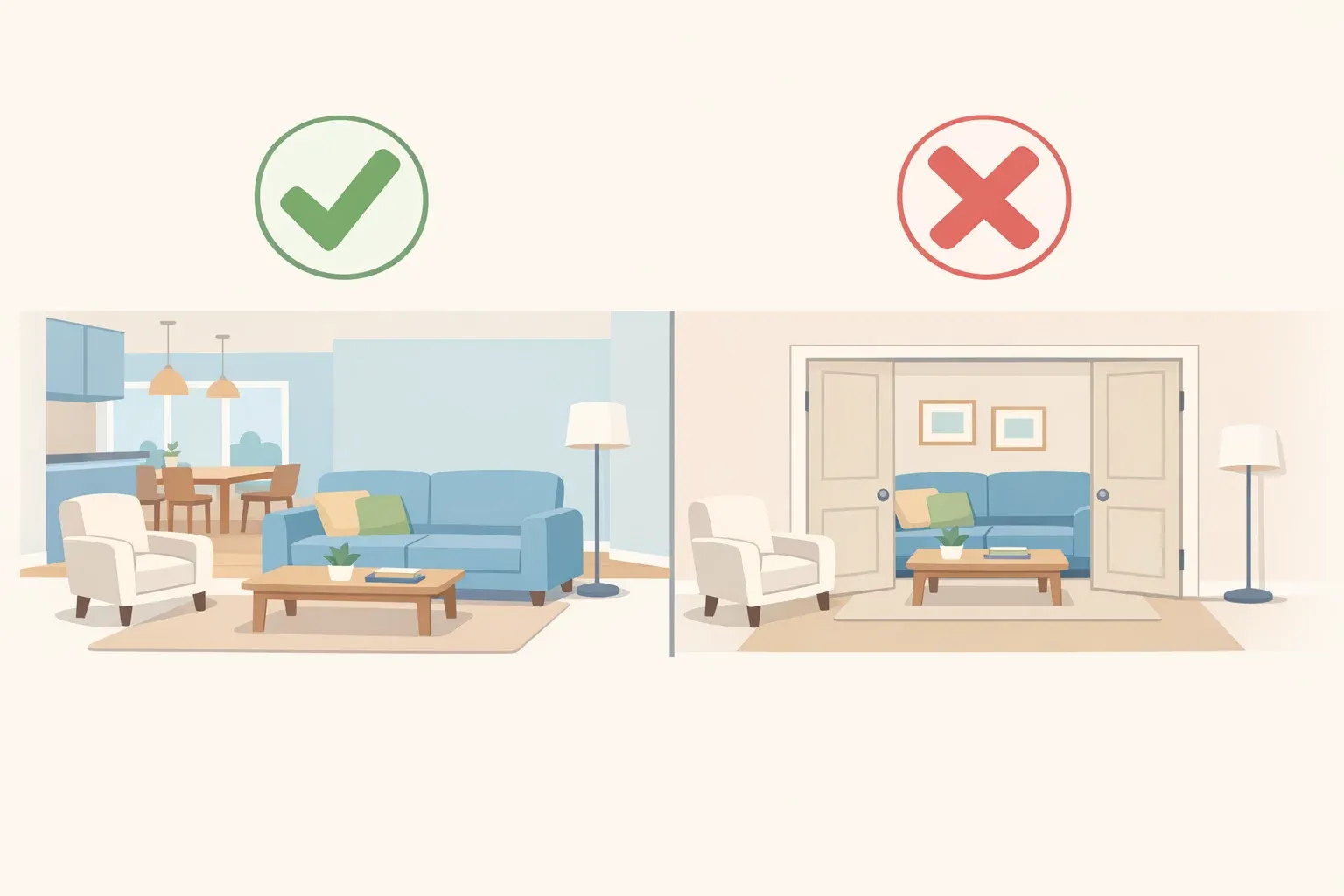
A glass partition defines a boundary without blocking daylight. That's its central advantage in a small apartment where natural light is scarce, and it's what separates it from every other option here. Solid walls solve a privacy problem while creating a light problem; glass sidesteps that exchange.
Architect DIhome demonstrated the concept in its simplest form in the Kyiv studio: distinct living and sleeping zones in 270 square feet, with a sense of openness intact throughout (Dezeen, July 2024). Light passes through. People don't have to.
At the high end, Crystal Sinclair Designs installed floor-to-ceiling glass panels in black metal frames to partition a corner bedroom in a Brooklyn loft. It worked beautifully, but the apartment had 14-foot concrete ceilings and over 1,190 square feet to work with (Dezeen, January 2023). That ceiling height matters structurally a glass partition spanning 14 feet requires anchoring that most standard-height rental apartments can't accommodate the same way. Worth studying as visual reference; less useful as a blueprint for a typical rental.
For renters, journalist Christina Ruffini built a faux version in her Washington, D.C. studio using IKEA picture ledges, a $40 metal desk from Amazon zip-tied as a frame, and leftover padded panels to fill the gaps, coming to roughly $200 total. Her reasoning was direct: "If I owned the place, I would have had a steel and glass one installed, but I don't. So I faked it" (Apartment Therapy, July 2024). The result created visual separation without blocking light, left no permanent marks, and came down without a contractor. When a picture ledge came up short on one side, she filled the gap with painted cardboard. The standard for success in a DIY build isn't a seamless result; it's solving problems as they appear.
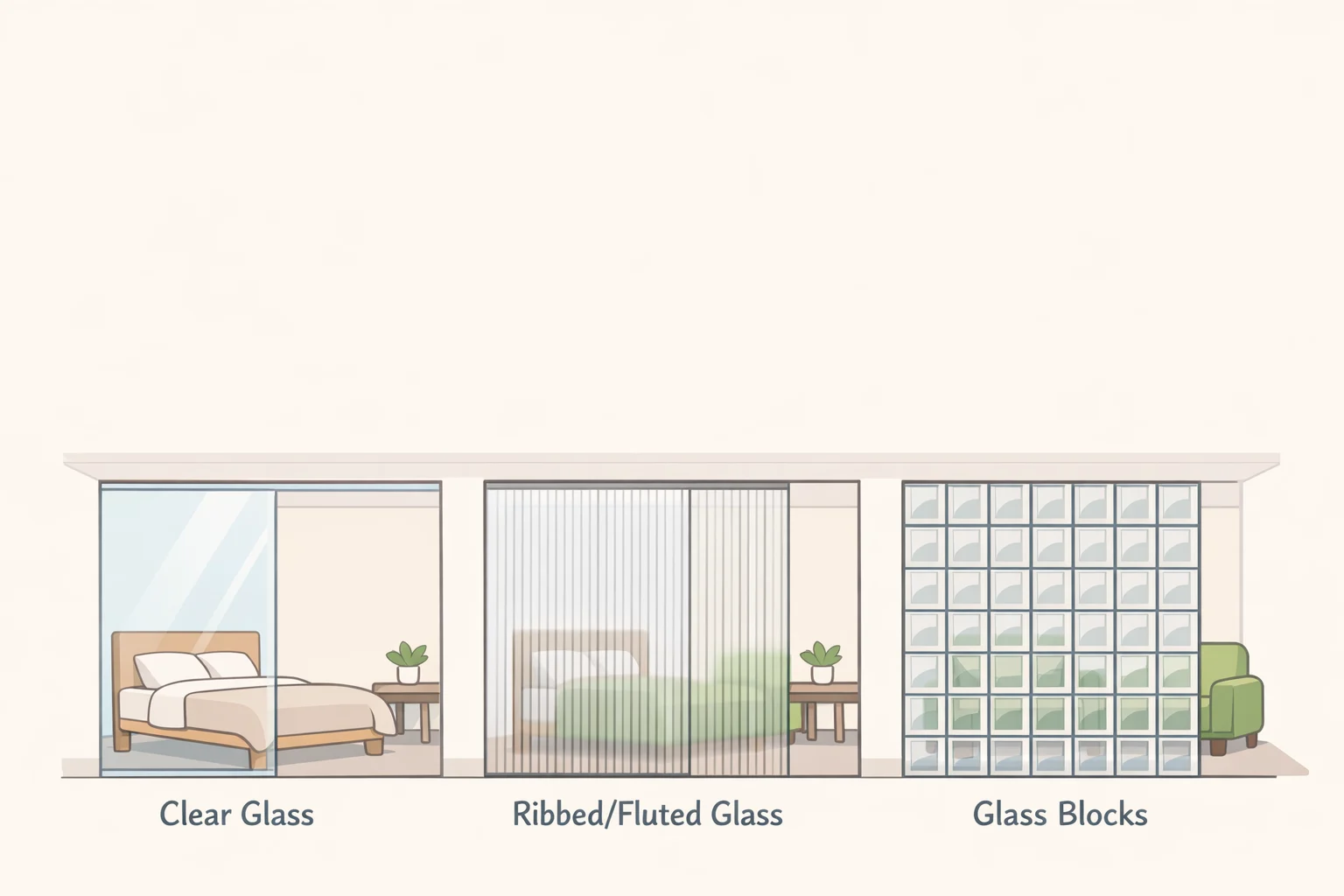
Three glass types, real differences:
- Clear glass maximizes light but offers minimal visual privacy unless frosted, curtained, or treated. Better suited to separating a home office than a sleeping area.
- Ribbed or fluted glass diffuses light while obscuring the view through the panel, the most practical choice for a bedroom partition that needs to feel private without going dark. AIM Studio used full-height ribbed glass doors in a Milan apartment that could open for a unified space or close for a separated bedroom (Dezeen, January 2024).
- Glass block is structural and permanent. Not appropriate for renters and requires professional installation.
One limitation cuts across all three: glass does not meaningfully reduce sound transmission. Conversation, TV audio, kitchen noise a glass wall slows none of it. Pairing the partition with a sliding door, heavy curtains on the bedroom side, or soft furnishings that absorb sound helps at the margins, but the expectation should be accurate going in. A glass partition makes a studio look and feel like a one-bedroom. It does not make it sound like one.
Convert a studio into a one-bedroom: the BILLY bookcase wall
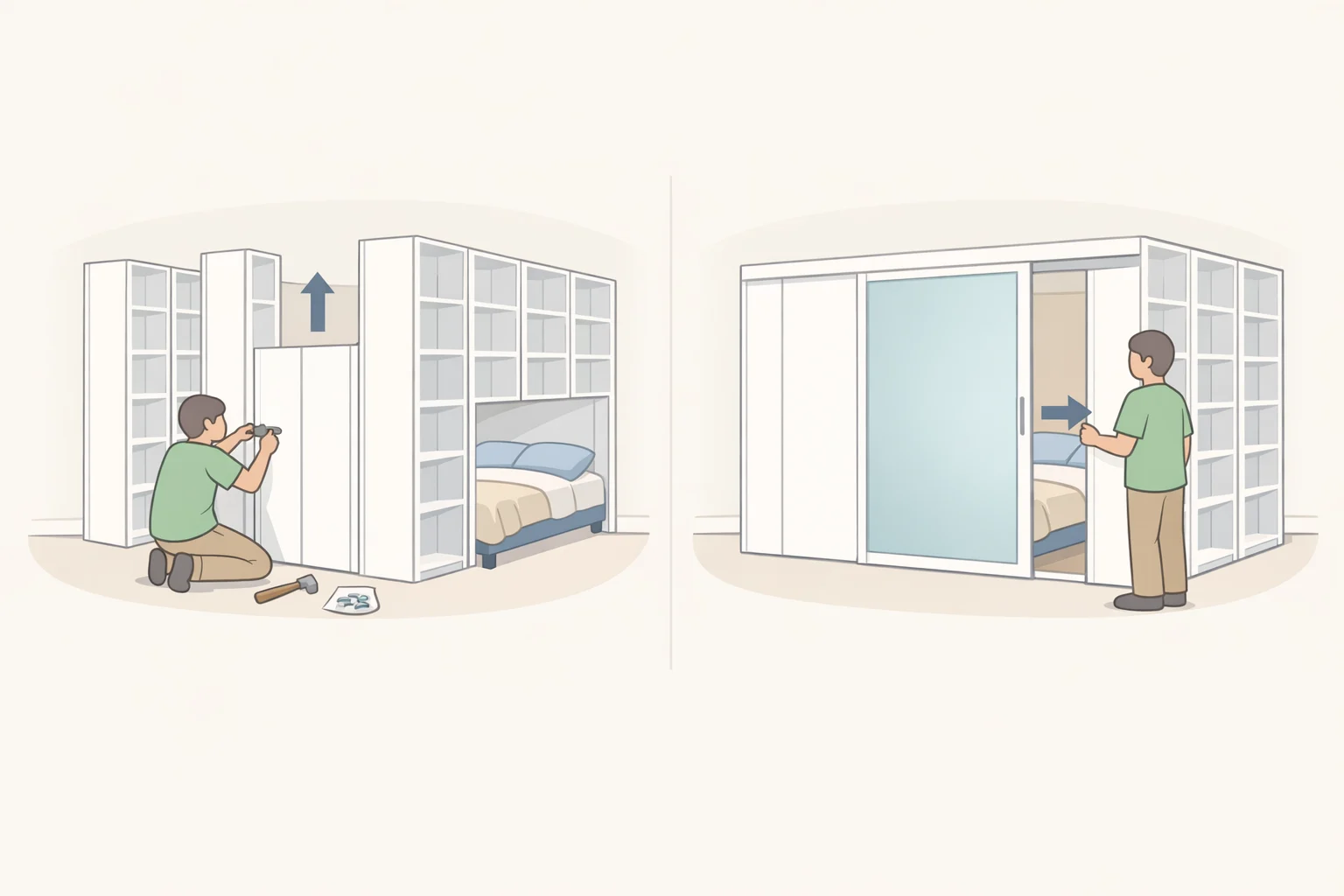
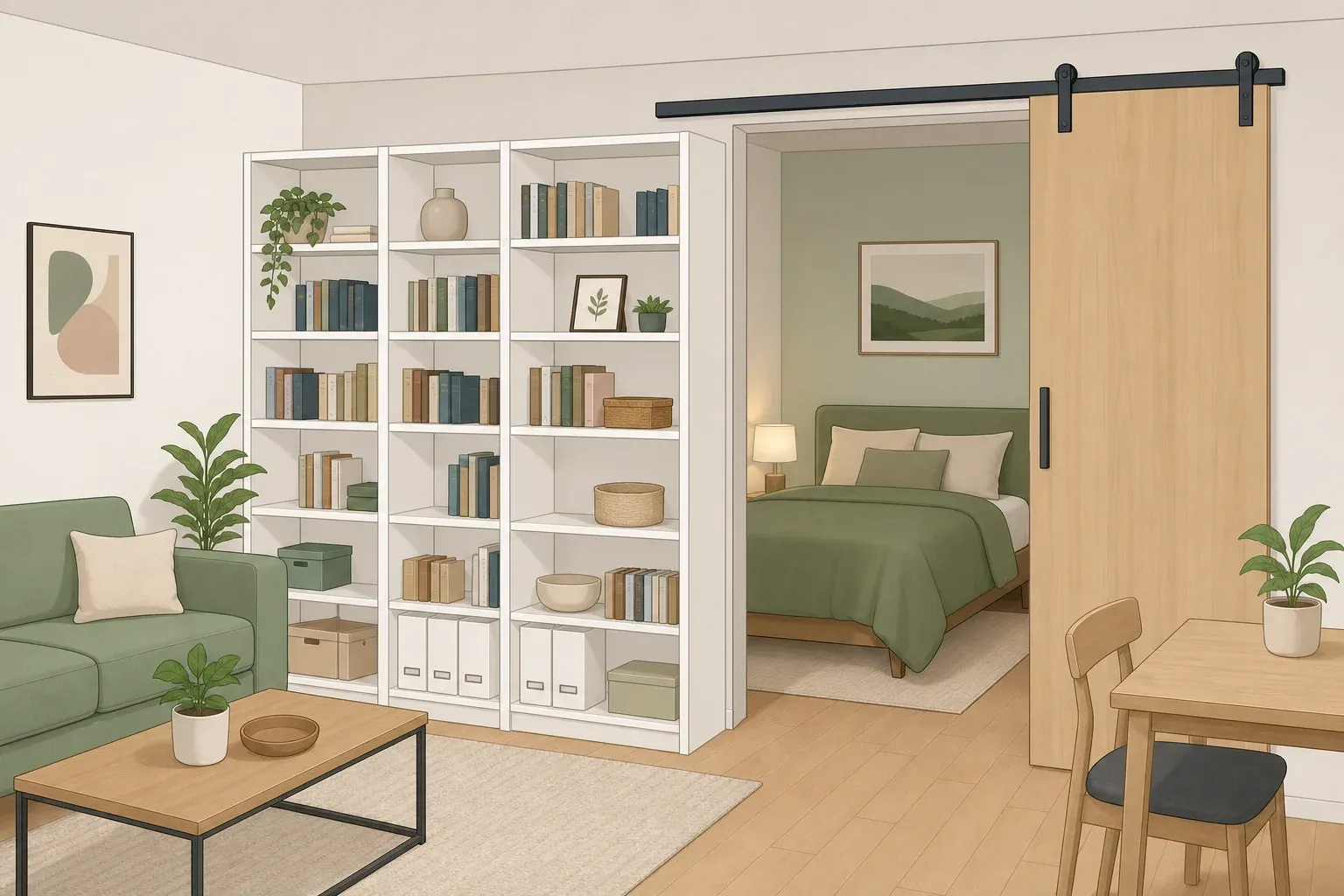
The IKEA BILLY's dimensions and modular height extensions make it well-suited to building a floor-to-near-ceiling divider. Unlike a freestanding room divider screen, it adds substantial storage while splitting the space, and in apartments where closet space is scarce, that double function is often the primary argument for choosing it over glass.
Olamilekan Isaac arranged six brown BILLY bookcases in a box configuration in the back corner of his studio, creating a defined bedroom zone on three sides. He fitted an IKEA SKYTTA sliding door between two units for access, a sliding rather than swinging door because a compact enclosed space can't spare the floor clearance a hinged door requires. Total cost: $1,100. A custom-built equivalent, he noted, could easily triple that figure before labor (Apartment Therapy, December 2025).
His most useful practical note: measure precisely before purchasing anything. Prefabricated units leave no tolerance for rounding errors a gap of a few centimeters throws off an entire wall configuration. He also encountered sloped flooring, common in older buildings, and resolved it by shimming some bookcases with cut plywood pieces (Apartment Therapy, December 2025). Worth anticipating before installation day.
Interior designer Matilde Cascella took a different approach in a 450-square-foot Greenwich Village apartment with only one closet. She used four BILLY bookcases with extenders to build a dividing wall that separated a sleeping area while adding storage the apartment otherwise lacked. At $109 per unit, the build was affordable. To allow for future changes, she nailed particle board to the back panels before applying wallpaper, so the finish can be removed or swapped without touching the shelves themselves (Apartment Therapy, June 2026). Anyone planning to move eventually should note that detail.
What BILLY walls don't do is worth stating plainly. Standard units don't reach a typical ceiling, which limits the sense of full enclosure; extensions add height but usually leave a gap. A curtain hung from the top edge can extend the visual and acoustic boundary without additional construction. And like glass, bookcase walls don't meaningfully block sound. Open-top configurations let it pass over freely, so the acoustic situation is similar either way.
Small apartment bedroom partition: which approach fits your space
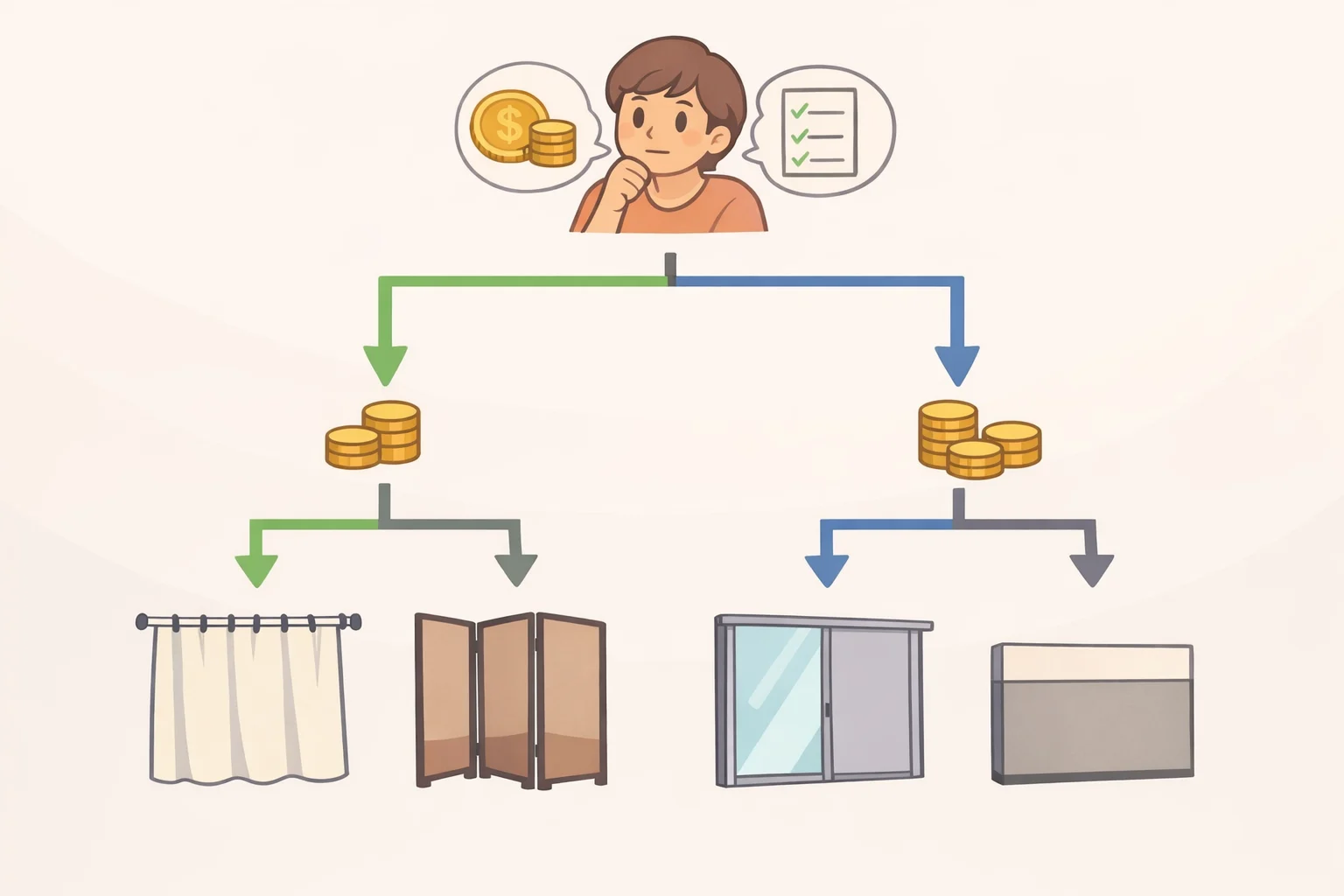
The decision follows from the layout, the lease, and what you're willing to trade. These three scenarios map to the options above.
A renter with a limited budget ($150-$400) who needs zones but not full enclosure is best served by the faux glass-and-metal approach: IKEA picture ledges, a freestanding frame, and zip ties. Ruffini's $200 build is the documented example. It creates visual separation without blocking light, leaves no permanent marks, and comes down when you move. The trade-offs are real: no acoustic privacy, no storage, minimal structural enclosure.
A renter with a moderate budget ($900-$1,500) who needs genuine separation and storage should look at the BILLY bookcase wall with a sliding door. Isaac's $1,100 build is the reference point. It creates an enclosed zone, adds significant storage, and is fully removable. The trade-offs: sound passes over and through, uneven floors may require shimming, and precise measurement before purchasing is non-negotiable.
An owner, or a long-term tenant with landlord approval, who wants light and visual openness is the right candidate for a fixed glass partition in a metal frame. It's the closest thing to the experience of an actual room. Ribbed or fluted glass provides more privacy than clear. The trade-offs: professional installation costs, no storage benefit, and acoustic privacy still depends on whether a door is included.
Real acoustic isolation requires mass thick walls, solid doors, insulation. None of the approaches here cross that threshold. What they deliver is experiential separation: the visual and psychological sense of distinct spaces. For most people sleeping in a studio, that's exactly what they need. For light sleepers or anyone sharing the apartment, it may not be sufficient on its own.
Where to go from here
AIM Studio described their Milan marble partition as "an inhabited wall whose thickness is continuously perforated, crossed and interrupted to host the different functions of living" (Dezeen, January 2024). The BILLY bookcase wall is a budget expression of the same logic: privacy and storage occupying the same footprint. The faux glass partition trades storage for light and reversibility. These aren't competing solutions so much as answers to different questions about what the space needs most.
Cost and reversibility track together. The $200 faux partition and the $1,100 BILLY bedroom both come down without a contractor, adjust when plans change, and don't require landlord sign-off for removal (Apartment Therapy, July 2024; Apartment Therapy, December 2025). That flexibility matters when the apartment, the lease, or the living situation isn't permanent. The fixed glass installation does more for the space visually, but it commits you to the layout.
For the smallest documented footprint in this article, Dezeen's coverage of the DIhome Kyiv apartment is worth studying for how the zones were proportioned in 270 square feet. For renter-friendly builds, Apartment Therapy's documentation of the Isaac and Cascella projects includes detailed photos and material lists that are useful starting points before purchasing anything.


Comments
Be the first, drop a comment!