



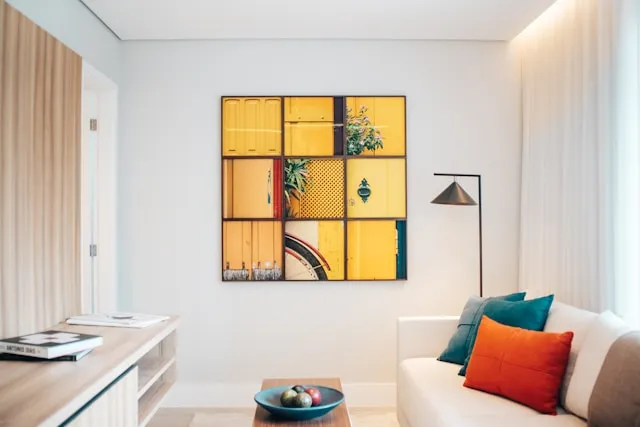
When a piece of artwork looks slightly off on a wall, checking the height is a good place to start, and the right fix depends on what sits underneath it: bare wall, a sofa, a console table, or nothing at all.
On an open wall, the standard is to hang art 60 inches from the floor, measured to the center of the piece, according to Colorado Art Services. That number is built around a comfortable eye-level viewing height, so the piece doesn't read as floating too high on the wall, per the same source. Once furniture sits underneath the art, the target changes: instead of measuring to a fixed height off the floor, the guideline becomes a 6-to-12-inch gap above the furniture, per the same source.
This guide covers how high to hang pictures in both situations: the hook-height math for a single wire-hung frame on a bare wall, a parallel calculation for placing art above furniture, and a short troubleshooting section for when the numbers don't look right once the piece is actually on the wall. A single wire-hung frame on one hook is usually straightforward for most home walls with basic tools. A heavy mirror, a frame that needs two mounting points, or a wall you can't confidently identify calls for more care, covered further down.
Before you start: what you'll need and the measuring point that matters
Every measurement in this guide runs to the center of the frame, not its top edge. Get that reference point wrong, and the rest of the math falls apart, so fix it in mind before the tape measure comes out.
The calculations below locate the mounting point. They don't replace the frame manufacturer's instructions or the hardware's load rating, so check both before drilling anything.
Gather these basics before starting:
Tape measure
Pencil
Level
Stud finder
Hanging hardware sized to the frame's actual weight and matched to the wall material
A stud finder locates likely wood framing behind the wall, but it doesn't tell you the safe capacity of the whole hanging setup. That number comes from the weight rating printed on the hardware or anchor packaging, matched to what the wall is actually made of. Before picking hardware, check:
The frame's actual weight
What the wall is made of: drywall over framing, plaster, masonry, tile, or a surface you can't confidently identify
The weight rating printed on the hardware or anchor packaging
Whether the frame has one hanging point or two; two-point systems change how the load gets distributed and often need their own spacing and mounting instructions
Whether the frame or hanging kit came with its own instructions, which should override general advice like this
If any of those come up uncertain, an unfamiliar wall material, no weight rating on the hardware, or a frame heavier than a standard picture hook is built for, stop. Look up hardware made for that specific situation, or bring in a professional installer.
How to use the 60-inch rule for hanging artwork on a bare wall
This method covers a single wire-hung frame going onto a wall with nothing below it, placing the center of the artwork 60 inches from the floor.
Measure the frame's height and divide by two to find its center point.
Mark 60 inches up from the floor in pencil. This is where the center of the artwork should land.
Pull the hanging wire taut with your fingers, simulating how it will sit once looped over the hook, and measure the distance from that taut point up to the top of the frame.
Apply the formula: hook height = 60 (the target center) plus half the frame height, minus the taut-wire distance from step 3.
Work the example: a 24-inch-tall frame has a center 12 inches from its top edge. If the taut wire sits 3 inches below that top edge, the hook goes at 60 + 12 − 3 = 69 inches from the floor.
Mark the hook location and hang the piece.
Check it with a level to confirm it's hanging straight, not tilted.
Once it's level, step back to a normal spot in the room before deciding whether it needs another hole. The math gets the center to 60 inches; the visual check tells you whether that actually looks right in the space.
Skipping step 3, the taut-wire measurement, and marking the hook straight at 60 inches is an easy way to end up with a frame that hangs lower than planned. The wire always sits below the frame's top edge once it's hanging, so working from the top edge instead of the taut wire pulls the real center down from where it was supposed to land.
Adjusting art height above furniture
Once furniture sits below the artwork, the 60-inch centerline stops being the reference point. A better rule for this situation, is to leave 6 to 12 inches between the top of the furniture and the bottom edge of the frame instead.
Picking the exact number within that range is a visual call more than a fixed formula. Furniture height, the size of the frame, and how the room is used can all push the choice toward one end of the range or the other. The source doesn't tie a specific number to a specific piece of furniture, so treat 6 to 12 inches as the working range and adjust by eye once the piece is actually up.
The rest of the placement follows a calculation built on that 6-to-12-inch guideline, worked out here rather than spelled out directly by the source. Wire offset means the same thing it did for the bare-wall formula: the distance from the taut hanging wire up to the top edge of the frame. The math below assumes the hook's contact point is measured from the floor and that the wire is pulled taut in the same position it will hold once the piece is hanging.
Hook height = furniture height + chosen gap + half the frame height − wire offset
Measure from the floor to the top of the furniture.
Choose a gap within the 6-to-12-inch range and add it to the furniture height. That's the target height for the bottom edge of the frame.
Add half the frame's height to find the target center height for the artwork.
Measure the wire offset and subtract it from the target center to get hook height.
Worked example: a console table stands 30 inches tall. Choosing an 8-inch gap puts the bottom-edge target at 38 inches. A 20-inch-tall frame has a center 10 inches from its top edge, so the target center is 48 inches. If the wire sits 2 inches below the top edge, the hook goes at 48 − 2 = 46 inches from the floor.
In rooms built around a sofa or a bed, where art is viewed mostly from a seated position, the piece may need to hang slightly lower so it's comfortable from that eye line. The source doesn't attach a specific number to that adjustment. In practice it can mean choosing a smaller gap within the 6-to-12-inch range rather than abandoning the range altogether, so there's still separation between the frame and the furniture even if the piece sits a little lower than it would elsewhere.
Frames built with two mounting points need their own hook height on each side, plus a level line connecting the two marks; a single center-point calculation doesn't apply to them. Follow that hardware's own spacing instructions, and run a level across both marks before drilling either hole. The calculations above are built around a single-point, wire-hung frame.
Gallery walls and multi-piece arrangements follow the same balance principle, but spacing between frames, grouping, and sightlines from more than one angle add enough variables that they're better treated as their own project than a direct extension of this single-frame formula.
Troubleshooting common placement problems
Even with the formula worked out correctly, a piece can still look off once it's actually on the wall. A few common outcomes and what to check:
Frame too low or too high: recheck the wire offset and target center measurements before drilling a second hole.
Frame tilted: check whether the hanging wire or mounting points are sitting unevenly, and follow the hardware's own instructions for leveling.
Frame feels too high above furniture: reassess the selected gap from the normal seated position rather than abandoning the 6-to-12-inch guideline entirely.
Frame is unstable, or the hardware doesn't match the wall: stop, and replace or reassess the mounting system before leaving it loaded.
Confirming the placement before you commit
View the finished placement from wherever people actually spend time in that room, whether that's the doorway, the hallway, or the couch across from it. That vantage point says more about whether a piece reads as balanced than another pass with the tape measure, since the goal is visual balance rather than hitting an exact number.
Before calling the piece finished, confirm:
The center height on a bare wall, or the gap above furniture, matches the target worked out earlier
The wire-offset measurement was taken with the wire pulled taut, not estimated from the top edge
The frame hangs level, with the bubble centered
The placement looks balanced from where people normally view it
Any test holes are patched only after the final location is confirmed





Comments
Be the first, drop a comment!